
Disability Insurance in Germany for Expats:
How Berufsunfähigkeitsversicherung Works

Table of Contents
Introduction: disability insurance in Germany for expats
Many expats begin researching disability insurance in Germany when they start building a more stable long-term life in the country.
The topic can affect income protection, financial planning, administrative obligations, and future security.
At the same time, the German system can feel difficult to navigate because insurance, tax, and legal processes often involve unfamiliar terminology and formal structures.
This guide explains occupational disability insurance in Germany from a general educational perspective.
Its purpose is to help readers better understand the broader framework, key considerations, and practical questions that may arise for expats living in Germany.
This article does not provide personal financial, legal, tax, or insurance advice.
It does not recommend any product, provider, contract, broker, pension arrangement, investment structure, or tax strategy.
The goal is to provide a clearer starting point before individual decisions are made.
Readers who want their own facts reviewed can contact The Wealth Lab
Key Terms
- Private disability insurance is separate from statutory reduced earning capacity rules.
- Applications usually involve health questions, occupational information, and underwriting.
- Contract suitability depends on individual circumstances and should not be assumed from a public article.
These points give readers a starting framework.
They do not determine what is suitable for any one person.
Individual facts can change the result.
How occupational disability insurance Works in Germany
Occupational disability insurance in Germany should always be understood within the broader German legal, administrative, and financial system.
For expats, the topic can become more complex because different rules may apply depending on employment status, tax residency, long-term residence plans, and existing financial arrangements.
Some aspects of occupational disability insurance in Germany are shaped by statutory regulations, while others may depend on private contract terms, underwriting conditions, employer structures, banking procedures, or tax treatment.
This distinction matters because a general public article can explain how disability insurance in Germany for expats works in principle, but it cannot determine whether a specific structure is suitable for an individual situation.
For example, rules that apply to salaried employees may not apply in the same way to freelancers or self-employed individuals.
Similarly, a structure that works for a German tax resident today may require a different review if the person later relocates outside Germany.
Even contracts that initially appear straightforward can create long-term implications related to cost, taxation, flexibility, portability, or administrative obligations over time.
What Expats Often Need to Clarify
Expats often compare German systems with the rules of their home country.
That comparison can be helpful, but it can also create wrong assumptions.
A familiar word may not have the same legal or tax meaning in Germany.
A product available in another country may be treated differently under German rules.
A document that seems optional may become relevant for tax, banking, pension, insurance, or immigration questions.
- Current tax residency
- Employment type
- Residence status
- Family situation
- Existing contracts
- Expected length of stay in Germany
- Future relocation plans
- Available documentation
Factors That Can Affect the Outcome
There is rarely one public answer that applies to every expat.
The same topic can lead to different considerations depending on the reader’s facts.
For this reason, the article should be read as an educational overview.
It can help readers prepare better questions before they speak with a qualified professional.
- Legal status or tax residency
- Employee, freelancer, founder, student, or retiree status
- Single household, married couple, children, or dependents
- Income level and income stability
- Need for liquidity
- Existing insurance, pension, investment, or loan contracts
- Administrative capacity and language barriers
- Plans to stay in Germany or leave later
Example Situations
The following examples are simplified.
They are only used to explain how facts can matter.
They are not recommendations.
Example 1: New employee in Germany
A new employee may first need to understand whether disability insurance in Germany for expats is connected to payroll, tax residency, insurance status, or private contract terms.
The first step is usually to identify which rules apply before comparing options.
Example 2: Freelancer or self-employed person
A freelancer may need to think about income volatility, documentation, tax reporting, and social insurance status.
The same topic may have different implications than it would for a salaried employee.
Example 3: Person planning to leave Germany
A person who may leave Germany later may need to clarify portability, tax reporting, cancellation rules, and administrative steps.
This is especially relevant for long-term contracts or cross-border financial arrangements.
Overview Table
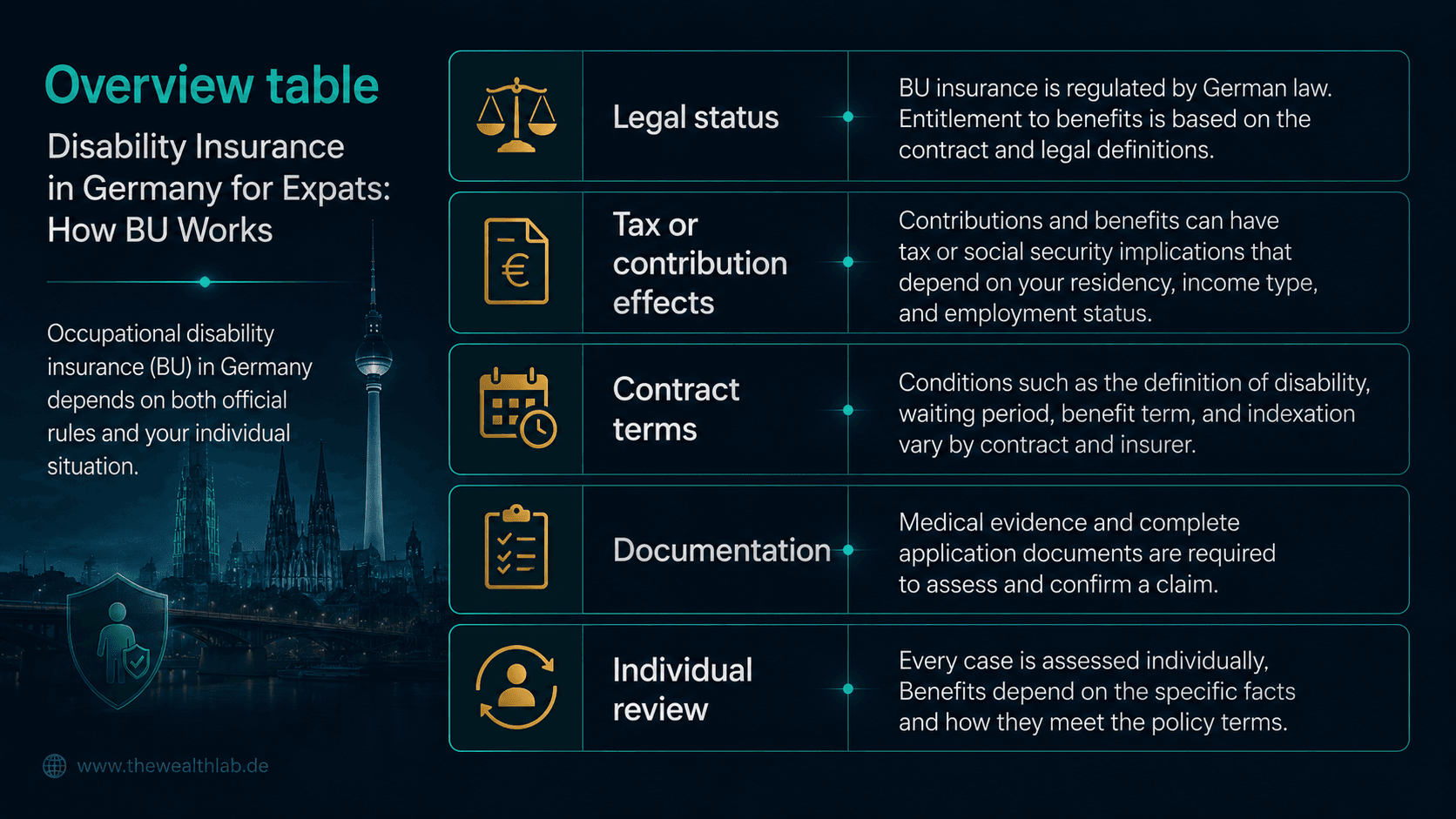
This table can be redesigned as a branded graphic for the website.
The graphic should keep the wording short and informational.
Common misunderstandings
A common misunderstanding is assuming that the cheapest or fastest option is automatically the most appropriate.
Cost is only one factor.
Other factors can include legal status, tax treatment, contract duration, exclusions, documentation, portability, and future plans.
Another misunderstanding is copying another expat’s decision.
Two people can live in the same city and still have different outcomes because their income, family, tax residency, health history, employment type, or future plans differ.
A third misunderstanding is assuming that online information is enough for every situation.
Online information can explain general mechanics, but it cannot verify personal suitability.
Why timing can matter
Timing can be important in Germany because many financial and administrative topics are document-driven.
A tax year can close.
A contract can become binding.
A waiting period can apply.
A residence status can change.
A bank, insurer, pension office, employer, or public authority may ask for documents later.
For disability insurance in Germany for expats, this means readers should avoid leaving clarification until the last moment.
Early clarification does not mean taking immediate action.
It means understanding which facts need to be checked before a deadline appears.
How this connects to broader financial planning
disability insurance in Germany for expats rarely exists in isolation.
A decision in one area can influence another area.
Insurance can affect household risk.
Investments can affect tax reporting.
Pension questions can affect long-term cash flow.
Property decisions can affect liquidity and debt planning.
Immigration status can affect income, employment, and documentation.
This is why expats often benefit from looking at the full picture rather than treating every topic as a separate task.
The broader planning question is not whether one option sounds attractive in general.
The broader question is how the topic fits the reader’s legal status, tax situation, family situation, cash flow, and time horizon.
Final practical reading notes
Readers can use this article as a neutral preparation tool before making personal decisions about occupational disability insurance.
The most useful next step is often not to choose immediately, but to identify missing information.
Missing information can include documents, dates, thresholds, contract terms, tax status, residence status, or family details.
Once those facts are clear, a professional conversation can be more focused and less confusing.
This approach also helps avoid turning general online information into a personal decision too quickly. For sensitive topics in Germany, that extra layer of caution is part of responsible financial planning.
Key Takeaways
- Disability insurance in Germany for expats is a general topic that may affect expats differently depending on individual facts.
- Official sources should be used for legal, tax, insurance, pension, mortgage, or immigration statements.
- A public article can explain mechanisms and questions, but it should not provide personal advice.
- Readers should verify current rules before making decisions.
- A personal consultation can help review the reader’s own documents, status, and objectives.
Frequently Asked Questions About disability insurance in Germany for expats
Is this article personal financial advice?
No. It is general educational information only. It does not assess personal suitability or recommend any product, provider, investment, insurance contract, pension contract, mortgage structure, or tax strategy.
Where should readers verify the rules?
Readers should verify rules through official German sources, public agencies, legal texts, regulated consumer-protection bodies such as the German Consumer Advice Center (Verbraucherzentrale), or qualified professionals.
Can one answer apply to all expats?
No. Outcomes can depend on tax residency, employment type, income, family situation, residence status, existing contracts, and future relocation plans.
Why does the article avoid saying one option is better?
Because suitability depends on individual facts. A public article can explain factors and mechanisms, but it should not make personal recommendations.
When can a reader seek individual help?
A reader can seek individual help when the topic affects taxes, insurance, pension rights, investments, property financing, relocation, family protection, or long-term contracts.
Disclaimer
This article is for general educational information only.
It does not constitute tax advice, legal advice, insurance advice, investment advice, pension advice, mortgage advice, or a personal financial recommendation.
No product, provider, fund, ETF, broker, insurance contract, pension contract, mortgage structure, or tax strategy is recommended.
German laws, thresholds, administrative practice, tax treatment, and product terms can change.
Readers should verify current rules with official sources and consult qualified professionals before making decisions.
For an individual discussion, readers can contact The Wealth Lab
Leave a Comment
Have a question or experience to share? Drop a comment below.
Leave a Comment