
Pension Planning in Germany for Expats —
Avoid a €500,000 Retirement Gap in 5 Steps
Most expats in Germany rely on the public pension system without realizing it won’t be enough.
We help you build a tax-efficient, long-term pension strategy in Germany — based on your income, career path, and future plans.
The German pension system explained — and why it’s not enough on its own
The German pension system (gesetzliche Rentenversicherung – GRV) is based on a pay-as-you-go model, meaning today’s workers finance current retirees.
For expats, this creates a critical challenge:
Even after 30–40 years of contributions, the average pension often replaces only 40–50% of your previous income.
At the same time, inflation, taxes, and rising living costs reduce your real retirement income even further.
What expats in Germany actually search before planning their pension?
- How much pension will I get in Germany after 10, 20, or 30 years?
- Is the German public pension enough for retirement?
- What happens to my pension if I leave Germany?
- How can expats build a private pension in Germany?
- What is the best pension plan in Germany for high earners?
- How do I reduce taxes while saving for retirement in Germany?
- Should I invest in ETFs instead of pension insurance?
- How do I avoid a pension gap (Rentenlücke)?
These questions decide your financial future — not just your retirement
If you don’t actively structure your pension, you are automatically accepting:
- lower retirement income
- limited flexibility later in life
- higher dependency on the system
Most people don’t make a decision — they just drift into one.
Before choosing any pension product, you need clarity
- how big your pension gap will be
- which strategies actually work in Germany
- and how to build a system that grows over time
Your pension options in Germany — explained clearly
There is no single “best pension plan” in Germany.
The right strategy depends on your income level, tax situation, mobility, and long-term goals.
Statutory Pension Insurance
The statutory pension is the foundation of the German retirement system.
For employees, contributions are linked to gross salary and shared between employer and employee. The rate is about 18.6%, making it income-dependent.
Key Characteristics
- Contributions increase with income
- Pension benefits depend on contribution history
- Provides a basic foundation, not full income replacement
- Limited flexibility for personalized wealth planning
Private Pension & Investment Strategy
Private retirement planning gives you more control over how your future capital is built.
This can include private pension contracts, investment portfolios, ETF-based strategies, or occupational pension solutions, depending on your situation.
Key Characteristics:
- Fully customizable based on your goals
- Potential for higher long-term returns
- Tax advantages depending on structure
- Essential for closing the pension gap
Most people ask:
“Which pension plan is best?”
Which structure gives you the best future income — based on your career, taxes, flexibility, and life plans?
What this actually means for you
Here’s how this plays out in real life:
- A high-income employee may need a private structure to maintain lifestyle after retirement.
- A freelancer may have to build most of their retirement strategy independently.
- An expat planning to leave Germany later needs to understand portability, tax impact, and long-term access.
This is where structured pension planning makes the difference.
Because the same income today can lead to completely different retirement outcomes — depending on how it is structured.
Why pension planning in germany matters more than most people think
Your pension decision is not only about old age.
It affects how much freedom you will have later, how dependent you become on the system, and how much private wealth you need to build during your working years.
◆ What this decision affects?
- Your future monthly retirement income
- Your tax efficiency during the saving phase
- Your flexibility if you leave Germany later
- Your ability to close a pension gap early enough
- Your long-term financial independence
What seems like a distant decision today
can become one of the biggest financial gaps of your life.
Many expats underestimate the importance of pension planning in Germany until it’s too late.
This is exactly why making a structured pension decision from the beginning is critical.
How we work with you
We don’t offer one-size-fits-all pension advice. Every recommendation is built around your income, career path, tax position, and long-term financial goals.
1. Pension Status Review
We review your current pension situation, employment status, existing contracts, and contribution history.
2. Pension Gap Analysis
We estimate how much retirement income you may need and identify the potential gap between expected pension income and your target lifestyle.
3. Strategy Design
We compare suitable options such as statutory pension, company pension, private pension, and investment-based strategies.
4. Implementation Support
We help you set up the selected structure and make sure the strategy fits your actual financial situation.
5. Ongoing Optimization
As your income, family situation, tax position, or country plans change, we adjust your pension strategy accordingly.
Structured retirement planning. Better decisions. More financial independence.
Pension planning in Germany — your most important questions, answered clearly
How much pension will I get in Germany?
Your future pension depends on your income, contribution years, pension points, and the rules of the statutory pension system.
For many expats, the public pension alone may not be enough to maintain their desired lifestyle.
Is the German public pension enough for retirement?
Official data from the German government shows that public pensions alone often do not fully cover retirement needs.
Usually, it should be seen as a foundation, not a complete retirement plan.
A strong pension strategy often combines public pension, occupational pension, and private wealth building.
What happens to my pension if I leave Germany?
It depends on your nationality, where you move, how long you contributed, and whether social security agreements apply.
This is especially important for expats who may not stay in Germany forever.
Should I invest in ETFs or private pension insurance?
It depends on your goals.
ETFs may offer flexibility and growth potential, while pension insurance structures may offer tax or payout advantages depending on the setup.
The right answer depends on your income, tax situation, investment horizon, and need for flexibility.
What is a pension gap?
A pension gap is the difference between the income you want in retirement and the income you are likely to receive from existing pension sources.
The earlier you calculate it, the easier it is to close.
Is company pension worth it in Germany?
It can be useful, especially when employer contributions or tax advantages are involved.
But it should be checked carefully, because costs, flexibility, and future taxation matter.
BMAS describes occupational pension schemes as part of Germany’s old-age security system, alongside statutory and individual pensions.
When should I start pension planning in Germany?
As early as possible.
The longer your money has time to grow, the less pressure you have later.
Waiting often means you need to save more aggressively to reach the same goal.
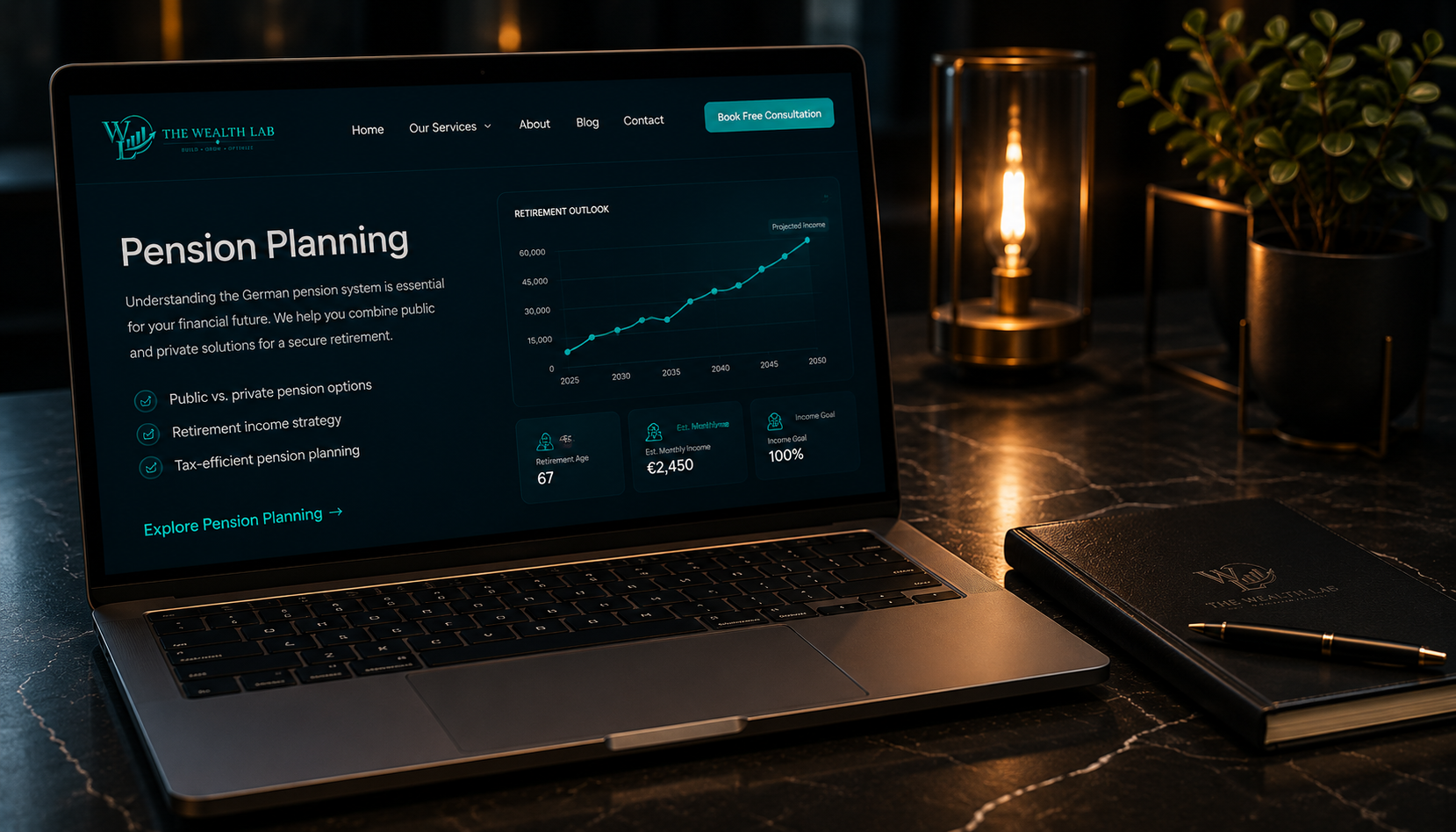
Know your numbers before it’s too late
Your retirement income depends on the structure you build today.
A structured approach to pension planning in Germany helps you avoid costly long-term mistakes.
We help you understand your numbers, identify your pension gap,
and create a strategy that fits your life in Germany.