
Ruerup Pension for Expats in Germany:
Tax Benefit or Long-Term Lock-In?

Table of Contents
Introduction: Ruerup Pension Germany for Expats Explained
The Ruerup pension Germany residents consider is one of the most tax-efficient retirement savings vehicles available — in the right circumstances. Also called the Basisrente, it allows self-employed workers, high-income earners, and those without access to a company pension to deduct pension contributions directly from their taxable income, reducing their annual income tax bill by potentially thousands of euros. But the Ruerup pension comes with a fundamental trade-off: once money goes in, it is locked away until retirement and must be paid out as a lifelong annuity. For expats who may relocate before retirement, or for those who value flexibility, this trade-off requires careful evaluation.
For many high-income expats and self-employed professionals in Germany, reducing annual taxes becomes just as important as building long-term retirement wealth.
This is where the Ruerup pension (Basisrente) enters the conversation.
In the right situation, it can create significant tax savings while helping build a protected retirement structure. But for many expats, the biggest question is not the tax deduction itself — it is whether the long-term lock-in is actually worth the trade-off.
What Is the Ruerup Pension Germany? The Basisrente Explained
The Ruerup pension — formally the Basisrente — is a state-certified private pension contract in Germany, named after economist Bert Ruerup who designed the scheme. It is not a specific product but a category of pension contract that meets the certification criteria defined by §1 Altersvorsorgevertraege-Zertifizierungsgesetz (AltZertG). Any insurance company or bank may offer a Ruerup-certified contract.
Unlike the Riester pension (which primarily benefits employed workers receiving state subsidies), the Ruerup pension was designed for self-employed individuals, freelancers, and high-income employees who are not eligible for Riester or who earn enough that a direct tax deduction is more valuable than the Riester Zulage.
The Ruerup pension is governed primarily by §10 Abs. 1 Nr. 2 lit. b EStG and §10 Abs. 3 EStG, which define the contribution deductibility. Source: gesetze-im-internet.de/estg/__10.html.
Ruerup Pension Germany: The Tax Deduction That Makes It Attractive
The core appeal of the Ruerup pension is simple: contributions are deductible as Sonderausgaben (special expenses) in your German tax return, reducing your taxable income by exactly the amount you contribute — up to the annual ceiling.
Since 1 January 2023, 100% of Ruerup contributions are deductible. Previously, deductibility was phased in at 2% per year from 60% in 2005 — that phase-in is now complete. Source: §10 Abs. 3 Satz 1 EStG, as amended.
The annual deductibility ceiling for 2024 was EUR 27,566 for single filers and EUR 55,132 for married couples filing jointly. This ceiling is updated each year based on the hypothetical maximum contribution to the Knappschaftliche Rentenversicherung. Source: §10 Abs. 3 EStG, with the current year’s limit published by the Bundesministerium der Finanzen. Check bundesfinanzministerium.de for the most recent figure.
This ceiling is shared between Ruerup contributions and any mandatory contributions to the gesetzliche Rentenversicherung. For self-employed individuals who do not contribute to the gesetzliche Rentenversicherung, the full ceiling is available for Ruerup.
Image Prompt: Dark navy desk with open German Basisrente/Ruerup-Rente pension policy document. Printed income tax calculation showing large Sonderausgaben deduction highlighted in teal. Calculator and gold pen in frame. thewealthlab.de watermark bottom-right at 50% opacity. TWL logo top-left.
How Much Can You Save in Tax? Examples by Income Level
The table below shows the approximate income tax saving from Ruerup contributions at different income levels. The actual saving depends on your personal marginal tax rate, which is calculated on your total taxable income under the §32a EStG income tax schedule (gesetze-im-internet.de/estg/__32a.html).
| Annual Gross Income | Approx. Marginal Tax Rate | Ruerup Contribution | Estimated Income Tax Saving | Effective Net Cost of Contribution |
| EUR 40,000 | ~30% | EUR 5,000 | ~EUR 1,500 | ~EUR 3,500 |
| EUR 70,000 | 42% | EUR 10,000 | ~EUR 4,200 | ~EUR 5,800 |
| EUR 100,000 | 42% | EUR 15,000 | ~EUR 6,300 | ~EUR 8,700 |
| EUR 150,000 | 42-45% | EUR 20,000 | ~EUR 8,400-9,000 | ~EUR 11,000-11,600 |
Marginal tax rates are approximate and based on §32a EStG income tax schedule (gesetze-im-internet.de/estg/__32a.html). Solidarity surcharge (Solidaritaetszuschlag) applies for higher incomes. Kirchensteuer not included. Ruerup deductibility: §10 Abs. 1 Nr. 2 lit. b and §10 Abs. 3 EStG. All figures illustrative — consult a tax adviser for your personal tax rate.
For a self-employed consultant earning EUR 100,000 per year, contributing EUR 15,000 to a Ruerup pension Germany contract can reduce their income tax bill by approximately EUR 6,300 — meaning the effective cost of the EUR 15,000 contribution is only EUR 8,700 after tax relief. Over many years, this deferred tax benefit compounds significantly.
The Lock-In: Why the Ruerup Pension Germany Is Not for Everyone
The tax deduction comes at a cost: inflexibility. The Ruerup pension is subject to strict rules that prevent access to the accumulated funds before retirement.
Key lock-in rules (§10 Abs. 1 Nr. 2 lit. b EStG):
- Minimum payout age: For contracts concluded from 1 January 2012 onwards, payouts cannot begin before age 62. Contracts concluded before this date have a minimum age of 60. Source: §10 Abs. 1 Nr. 2 lit. b EStG.
- Annuity only: The Ruerup pension must be paid out as a lifelong monthly annuity. No lump-sum option is permitted. You cannot withdraw a portion at retirement — the contract pays a fixed monthly amount for the rest of your life.
- No early withdrawal: Unlike a bank savings account or ETF portfolio, you cannot access Ruerup funds early — not for emergencies, not for property purchase, not for anything. There is no formal surrender value accessible to you before retirement.
- No assignment or pledging: The contract cannot be used as collateral for a loan and cannot be transferred to a third party. It can only be cancelled (beitragsfreigestellt — contributions stopped, value preserved until retirement) or maintained.
What happens if you cancel contributions? You can stop paying into the contract (make it beitragsfrei), and the accumulated value will grow (depending on the product type) until payout begins at retirement. You cannot withdraw the accumulated amount early — it remains locked in the contract.
Ruerup vs Riester vs Self-Invested ETF Portfolio: A Direct Comparison
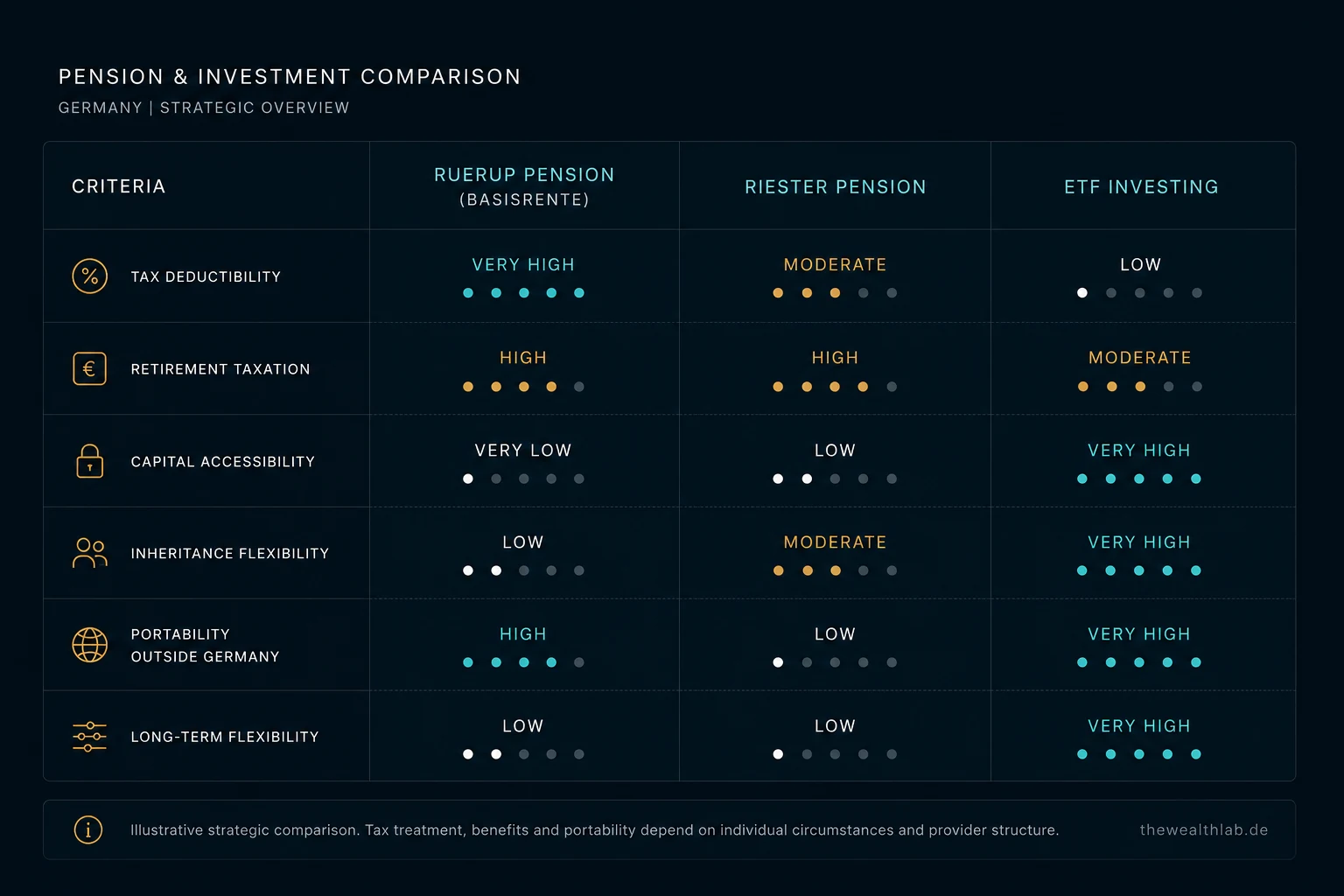
For expats and self-employed workers evaluating their pension options in Germany, it helps to see the key differences in one place.
| Feature | Ruerup (Basisrente) | Riester-Rente | Self-Invested ETF Portfolio |
| Tax deduction on contributions | Yes — up to annual ceiling (§10 Abs. 3 EStG) | Partial (Zulagen + limited deductibility) | None |
| Tax on retirement income | 100% taxable as income (§22 EStG) | 100% taxable as income | Abgeltungsteuer 26.375% on gains only |
| Access before retirement age | Not permitted — locked until age 62 (contracts from 2012+) | Harmful use penalties apply | Full access at any time |
| Payout form | Lifelong annuity only — no lump sum | Lifelong annuity (lump sum partial option in some contracts) | Full flexibility — lump sum, drawdown, or annuity |
| Inheritance / survivor benefit | Generally not inheritable. Spouse survivor annuity possible but reduces payout. | Spouse/child survivor benefit possible | Fully inheritable |
| Portability if leaving Germany | Contract stays active; no further German tax deduction once non-resident | Zulagen stop; tax consequences may apply | Fully portable — assets remain yours |
| Best suited for | High-income self-employed; those without company pension | Employees; families with children; low/middle earners | All investors seeking flexibility and control |
Sources: §10 Abs. 1 Nr. 2 EStG (Ruerup deductibility); §22 EStG (pension income taxation); §1 AltZertG (Ruerup certification); §84-85 EStG (Riester Zulagen). All at gesetze-im-internet.de. Table is a simplified comparison — individual contracts vary.
The comparison makes the trade-off clear: the Ruerup pension Germany offers the strongest tax deduction of the three options but the least flexibility. An ETF portfolio offers no tax deduction on contributions but complete control over access, inheritance, and portability. For most expats, the right answer is not either/or — it is a deliberate combination of products calibrated to their income level, likely length of stay in Germany, and retirement timeline.
Not sure whether a Ruerup pension makes sense for your situation in Germany?
We help expats and self-employed workers in Germany evaluate pension options, model the tax impact, and make decisions based on their actual plans — not generic advice.
Ruerup Pension Germany for Expats: The Specific Questions to Ask
Expats face additional considerations that German nationals who plan to retire in Germany do not. Before committing to a Ruerup pension Germany contract, these are the critical questions to answer:
How long do I plan to stay in Germany?
The Ruerup pension’s tax deduction is most valuable if you remain a German tax resident for many years. If you are likely to leave Germany within 5 years, the tax saving in those years may not outweigh the inflexibility of a locked, annuity-only product. For expats on fixed-term contracts or uncertain residency plans, a self-invested ETF portfolio may be a more suitable primary savings vehicle.
Where will I retire?
The Ruerup annuity will be paid to you wherever you live in retirement. However, the pension income will be 100% taxable in Germany under §22 Nr. 1 Satz 3 lit. a EStG (gesetze-im-internet.de/estg/__22.html). Depending on any double taxation agreement between Germany and your country of retirement, you may also face taxation in your country of residence. Some bilateral tax treaties grant Germany the primary right to tax German-source pensions — others split taxing rights. This requires country-specific legal advice.
Am I self-employed or employed?
The Ruerup pension is most beneficial for self-employed individuals who do not contribute to the gesetzliche Rentenversicherung — because they can use the full annual deductibility ceiling (EUR 27,566 for 2024) entirely for Ruerup contributions. Employees who already contribute to the state pension have a reduced ceiling, as mandatory RV contributions count against the same limit. For employed expats with a high income and an existing company pension, the incremental benefit of Ruerup may be smaller than it first appears.
What is my current marginal tax rate?
The tax saving from a Ruerup contribution equals your marginal tax rate x the contribution amount. At a marginal rate of 42% (the Spitzensteuersatz, applicable from approximately EUR 66,761 in 2024 — §32a Abs. 1 Nr. 4 EStG), every EUR 1,000 contributed saves approximately EUR 420 in income tax. At a lower marginal rate of 25%, the same contribution saves only EUR 250. The Ruerup pension is primarily a high-earner product — the lower your marginal rate, the weaker the case for the tax lock-in.
What Happens to Your Ruerup Pension If You Leave Germany?
This is one of the most important questions for expats. The Ruerup pension does not disappear if you leave Germany. The contract remains active, the accumulated value continues to grow (per the contract terms), and you will receive the annuity from retirement age regardless of where you live.
However, once you are no longer a German tax resident (unbeschraenkt steuerpflichtig), you can no longer claim the German income tax deduction for new contributions. Making further contributions after leaving Germany would provide no tax relief in Germany and no deduction in your new country of residence either — making it economically irrational for most people to continue contributing.
The most common approach for expats who leave Germany is to make the contract beitragsfrei (stop contributions, preserve the accumulated value) and allow it to grow until retirement. There is no penalty for doing this. The accrued Ruerup pension will then pay a smaller monthly annuity from retirement age than it would have if contributions had continued — but the existing tax deductions taken in Germany remain valid.
FAQ: Ruerup Pension Germany for Expats
Can I take a lump sum from my Ruerup pension?
No. The Ruerup pension must be paid as a lifelong monthly annuity. There is no lump-sum option, no partial withdrawal, and no way to access the capital before retirement. This is a certification requirement under §1 AltZertG (gesetze-im-internet.de/altzertg/__1.html) — any contract that allows a lump sum does not qualify as a Ruerup/Basisrente.
Is the Ruerup pension inheritable?
Generally no. If you die before retirement, the accumulated value in a Ruerup contract does not pass to your heirs as it would with a savings account or ETF portfolio. Some contracts offer an optional Hinterbliebenenrente (survivor annuity) for a spouse or registered partner — but adding this rider reduces the monthly annuity you receive. There is no option to leave Ruerup capital to children or non-spouse partners.
Is the Ruerup pension useful for self-employed people in Germany?
Yes. One of the main target groups for the Ruerup pension in Germany is self-employed professionals who do not participate in the gesetzliche Rentenversicherung.
Can I have both a Ruerup pension and contribute to the state pension voluntarily?
Yes, but the combined deduction is capped at the same EUR 27,566 (2024) annual ceiling. Voluntary contributions to the gesetzliche Rentenversicherung (§197 SGB VI) and Ruerup contributions both fall within §10 Abs. 1 Nr. 2 EStG and compete for the same deductibility ceiling. If you contribute EUR 5,000 in voluntary state pension contributions, your remaining Ruerup deductibility ceiling for that year is reduced accordingly.
What product types can be sold as a Ruerup pension?
Several product types qualify: traditional annuity contracts (klassische Rentenversicherung), unit-linked pension contracts (fondsgebundene Rentenversicherung), and in some cases, certain investment-focused products. The key criterion is certification under AltZertG. Among expats and financially literate investors, fondsgebundene Ruerup contracts (where premiums are invested in ETFs or funds during the accumulation phase) have become more popular as they combine the tax deduction with equity-like returns, though they carry investment risk and typically higher fees than a direct ETF portfolio.
Thinking about a Ruerup pension as part of your Germany financial plan?
You can also explore our guides on ETF investing in Germany and company pension structures for expats.
The Ruerup pension can be powerful for the right person — but only if the tax deduction outweighs the loss of flexibility. We help you model both sides of the equation.
DISCLAIMER
The information in this article is for general educational purposes only and does not constitute financial, legal, tax, or pension advice. The Ruerup pension (Basisrente) involves long-term contractual commitments and complex tax treatment that depends on individual circumstances. All figures and examples are illustrative only. The Wealth Lab is not a licensed financial, tax, or pension adviser. Before purchasing or cancelling a Ruerup contract, consult a qualified, regulated financial or tax adviser who can provide personalised guidance.
Leave a Comment
Have a question or experience to share? Drop a comment below.
Leave a Comment