
Portfolio Rebalancing in Germany:
Tax-Smart Rules for Long-Term Investors
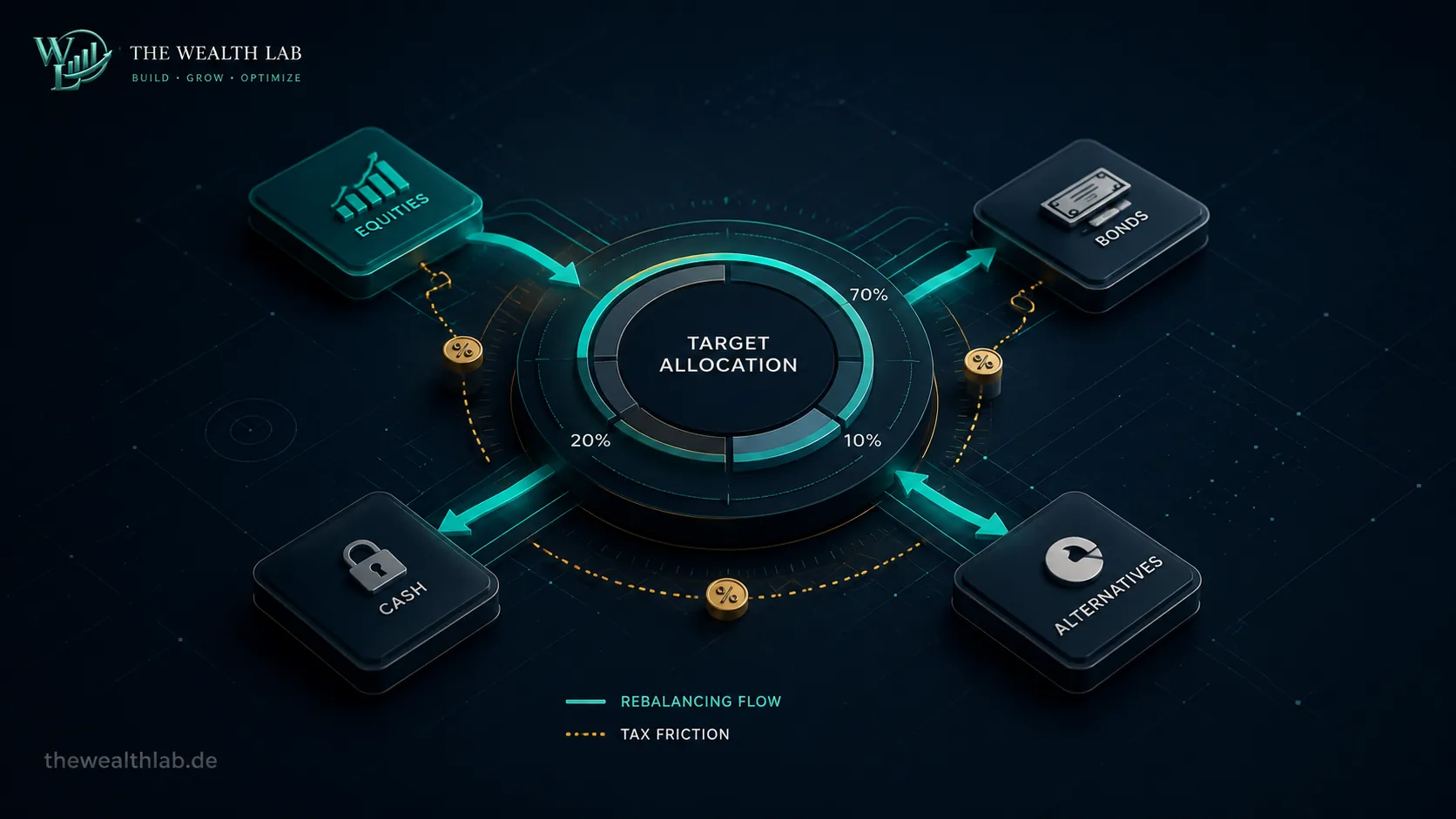
Table of Contents
Why Portfolio Rebalancing in Germany Is More Than Just an Investment Decision
For long-term investors in Germany, keeping a portfolio on track is not just a question of maths — it is a tax decision. Portfolio rebalancing Germany investors must navigate triggers Abgeltungsteuer — Germany’s flat capital gains tax — almost every time you sell an overweighted asset. Before executing a single rebalancing trade, every investor in Germany needs to understand exactly how much that decision will cost, and whether there is a tax-smarter way to achieve the same result. This guide covers the rules, the numbers, and the strategies.
What Is Portfolio Rebalancing in Germany and Why Does Tax Change Everything?
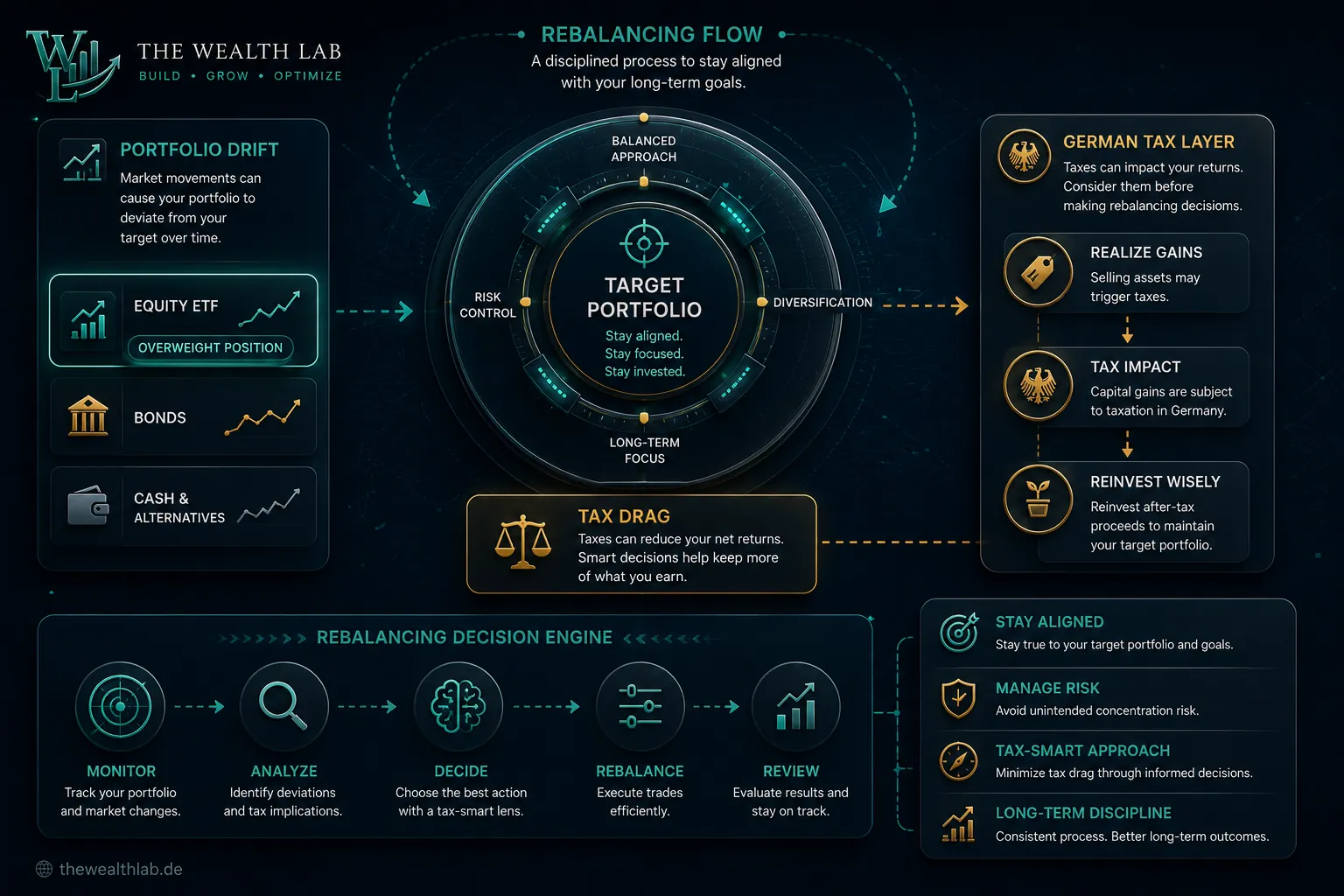
Rebalancing is the process of restoring your portfolio to its target allocation after market movements have shifted the weights of individual assets. If you started with 70% equities and 30% bonds, and a strong equity market has pushed you to 80/20, rebalancing means selling some equities and buying more bonds to return to 70/30.
In Germany, that sale triggers Abgeltungsteuer at a flat rate of 25% on every euro of capital gain, plus 5.5% Solidaritaetszuschlag on the tax itself — giving an all-in effective rate of 26.375%. If you are a registered church member, Kirchensteuer (8-9%) on top of the base tax raises the effective burden further. This is not a minor detail: it fundamentally changes the cost-benefit calculation of rebalancing.
Source: §32d Einkommensteuergesetz (EStG) and §20 EStG, Federal Ministry of Justice.
Abgeltungsteuer and the Freistellungsauftrag: The Two Numbers Every Investor Must Know
German tax law classifies investment gains, dividends, and interest as Kapitalertraege (capital income), subject to the flat 25% Abgeltungsteuer plus Solidaritaetszuschlag. There is, however, one annual relief: the Freistellungsauftrag (tax exemption order).
Since 1 January 2023, every investor resident in Germany is entitled to a tax-free allowance of EUR 1,000 per year for single filers, or EUR 2,000 per year for married couples and registered civil partnerships. All capital income — gains, dividends, interest, and even the Vorabpauschale (see below) — counts towards this threshold. You can split the allowance across multiple banks. Gains within the threshold are completely tax-free.
The Real Cost of Portfolio Rebalancing Germany Investors Rarely Calculate
Before rebalancing, calculate the exact tax cost. The table below shows what Abgeltungsteuer and Solidaritaetszuschlag will deduct at four common gain levels, assuming no Freistellungsauftrag headroom remains and no Kirchensteuer applies.
| Capital Gain Realised (EUR) | Abgeltungsteuer 25% | Solidaritaetszuschlag 5.5% of tax | Total Tax Deducted | Net Gain Kept |
| 2,000 | 500.00 | 27.50 | 527.50 | 1,472.50 |
| 5,000 | 1,250.00 | 68.75 | 1,318.75 | 3,681.25 |
| 10,000 | 2,500.00 | 137.50 | 2,637.50 | 7,362.50 |
| 20,000 | 5,000.00 | 275.00 | 5,275.00 | 14,725.00 |
All amounts in euros. Assumes no Freistellungsauftrag remaining and no Kirchensteuer. Source: §32d EStG and Solidaritaetszuschlaggesetz. Figures are illustrative examples only.
A rebalancing sale with EUR 10,000 in gains does not simply restore your target allocation — it first transfers EUR 2,637.50 to the tax authorities. For portfolio rebalancing Germany investors with large unrealised gains, this cost must be weighed against the actual risk of leaving the portfolio unbalanced.
Important nuance: losses can offset gains, but German law separates them into different Verlustverrechnungstoepfe (loss pools). Under §20 Abs. 6 EStG, equity losses (Aktien) may only be offset against equity gains — not against gains from bonds, ETFs, or interest. Your broker tracks these pools automatically (Source).
Tax-Smart Strategy 1: Rebalance With New Contributions, Not Sales
The most powerful and most underused tool for German investors is contribution-based rebalancing. Instead of selling the overweighted asset and triggering tax, you direct all new monthly savings into the underweighted assets. No sale occurs. No Abgeltungsteuer is triggered.
For an investor contributing EUR 500 per month who finds equities at 78% against a 70% target, directing all new contributions into bonds for several months will pull the allocation back gradually. For regular investors with monthly savings plans (Sparplaene), this should always be the first rebalancing tool to reach for.
The limitation: if portfolio drift is large — for example, equities at 90% of a large portfolio after a multi-year bull market — new contributions alone may take years to correct the imbalance. In that case, selective selling becomes necessary, but should still be minimised.
Tax-Smart Strategy 2: Use Your Freistellungsauftrag Every December
Many German investors allow their annual Freistellungsauftrag to expire unused. The EUR 1,000 (or EUR 2,000 for couples) allowance does not roll over — it resets and disappears on 31 December each year.
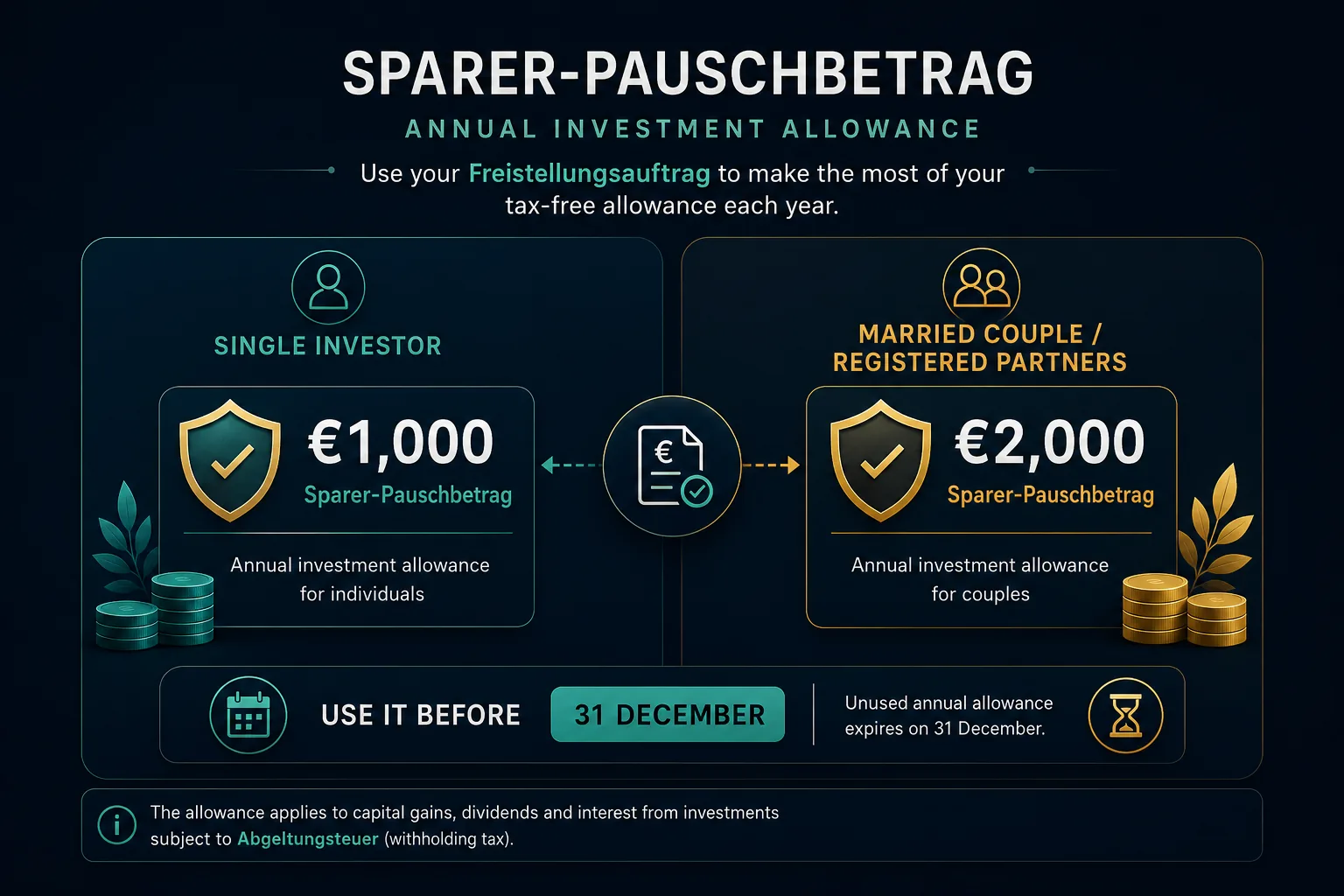
A practical strategy is to sell a small portion of overweighted assets each December — just enough to realise gains within the remaining Freistellungsauftrag — and immediately repurchase equivalent positions. This harvest of tax-free gains gradually reduces the unrealised gain position and contributes to rebalancing with zero tax cost.
For a couple with EUR 2,000 annual allowance, this strategy alone can rebalance several thousand euros of portfolio drift per year across a long investment horizon — entirely tax-free, one December at a time.
Not sure how German tax rules affect your investment strategy?
We help long-term investors and expats in Germany build tax-efficient portfolios that work with German tax law — not against it.
Understanding Vorabpauschale: The Annual Tax on Accumulating ETFs
Many investors choose accumulating (thesaurierende) ETFs expecting to pay no tax until they eventually sell. This assumption is incorrect in Germany.
Since the Investmentsteuerreformgesetz took effect on 1 January 2018, accumulating ETFs are subject to an annual Vorabpauschale — a prepayment mechanism that imputes a minimum taxable return even when no distributions are made. The formula is: Basisertrag = fund value at start of year x Basiszins x 0.7.
The Basiszins is derived from long-term German government bond yields and published each year by the Deutsche Bundesbank and the Bundesministerium der Finanzen. For 2024 (with the Vorabpauschale deducted in January 2025), the Basiszins was 2.29%. Source: Bundesministerium der Finanzen, published January 2025.
Example: An accumulating equity ETF worth EUR 100,000 at the start of 2024 generates a Basisertrag of approximately EUR 100,000 x 2.29% x 0.7 = EUR 1,603. For equity ETFs, a Teilfreistellung (partial exemption) of 30% applies, so only 70% of this amount is taxable. (Source: 1 and 2 )
The Vorabpauschale is deducted from your Freistellungsauftrag first. For smaller portfolios it may be covered entirely by the annual allowance. For larger portfolios, it can silently consume most of the exemption — leaving less headroom for rebalancing gains to be harvested tax-free.
Tax-Smart Strategy 3: Loss Harvesting Within German Rules
If some holdings have fallen in value, selling them crystallises a loss that can be used to offset gains. This is loss harvesting — a legitimate and widely used strategy, but one that German law constrains significantly.
German loss offsetting rules — §20 Abs. 6 EStG:
- Losses on shares (Aktien) can only offset gains on other shares — not on ETFs, bonds, or interest income
- Losses on investment funds (ETFs, mutual funds) can offset gains on other investment funds
- Unused losses are carried forward automatically to future years, but the category restriction still applies
- Your broker maintains separate Verlustverrechnungstoepfe for equity losses vs other investment losses
Practical implication: if you hold equity ETFs with large gains and bond ETFs with a loss, the bond loss cannot offset the equity gain. Always check your loss pools with your broker before executing a rebalancing sale. (Source)
Comparing Rebalancing Strategies: A Summary for German Investors
| Rebalancing Strategy | Tax Event? | Best Suited For | Key Limitation |
| Redirect new contributions | None | Regular savers with monthly savings plans | Slow — works best over months or years |
| Use Freistellungsauftrag allowance | Minimal (within allowance) | Gains below EUR 1,000 / 2,000 per year | Limited to EUR 1,000 single or EUR 2,000 married per year |
| Loss harvesting within rules | Offset only | Portfolios with both gains and losses in same asset category | Equity losses can only offset equity gains (§20 Abs. 6 EStG) |
| Sell and rebalance | Full tax applies | Portfolios with significant drift over 10% | Triggers full Abgeltungsteuer and Soli immediately |
Source: §32d EStG, §20 Abs. 9 EStG, §20 Abs. 6 EStG. gesetze-im-internet.de
When Portfolio Rebalancing in Germany Is Worth the Tax Cost
There are situations where selling and paying the tax is the right decision. The question is whether the risk of continued drift outweighs the immediate tax cost.
Rebalance and accept the tax cost when:
- Allocation has drifted by more than 10 percentage points from target
- You are approaching retirement and your portfolio carries more risk than intended
- A market concentration has developed in a single asset, sector, or country
- Your financial goals have materially changed and the original allocation no longer fits
Wait or use contribution-based rebalancing when:
- Drift is below 5% and can be corrected within 12-18 months through new contributions
- You have unused Freistellungsauftrag that can absorb the gain with no tax
- You have offsettable losses in the same asset category that reduce or eliminate the tax bill
The core principle for portfolio rebalancing Germany investors: treat the Abgeltungsteuer cost as a real transaction cost, quantify it before every sale, and choose the strategy that achieves your target allocation at the lowest combined financial and tax cost.
Portfolio Rebalancing Germany: Frequently Asked Questions
Do I need to rebalance every year?
No. Most long-term investors use a threshold-based approach rather than a calendar schedule: rebalance only when an allocation drifts beyond a tolerance band of 5% from target. This reduces taxable events while keeping the portfolio aligned with your risk profile.
Can I rebalance inside a German Depot without triggering Abgeltungsteuer?
No. Germany does not offer a tax-sheltered general investment account like a UK ISA or US 401(k). Every sale of an asset with a gain in a German brokerage account (Depot) triggers Abgeltungsteuer. Certain pension wrappers and betriebliche Altersvorsorge contributions have different tax treatment, but general investment portfolios have no tax shelter equivalent.
Does the Vorabpauschale affect my rebalancing headroom?
Yes, indirectly. The Vorabpauschale is automatically deducted from your Freistellungsauftrag each January by your broker. For portfolios with significant accumulating ETF holdings, this can consume a large portion of the annual EUR 1,000 (or EUR 2,000 for couples) allowance, leaving less headroom for tax-free rebalancing gains.
What happens to unrealised gains if I leave Germany?
Germany applies an exit tax (Wegzugsbesteuerung) on certain assets when you cease to be a German tax resident. For significant unrealised gains in investment funds, this is a technically complex area. Seek specialist advice before any planned relocation. Legal basis: §6 Aussensteuergesetz (AStG),
Ready to build a tax-smart portfolio strategy in Germany?
Portfolio rebalancing in Germany is more complex than in most other countries — but with the right plan, you can minimise tax drag and stay on track for long-term wealth.
DISCLAIMER
The information in this article is for general educational purposes only and does not constitute financial, legal, or tax advice. German tax laws, including Abgeltungsteuer, Freistellungsauftrag, and Vorabpauschale rules, are subject to change. All figures and examples are illustrative only and may not reflect your individual tax situation. The Wealth Lab is not a licensed financial or tax adviser. Before making any investment or rebalancing decisions, consult a qualified, regulated adviser who can provide personalised guidance based on your specific circumstances.
Leave a Comment
Have a question or experience to share? Drop a comment below.
Leave a Comment