
SCHUFA for Expat Homebuyers Germany :
Credit and Mortgage Basics

Table of Contents
Introduction
Author note: The Wealth Lab Team often works with expats who are financially strong on paper, but still unsure how German credit history, SCHUFA records, mortgage documents, and bank expectations fit together. This guide is written to make that process clearer without turning general information into personal mortgage advice.
SCHUFA for expat homebuyers Germany is a topic many people only start researching once they have already found a property, spoken with a bank, or realized that German lenders may ask for more than salary alone. If you are planning to buy a home in Germany, it is better to understand the structure before the process becomes urgent.
This article explains how SCHUFA can fit into the wider homebuying picture, what expats often misunderstand, and which documents can help create a more complete financial profile. It does not recommend a lender, mortgage product, property, or financing strategy. The key point is simple: SCHUFA matters, but it is not the whole mortgage story. Banks may also review income stability, residence status, probation period, equity, property details, debt obligations, and the quality of the documents you provide.
Why SCHUFA for expat homebuyers Germany matters
Buying property in Germany is rarely just a property decision. It is also a documentation decision, a financing decision, and a cash-flow decision. For expats, the process can feel unfamiliar because several systems meet at the same time: the bank, the property market, the notary process, tax costs, credit records, and residence documents.
A person may have a strong salary, a good job, and responsible financial habits, but still have a thin German credit file. That does not automatically mean a mortgage is impossible. It means the wider financial profile needs to be explained clearly and supported with documents.
This is why SCHUFA for expat homebuyers Germany should be understood as part of broader financial planning for expats in Germany. The goal is not to chase a perfect score. The goal is to understand what a lender may want to see and where the application could raise questions.
Mini-CTA: If you are thinking about buying within the next 6 to 18 months, a mortgage-readiness review can help you identify document gaps before the property search becomes emotional.
What SCHUFA can and cannot explain
SCHUFA is commonly associated with creditworthiness in Germany. In simple terms, it collects and processes certain credit-related information and provides scoring information that businesses may use as part of their risk assessment. The exact use of that information can depend on the lender and the type of application.
For a mortgage, SCHUFA may be one part of the picture. It can help a lender understand whether there are negative entries, existing credit obligations, or credit behavior that requires attention. But it does not replace the bank’s own underwriting.
A mortgage lender may still ask for salary statements, employment contracts, bank statements, proof of equity, tax documents for self-employed buyers, residence documents, and property documents. A clean SCHUFA record does not remove those requirements.
At the same time, a limited SCHUFA history does not automatically tell the full story of a financially responsible expat. Someone who recently moved to Germany may simply not have had enough time to build a long domestic credit record.
Key German rules and context
– SCHUFA describes its score as an assessment related to creditworthiness.
– For homebuyers, credit information can be one part of a wider mortgage review.
– A limited German credit history can be relevant for newcomers, but lenders also review income, employment, equity, and property details.
– Payment behaviour, open accounts, credit agreements, and address history may be relevant depending on available data.
– Consumers can request information about their stored data.
These points give the article its factual base. They are still general information. The exact result can depend on individual documents, timing, contracts, tax residency, employment status, and family situation.
Where a legal rule, threshold, tax treatment, or authority process is involved, the current official source should be checked before acting.
Common mistakes expats discover too late
Many expats discover too late that a strong income alone may not be enough to make a German mortgage file easy to approve. The missing piece is often documentation, timing, or an assumption about how credit history works in Germany.
One common mistake is applying before checking whether the SCHUFA file contains outdated or incorrect information. Another is assuming that a foreign credit history will automatically be understood by a German lender. A third is ignoring the effect of probation period, temporary contracts, or unclear residence documentation.
The cost of these mistakes can be real. A buyer may lose time, miss a property opportunity, accept weaker financing terms, or feel pressured into a decision before the numbers are fully understood. The more useful approach is to prepare before urgency starts. That means checking records, building a document folder, understanding acquisition costs, and knowing which parts of the financial profile may need explanation.
How SCHUFA and mortgage readiness works in practice
In practice, SCHUFA and mortgage readiness usually has four layers.
The first layer is the rule or contract wording. This is where official sources, legal texts, consumer guidance, or product terms matter.
The second layer is your personal situation. Employment type, family situation, residence status, tax residency, income, health history, or future plans can change the questions you need to ask.
The third layer is documentation. German institutions often rely on documents, statements, certificates, contracts, and written confirmation.
The fourth layer is flexibility. A decision that looks simple today may feel different after a job change, a move, a family change, or a decision to stay in Germany permanently.
Practical factors to review
– Is this topic mandatory, voluntary, conditional, or contract-based?
– Which German authority, law, or neutral consumer source explains the rule?
– Is there a year-specific threshold, tax figure, deadline, or waiting period?
– Does employment status change the answer?
– Could a spouse, partner, child, or dependent be affected?
– Could leaving Germany later create tax, contract, or paperwork questions?
– Are there exclusions, fees, waiting periods, or cancellation rules?
– Would the decision still make sense if income, visa status, or family plans changed?
Scenario examples
Scenario 1: New employee in Germany
A new employee may first look for the quickest setup. That is understandable, but speed can hide important details. For SCHUFA for expat homebuyers Germany, the employee may need to understand how the topic connects to payroll, tax residency, employer documents, insurance status, or future income planning.
If your job, salary, or benefits changed recently, a review can help connect the article to your actual documents.
Scenario 2: Freelancer or founder
A freelancer often has more moving parts. Income can vary, tax payments may not be handled through payroll, and insurance or pension questions can become more personal. The same German topic can therefore have a different impact for a freelancer than for an employee.
If you are self-employed, the useful question is often not “What do most people do?” but “Which parts of my setup create risk, cost, or paperwork?”
Scenario 3: Expat who may leave Germany
A person planning to leave Germany later may need to think about portability, cancellation, tax reporting, and cross-border documentation. This does not mean one choice is automatically better. It means relocation plans can change which questions matter.
If Germany may not be your final destination, a planning conversation can help identify what should stay flexible.
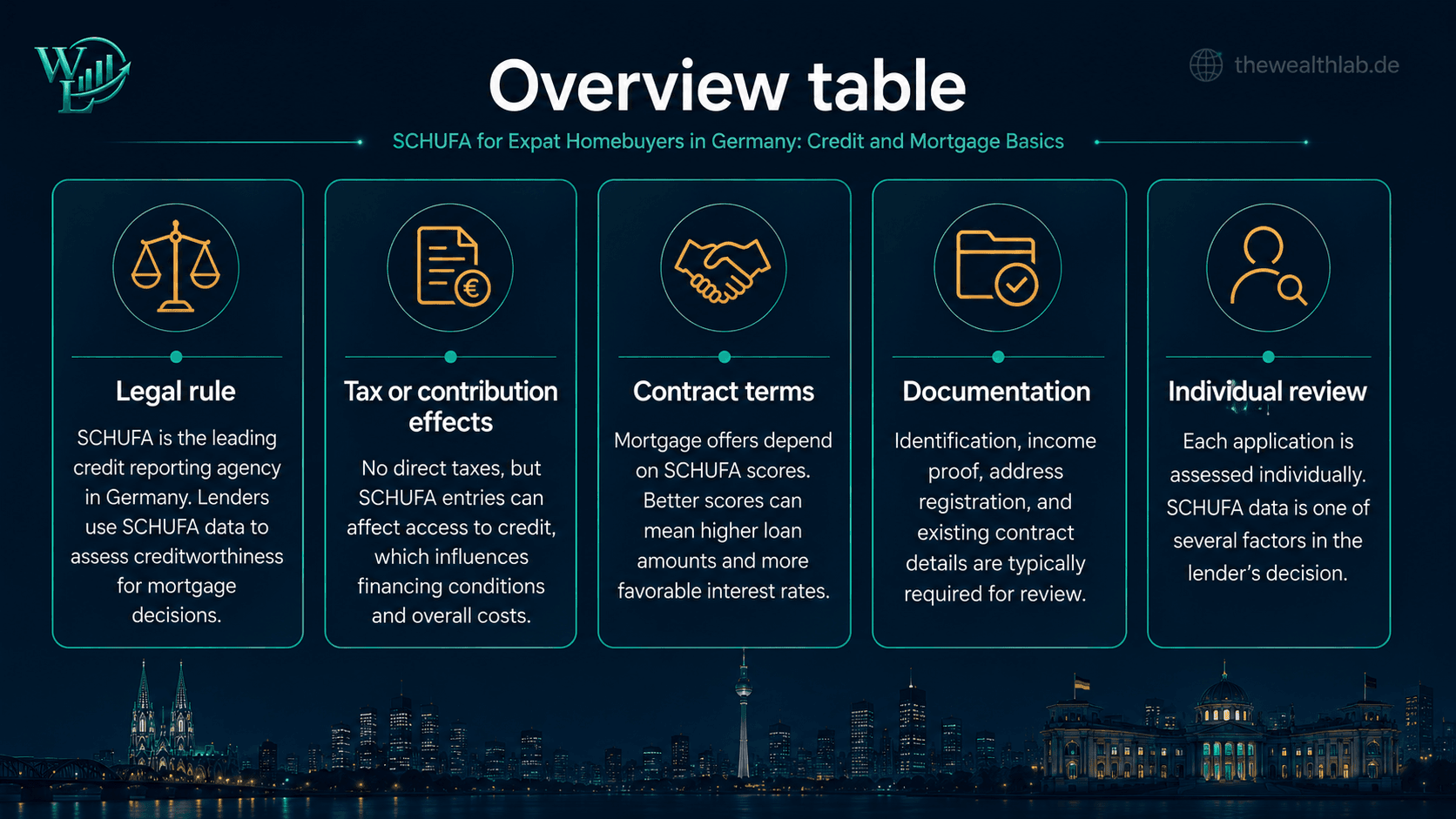
Overview table
Lead magnet: free resource
Helpful resource: Free SCHUFA Mortgage Prep List.
This free checklist can help you organise the key questions before a consultation. To request it, contact The Wealth Lab and mention the article topic: SCHUFA for expat homebuyers Germany.
Common misunderstandings
A common misunderstanding is assuming that the cheapest or fastest option is automatically the most appropriate. Cost matters, but it is only one part of the picture.
Another misunderstanding is copying another expat’s decision. Two people can live in the same city and still have different outcomes because of income, family, tax residency, employment status, health history, or future plans.
A third misunderstanding is treating online information as if it were personal advice. Online information can explain rules and concepts. It cannot verify individual documents or suitability.
The safer approach is to use public information to prepare better questions, then review the personal facts before making a decision.
What to prepare before getting individual help
– Current employment status and income structure.
– Tax residency for the relevant year.
– Existing contracts, accounts, or policies connected to the topic.
– Family situation and dependents.
– Expected length of stay in Germany.
– Possible future relocation plans.
– Documents received from employers, banks, insurers, pension offices, or authorities.
– Any deadlines, renewals, waiting periods, or tax-year dates.
How to evaluate the topic without rushing
A careful evaluation of SCHUFA for expat homebuyers Germany should start with the question behind the search.
Some readers are looking for a definition. Others are trying to decide what to do next. Those are not the same task.
A definition explains the term. A decision requires context, documents, numbers, timing, and personal priorities.
This is where many expats in Germany lose clarity. They read five articles, compare comments from friends, and still do not know which part applies to them.
A better method is to separate the topic into three parts: the German rule, the contract or process, and the personal situation.
The German rule tells you what framework exists. The contract or process tells you what the practical terms are. The personal situation tells you whether the topic creates cost, risk, paperwork, or flexibility issues for you.
This structure helps keep the article useful without turning it into individual advice.
Questions that create better decisions
– What is the official German term for this topic?
– Which source explains the legal or administrative rule?
– Is the figure or threshold connected to a specific year?
– Does the answer change for employees, freelancers, families, or people planning to leave Germany?
– Could this topic affect tax reporting, insurance status, pension rights, mortgage readiness, or liquidity?
– Is there a contract term, exclusion, waiting period, fee, or deadline that changes the practical result?
– Would I understand the consequences if my job, income, residence status, or family situation changed?
– Do I need a personal review before signing, cancelling, switching, investing, or filing?
What good planning looks like
Good planning does not mean making every decision immediately.
It means knowing which decision is urgent, which one can wait, and which one needs better information.
For SCHUFA for expat homebuyers Germany, this can be especially important because the visible decision is often only part of the story.
A person may understand the basic rule but still miss the interaction with tax residency, family coverage, cash flow, pension planning, or future relocation.
A professional review should not start with a product. It should start with facts: income, status, timeline, risk exposure, documents, existing contracts, and goals.
Only after that does it make sense to discuss options, trade-offs, or next steps.
This is also why a calm consultation can be more useful than trying to solve everything from scattered online information.
Real-world expat pattern
In our work with expats in Germany, a common pattern appears again and again.
The person does not make a mistake because they are careless. They make a mistake because the system is fragmented.
One part of the answer comes from an employer. Another part comes from a bank, insurer, tax office, broker, pension office, immigration office, or online forum.
Each source may be correct within its own context, but the reader still has to connect the dots.
That is exactly where SCHUFA for expat homebuyers Germany can become confusing. The issue is not only information; it is coordination.
A coordinated view helps the reader understand what affects cash flow now, what affects rights later, and what should be documented before a deadline appears.
Mistakes that can be expensive
Many expats discover too late that a small missing detail can create a larger cost later.
For this topic, the expensive mistake is usually not one dramatic decision. It is a chain of small assumptions.
One assumption might be that a friend’s setup also fits your case. Another might be that a monthly price shows the full cost. Another might be that a foreign account, old contract, or missing document will not matter in Germany.
The result can be lost time, avoidable paperwork, reduced flexibility, unclear tax reporting, missed rights, or unnecessary stress at exactly the wrong moment.
The better approach is to pause early and ask what the decision could affect before deciding whether it is simple or complex.
How this article should be used
Use this article as a structured starting point.
It can help you understand the terminology, the common risks, and the questions that deserve attention.
It should not be used as a personal recommendation.
If your situation involves multiple countries, family members, self-employment, property plans, investment accounts, pension questions, or a possible move away from Germany, the topic may need individual review.
That review can help turn general information into a clear list of next steps without guessing.
Final planning note
For SCHUFA for expat homebuyers Germany, a small amount of structure can make the difference between feeling overwhelmed and knowing what to check next.
A reader does not need to become an expert in every German rule. The more realistic goal is to understand the main risk, identify the documents that matter, and know when general information is no longer enough.
This is especially important for expats because decisions often happen during busy life transitions: a new job, a move, a visa renewal, a family change, a property search, or a new tax year.
When several of those changes happen at the same time, a neutral review can help protect money, rights, time, and flexibility.
Key takeaways
– SCHUFA for expat homebuyers Germany can affect expats differently depending on personal facts.
– Official and neutral sources are important for legal, tax, insurance, pension, property, and immigration statements.
– The biggest risk is usually not lack of information, but acting on incomplete information.
– A consultation can help connect general rules to the reader’s documents, goals, and timeline.
– The article is educational and should be used as a starting point, not as a personal recommendation.
Frequently asked questions about SCHUFA for expat homebuyers Germany
Is SCHUFA required for a mortgage in Germany?
Mortgage lenders commonly consider credit information, and SCHUFA can be part of that process. The exact role depends on the lender and application.
Why can expats get different answers?
Tax residency, employment type, income, family situation, residence status, health history, and relocation plans can change the relevant questions.
What do expats often miss?
Many expats focus on price or speed and miss contract terms, tax reporting, documentation, waiting periods, or future flexibility.
Where should official rules be checked?
Use official German sources, legal texts, public agencies, neutral consumer-protection bodies, or qualified professionals.
When is a consultation useful?
A consultation is useful when the topic affects taxes, insurance, pension rights, investments, property financing, family protection, or relocation.
What is the first step for SCHUFA for expat homebuyers Germany?
Identify whether the topic is mandatory, voluntary, tax-sensitive, contract-based, or administrative.
Disclaimer
This article is for general educational information only.
It does not constitute tax advice, legal advice, insurance advice, investment advice, pension advice, mortgage advice, immigration advice, or a personal financial recommendation.
No product, provider, fund, ETF, broker, insurance contract, pension contract, mortgage structure, or tax strategy is recommended.
German laws, thresholds, administrative practice, tax treatment, and product terms can change.
Readers should verify current rules with official sources and consult qualified professionals before making decisions.
Leave a Comment
Have a question or experience to share? Drop a comment below.
Leave a Comment