
EU Blue Card Germany 2026 Salary Threshold: Financial Planning Guide for Expats
Table of Contents
Introduction
Germany remains one of the most attractive destinations in Europe for skilled international professionals. Every year, thousands of expats move to Germany through the EU Blue Card pathway to work in industries such as IT, engineering, healthcare, finance, and research.
However, many people focus only on visa approval and underestimate the financial realities that begin after relocation.
The EU Blue Card Germany 2026 salary threshold is not only an immigration requirement. Your salary level can influence taxes, health insurance structure, pension contributions, apartment applications, long-term savings capacity, and overall financial stability in Germany.
For many expats, the biggest challenge is not receiving the visa. The difficult part is building a financially stable life after arrival.
This guide explains the EU Blue Card salary framework in plain English, highlights important financial considerations for expats in Germany, and provides educational information to help readers prepare more strategically before relocating.
Important:
This article is educational information only and does not provide legal, immigration, tax, or financial advice. Regulations and salary thresholds may change over time and individual situations differ significantly.
What Is the EU Blue Card in Germany?
The EU Blue Card is a residence permit designed for qualified non-EU professionals who receive an eligible job offer in Germany.
The program is intended to help Germany attract skilled international workers in sectors facing labor shortages.
Depending on the individual situation, the EU Blue Card may provide benefits such as:
- Residence rights in Germany
- Easier family reunification
- Potentially faster permanent residency pathways
- Long-term career opportunities within the EU
Eligibility requirements can depend on several factors, including:
- University qualification recognition
- Employment contract type
- Salary level
- Occupation category
- Employer location
- Immigration regulations applicable at the time of application
Because immigration rules may change, applicants should always verify current requirements using official German government sources.
EU Blue Card Germany 2026 Salary Threshold Explained
Germany updates EU Blue Card salary thresholds periodically based on labor market and salary developments.
In practice, Germany usually applies:
- A general salary threshold
- A lower threshold for certain shortage occupations
Shortage occupations may include professions such as:
- IT specialists
- Engineers
- Doctors
- Researchers
- Scientists
- Certain healthcare professions
However, exact eligibility requirements depend on current regulations and individual employment conditions.
It is also important to understand that the threshold refers to gross annual salary before taxes and deductions, not net income.
Many expats misunderstand this distinction before relocating to Germany.
Why the EU Blue Card Germany 2026 Salary Threshold Matters Financially
Salary in Germany affects much more than immigration eligibility.
Your income level may influence:
- Monthly net income after taxes
- Health insurance structure
- Public pension contributions
- Apartment approval chances
- Long-term savings potential
- Mortgage eligibility
- Financial flexibility
- Family financial planning
This is why many expats begin researching financial planning for expats in Germany before relocation.
Understanding Gross Salary vs Net Salary in Germany
One of the most common financial surprises for expats in Germany is the difference between gross salary and net salary.
German payroll deductions may include:
- Income tax
- Pension contributions
- Health insurance
- Unemployment insurance
- Long-term care insurance
- Additional taxes depending on personal circumstances
The exact amount deducted depends on multiple factors, including:
- Tax class
- Marital status
- Federal state
- Church tax status
- Insurance structure
- Number of children
- Income level
Because every situation is different, it is usually not possible to provide one exact net salary calculation that applies to everyone.
For this reason, expats should avoid relying on generalized online estimates without considering their own circumstances.
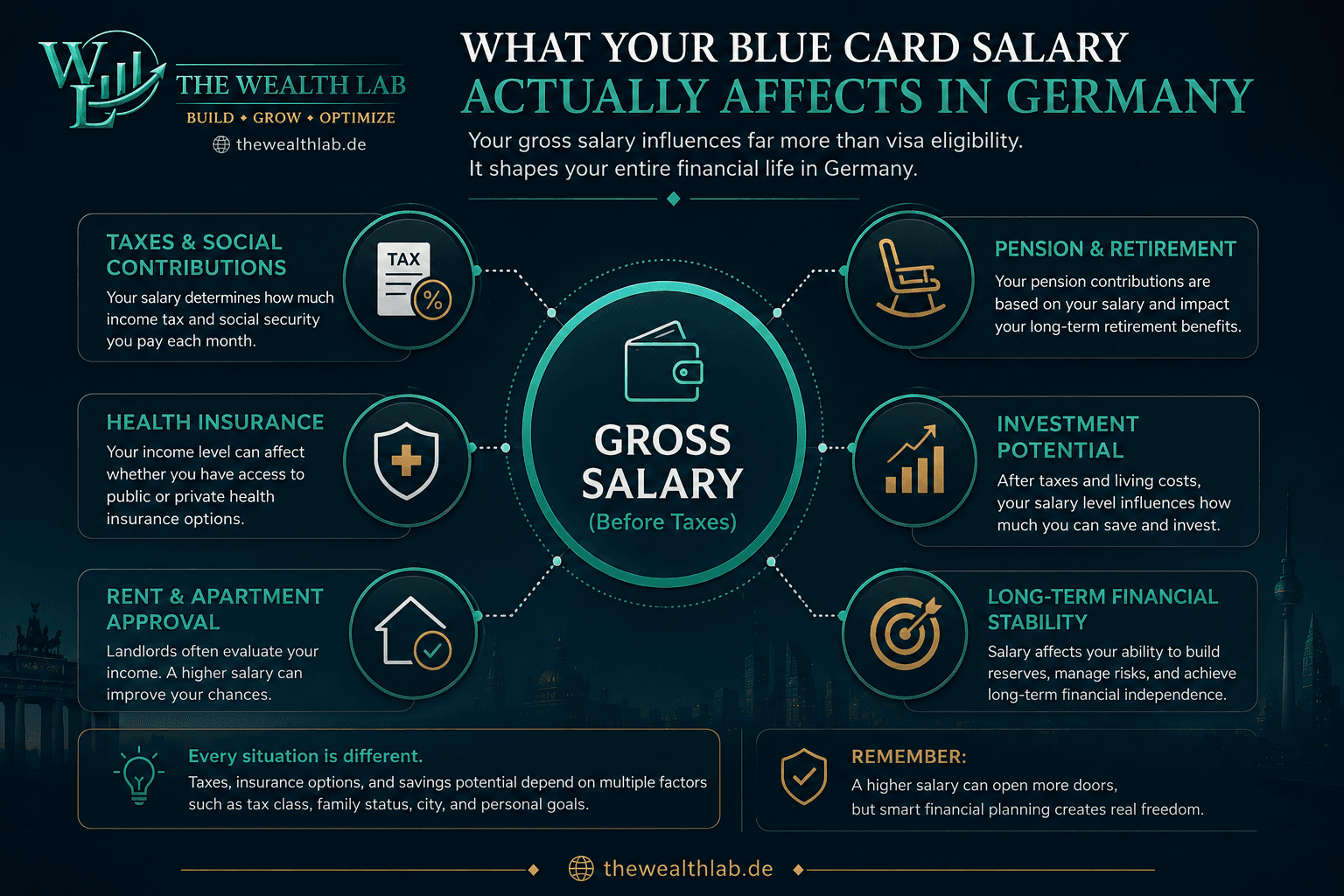
What Your Blue Card Salary Actually Affects in Germany
Many expats initially focus only on whether their salary qualifies for the EU Blue Card. In practice, salary in Germany affects multiple financial areas at the same time — including taxes, insurance structure, housing applications, pension contributions, and long-term financial flexibility.
Cost of Living in Germany for Expats
The cost of living in Germany can vary significantly depending on:
- City
- Lifestyle
- Family size
- Housing market conditions
- Transportation needs
- Insurance structure
Cities such as Munich, Frankfurt, Hamburg, and parts of Berlin are generally more expensive than smaller cities.
Typical monthly expenses may include:
- Rent
- Utilities
- Health insurance
- Transportation
- Groceries
- Childcare
- Internet and mobile services
Because housing prices and inflation can change over time, readers should always verify current local costs before making relocation decisions.
A salary that qualifies for the EU Blue Card does not automatically guarantee financial comfort in every German city.
Public vs Private Health Insurance for EU Blue Card Holders
Health insurance is one of the most important financial decisions for many expats in Germany.
Depending on salary level and individual circumstances, some EU Blue Card holders may have access to different insurance options.
Germany generally has two main systems:
- Public health insurance (GKV)
- Private health insurance (PKV)
The suitability of each option depends on factors such as:
- Income level
- Age
- Family situation
- Long-term residency plans
- Health condition
- Career plans
No insurance structure is universally better for everyone.
What works well for one expat may not be appropriate for another.
Because health insurance decisions may have long-term financial consequences, individualized professional guidance is often important.
Common Financial Mistakes Expats Make After Moving to Germany
1. Focusing Only on Gross Salary
Many expats negotiate salary without understanding German deductions and living costs.
A higher gross salary does not automatically translate into financial flexibility.
2. Ignoring Long-Term Pension Planning
Germany’s public pension system works differently from many international systems.
Long-term retirement planning may require additional private preparation depending on personal goals and future residency plans.
3. Choosing Insurance Too Quickly
Insurance decisions in Germany can affect both short-term costs and long-term financial planning.
Choosing based only on price may create future limitations.
4. Underestimating Relocation Costs
Relocation expenses may include:
- Apartment deposits
- Temporary housing
- Furniture
- Administrative fees
- Translation costs
- Registration expenses
Building an emergency reserve before moving can reduce financial pressure during the first months in Germany.
5. Not Understanding the German Financial System Early Enough
Germany has a highly structured financial and administrative system.
Understanding taxes, insurance, banking, and long-term planning early can help expats avoid unnecessary stress later.
Financial Planning Checklist Before Relocating to Germany
Before moving to Germany through the EU Blue Card pathway, many expats review the following areas:
✅ Estimated net salary
✅ Cost of living by city
✅ Health insurance structure
✅ Emergency savings
✅ Housing market expectations
✅ Pension planning
✅ Banking setup
✅ Tax obligations
✅ Family financial planning
✅ Long-term residency goals
Preparing these areas early may help create a smoother relocation experience.
Can EU Blue Card Holders Buy Property in Germany?
In general, foreign nationals can purchase real estate in Germany.
However, mortgage approval depends on multiple factors, including:
- Employment stability
- Income structure
- Residence status
- Credit history
- Savings level
- Debt obligations
- Bank-specific criteria
Each bank may apply different approval standards.
For this reason, expats should avoid assuming that visa approval automatically guarantees mortgage eligibility.
Long-Term Financial Planning for Expats in Germany
Many expats initially focus only on relocation logistics.
However, long-term financial planning often becomes equally important after arrival.
Areas many international professionals review over time include:
- Retirement planning
- Investment structure
- Emergency reserves
- Insurance optimization
- Tax-efficient strategies
- Real estate planning
- Family financial protection
Every situation is different, which is why financial planning in Germany is rarely one-size-fits-all.
Official Resources for EU Blue Card Germany Information
Because immigration and salary regulations may change, readers should always verify information using official or government-related sources.
Recommended resources include:
- Make it in Germany – EU Blue Card
- European Commission Immigration Portal
- German Federal Ministry of Finance
Final Thoughts
The EU Blue Card Germany 2026 salary threshold is more than an immigration requirement.
For many expats, it becomes the starting point of a much larger financial journey in Germany.
Understanding taxes, insurance systems, cost of living, pension structure, and long-term planning early can help reduce uncertainty and support more informed financial decisions after relocation.
Germany offers strong professional opportunities for many international professionals, but building financial stability often requires preparation, structure, and realistic expectations.
Frequently Asked Questions (FAQ)
What is the expected EU Blue Card Germany 2026 salary threshold?
The exact official number may still change, but Germany generally updates the threshold annually based on labor and salary data.
Does gross salary mean salary before taxes?
Yes. The Blue Card threshold uses gross annual salary before deductions.
Can I get private health insurance with a Blue Card?
In some cases, yes. Eligibility depends on salary level and employment situation.
Is Germany financially worth it for expats?
That depends on your profession, salary structure, lifestyle, taxes, and long-term goals.
Can Blue Card holders apply for permanent residency?
Yes. Under certain conditions, EU Blue Card holders may qualify for faster permanent residency pathways.
Disclaimer
This article is general educational information only and does not constitute legal, immigration, tax, or financial advice. Regulations, salary thresholds, tax rules, insurance structures, and residency laws in Germany may change over time. Individual outcomes depend on personal circumstances, employment contracts, residency status, family situation, and financial objectives. Readers should consult qualified legal, tax, immigration, or financial professionals before making decisions based on this article.
Leave a Comment
Have a question or experience to share? Drop a comment below.
Leave a Comment