
Financial Planning for Expats in Germany:
The Ultimate Wealth Guide (2026)
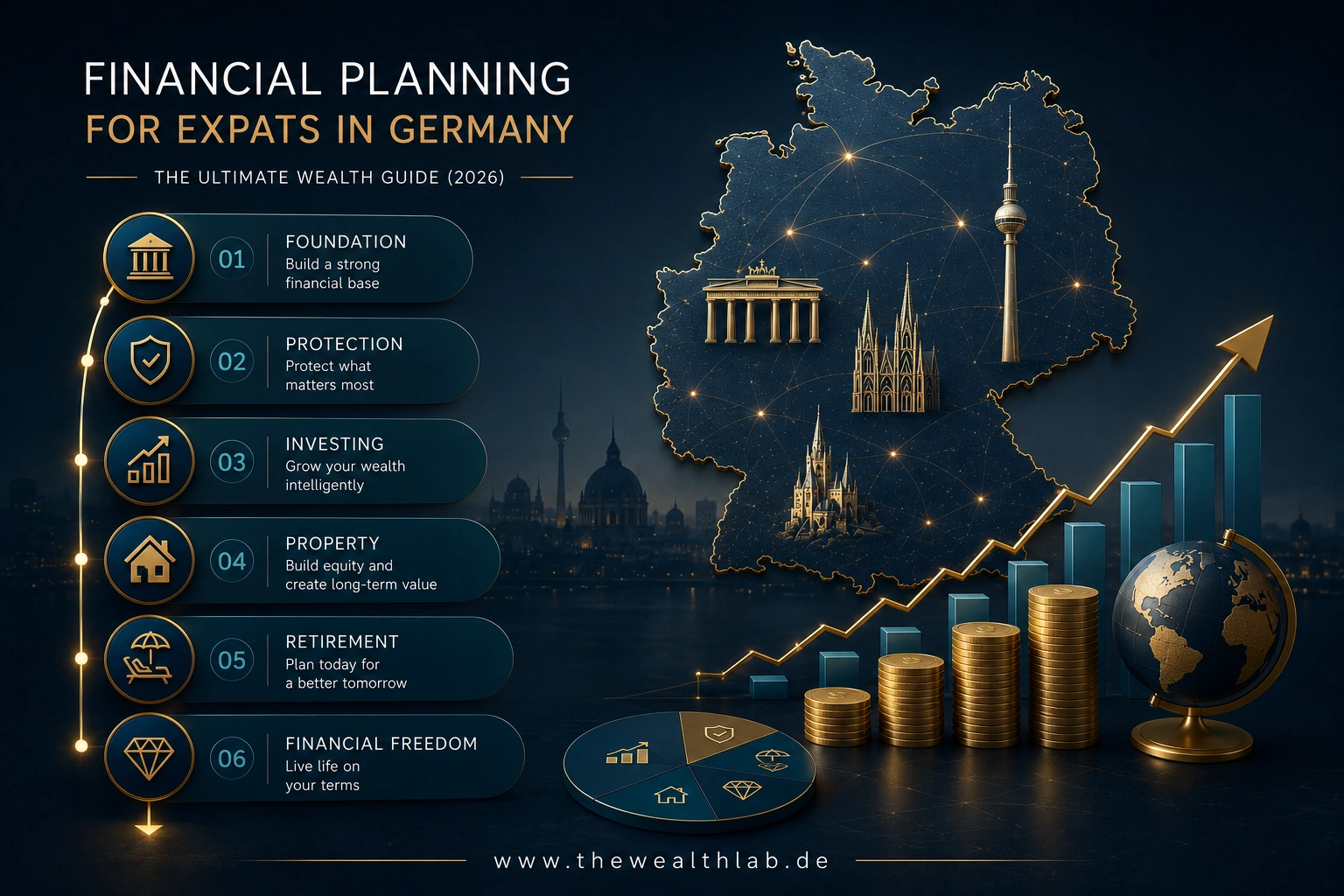
Table of Contents
Introduction: The Ultimate Wealth Guide (2026)
Moving to Germany can be one of the best financial decisions of your life—or one of the most expensive mistakes if you fail to understand how the German financial system works.
Every year, thousands of professionals, entrepreneurs, students, and families relocate to Germany in search of better opportunities and long-term security. However, many expats discover that earning a good salary alone does not automatically lead to financial success.
Financial planning for expats in Germany requires understanding how taxes, social security contributions, pensions, health insurance, and investments work together.
Without a clear strategy, even high-income earners can make costly mistakes that affect their finances for years.
⚠️ Many expats underestimate the long-term impact of financial decisions made during their first few years in Germany.
Choosing the wrong health insurance, delaying investments, ignoring retirement planning, or failing to optimize taxes can potentially cost tens of thousands of euros over a lifetime.
The good news is that Germany offers outstanding opportunities for individuals who approach their finances strategically.
Germany combines a stable economy, strong investor protections, a highly regulated financial system, and access to global investment markets.
These advantages make Germany one of the most attractive countries in Europe for long-term wealth building.
This guide was specifically created for professionals, families, entrepreneurs, and international residents who want to make smarter financial decisions while living in Germany.
By the end of this guide, you will understand:
✅ How the German financial system works
✅ Which insurance policies are essential for expats
✅ How investing in Germany for expats differs from many other countries
✅ How the German pension system impacts your retirement
✅ The most effective strategies for building wealth in Germany
✅ Common financial mistakes expats make and how to avoid them
Why Financial Planning for Expats in Germany Matters More Than Ever
One of the biggest financial myths is that income determines wealth.
In reality, wealth is not created by how much you earn—it is created by how much you keep, protect, invest, and grow over time.
Consider two professionals earning exactly the same salary in Germany.
One spends most of their income, postpones investing, and relies entirely on the state pension system.
The other builds an emergency fund, invests consistently in globally diversified assets, optimizes taxes, and actively plans for retirement.
Although both individuals earn the same income today, their financial outcomes twenty years from now could be dramatically different.
📈 Small financial decisions made consistently over long periods often have a greater impact than occasional large financial decisions.
This is why financial planning for expats in Germany should not be viewed as a luxury. It is a fundamental process for achieving long-term financial security and creating greater freedom of choice in the future.
According to demographic and pension projections published by German authorities, personal retirement planning is becoming increasingly important as the population ages and pressure on public pension systems grows (based on information from Deutsche Rentenversicherung and the German Federal Government, 2026).
The earlier you start planning, the more time your money has to benefit from compounding, tax efficiency, and long-term market growth.
Understanding the German Financial System: The Foundation of Financial Planning for Expats in Germany
Before discussing investing, retirement planning, or wealth building, it is essential to understand how the German financial system works.
One of the biggest mistakes expats make is applying financial strategies from their home country without adapting them to Germany. The German system operates differently, and understanding its structure is the first step toward making informed financial decisions.
💡 Successful financial planning for expats in Germany starts with understanding the rules of the system before trying to optimize within it.
Germany’s financial framework is built around five major pillars:
✅ Taxation
✅ Social Security Contributions
✅ Health Insurance
✅ Pension System
✅ Private Wealth Building
Each of these pillars affects your ability to build wealth, protect your income, and achieve long-term financial goals.
The German Tax System
Germany has one of the most comprehensive tax systems in Europe.
Income tax rates increase progressively as earnings rise. This means that individuals with higher incomes generally pay a larger percentage of their income in taxes.
However, many expats incorrectly assume that a higher tax rate automatically means they cannot build wealth.
The reality is quite different.
📌 Your ability to build wealth depends more on your savings rate and investment strategy than on your tax rate alone.
Germany also provides various tax deductions and allowances that can reduce taxable income when used correctly.
Examples may include:
• Work-related expenses
• Professional training costs
• Certain insurance contributions
• Relocation expenses in specific situations
• Pension-related contributions
(Based on information published by the German Federal Ministry of Finance, 2026.)
Social Security Contributions
Many newcomers are surprised when they receive their first German payslip.
A significant portion of gross income is allocated to the German social security system.
These contributions help finance:
• Public pension insurance
• Health insurance
• Nursing care insurance
• Unemployment insurance
For many expats, these deductions initially appear expensive.
However, they provide access to one of the most comprehensive social protection systems in Europe.
⚠️ Understanding where your contributions go is essential because these payments directly affect your long-term financial planning strategy.
Health Insurance: A Critical Financial Decision
Health insurance is not simply a medical topic in Germany.
It is one of the most important financial decisions an expat will make.
The choice between public and private health insurance can influence:
• Monthly expenses
• Family planning
• Retirement costs
• Access to healthcare services
• Long-term financial flexibility
Many expats focus only on current monthly premiums when selecting a health insurance system.
📌 A better approach is to evaluate how today’s decision may affect your finances ten, twenty, or even thirty years from now.
(Based on information from the Federal Ministry of Health and statutory health insurance regulations, 2026.)
The German Pension System
The German pension system operates primarily on a pay-as-you-go model.
Current workers contribute to the system, and these contributions help finance benefits for current retirees.
While the public pension system remains an important component of retirement planning, most experts agree that relying solely on the state pension may not be sufficient for maintaining one’s desired lifestyle during retirement.
This difference between expected retirement income and desired retirement spending is commonly known as the pension gap.
📈 Understanding and addressing your pension gap is one of the most important aspects of retirement planning in Germany.
Private Wealth Building
The final pillar of the German financial system is private wealth creation.
This includes:
• Stock market investing
• Real estate investments
• Private pension solutions
• Long-term investment portfolios
For many expats, this pillar ultimately becomes the primary driver of financial independence.
While taxes, insurance, and social security create the foundation, private investments are often what transform financial stability into long-term wealth.
⭐ The most financially successful expats typically do not rely on a single source of future income. Instead, they build multiple layers of financial security through strategic saving, investing, and long-term planning.
Now that you understand the structure of the German financial system, the next step is learning how to build a strong financial foundation that can support every future financial decision you make.
Building a Strong Financial Foundation in Germany
Before investing in ETFs, buying property, or planning for retirement, every expat should focus on building a strong financial foundation.
Many people become excited about investing and wealth building but overlook the basics. Without a solid foundation, even the best investment strategy can be disrupted by unexpected financial events.
🏗️ Think of your financial life as a house. Investments represent the upper floors, but your financial foundation is the structure that supports everything above it.
The stronger the foundation, the more resilient your financial future becomes.
Create an Emergency Fund Before Investing
One of the first priorities in financial planning for expats in Germany should be building an emergency fund.
An emergency fund is money set aside specifically for unexpected expenses such as:
• Job loss
• Medical emergencies
• Family emergencies
• Urgent travel expenses
• Major household repairs
• Unexpected relocation costs
Without emergency savings, many people are forced to sell investments at the wrong time or take on unnecessary debt.
📌 Most financial experts recommend maintaining an emergency fund equivalent to three to six months of essential living expenses.
The exact amount depends on factors such as job security, family responsibilities, and overall financial situation.
For example, if your monthly essential expenses are €2,500, your emergency fund may range between €7,500 and €15,000.
⚠️ Emergency funds should prioritize accessibility and security over investment returns.
Understand Your Monthly Cash Flow
Many expats know their salary but do not fully understand where their money goes each month.
This is one of the biggest obstacles to building wealth.
Financial success is not determined solely by income. It is largely determined by the difference between what you earn and what you spend.
💡 Wealth grows when a positive gap exists between income and expenses and that gap is invested consistently over time.
A simple monthly cash flow review should include:
• Net income
• Fixed expenses
• Variable expenses
• Savings rate
• Investment contributions
• Insurance costs
• Discretionary spending
Even small improvements in spending habits can create significant long-term financial benefits when maintained consistently.
Build a Healthy Savings Rate
Your savings rate is one of the most powerful predictors of future wealth.
While income matters, the percentage of income you save often has a greater impact on long-term financial outcomes.
Consider two individuals:
Person A earns €80,000 annually but saves only 5% of their income.
Person B earns €60,000 annually but consistently saves 20%.
Over time, Person B may accumulate significantly more wealth despite earning less.
📈 A high savings rate creates flexibility, investment opportunities, and greater financial security.
Many financially successful expats aim to save and invest between 15% and 30% of their net income, depending on their goals and life stage.
Understand SCHUFA and Your Credit Profile
One aspect of the German financial system that surprises many newcomers is the importance of SCHUFA.
SCHUFA is Germany’s primary credit reporting system and plays a significant role in many financial decisions.
Your SCHUFA profile may affect:
• Apartment applications
• Mobile phone contracts
• Bank products
• Financing approvals
• Mortgage applications
• Certain utility contracts
⚠️ A strong SCHUFA profile can make many aspects of life in Germany easier and more affordable.
Although credit scores are not the sole factor considered by financial institutions, maintaining a positive credit history is generally beneficial.
(Based on information published by SCHUFA Holding AG and consumer financial guidance in Germany, 2026.)
Choose the Right Bank Account Structure
A bank account is more than a place to receive your salary.
The way you organize your accounts can influence your financial behavior and savings habits.
Many financially organized individuals separate their finances into multiple categories, such as:
• Salary account
• Emergency fund account
• Investment account
• Daily spending account
• Short-term savings account
This structure creates clarity and helps reduce unnecessary spending.
💡 The simpler your financial system is, the more likely you are to follow it consistently.
Avoid High-Interest Consumer Debt
Building wealth becomes significantly more difficult when a large portion of income is used to service debt.
Not all debt is necessarily bad.
However, high-interest consumer debt often slows financial progress and reduces flexibility.
Examples may include:
• Revolving credit balances
• High-interest consumer loans
• Unnecessary financing arrangements
• Expensive installment purchases
📌 Every euro spent on unnecessary interest is a euro that cannot be invested for future growth.
Reducing high-interest debt often provides a guaranteed financial benefit and may improve overall financial stability.
Protect Your Financial Foundation Before Chasing Returns
Many investors spend countless hours searching for the perfect ETF or investment strategy while neglecting risk management.
However, protecting your financial foundation is just as important as growing your assets.
Before focusing heavily on investment returns, consider whether you have:
✅ An emergency fund
✅ Adequate insurance coverage
✅ A manageable debt level
✅ A healthy savings rate
✅ A clear monthly cash flow plan
✅ Long-term financial goals
⭐ The most successful wealth-building journeys rarely begin with complex investment strategies. They begin with strong financial habits, disciplined saving, and a well-structured financial foundation.
Once this foundation is established, you are in a much stronger position to begin investing, growing wealth, and working toward long-term financial independence in Germany.
Insurance for Expats in Germany: Protecting Your Wealth Before Building It
Insurance is another essential pillar of financial planning for expats in Germany because it helps protect the wealth you are working hard to build.
Many expats focus heavily on investing and growing their wealth while overlooking one critical reality:
Wealth that is not protected can disappear much faster than it was built.
A well-designed financial plan does not begin with investments. It begins with risk management.
The purpose of insurance is not to make you rich. The purpose of insurance is to prevent unexpected events from destroying your financial progress.
⚠️ One major accident, illness, lawsuit, or loss of income can potentially have a greater financial impact than years of successful investing.
This is why insurance for expats in Germany plays such an important role in financial planning.
The challenge is that Germany offers dozens of insurance products, many of which are aggressively marketed. As a result, many expats either become overinsured or remain exposed to significant financial risks.
A smart financial strategy focuses on protecting the risks that could have the greatest impact on your financial future.
Health Insurance: The Foundation of Financial Security
Health insurance is mandatory for residents of Germany and is one of the most important financial decisions you will make.
Most expats will typically choose between:
- Public Health Insurance (GKV)
- Private Health Insurance (PKV)
Both systems have advantages and disadvantages depending on factors such as:
- Income
- Age
- Family situation
- Career plans
- Long-term residency goals
- Retirement planning objectives
📌 The cheapest option today is not necessarily the most cost-effective option over the next twenty or thirty years.
Many people evaluate health insurance solely based on monthly premiums. However, a proper evaluation should also consider future contributions, family coverage, flexibility, and retirement implications.
(Based on information published by the German Federal Ministry of Health and German health insurance regulations, 2026.)
Personal Liability Insurance (Haftpflichtversicherung)
If there is one insurance policy that almost every financial advisor in Germany recommends, it is personal liability insurance.
This insurance protects you if you accidentally cause damage to another person or their property.
Examples may include:
- Damaging someone else’s property
- Causing accidental injury
- Damaging a rented apartment
- Accidentally causing financial loss to another person
Many liability claims can reach tens of thousands—or even hundreds of thousands—of euros.
⚠️ Without liability insurance, you may be personally responsible for covering these costs.
Considering its relatively low cost compared to the potential financial risk, liability insurance is often regarded as one of the highest-value insurance policies available in Germany.
Disability Insurance (Berufsunfähigkeitsversicherung)
For most working professionals, their ability to earn an income is their most valuable financial asset.
Yet surprisingly, many people spend more time protecting their smartphone than protecting their future income.
Disability insurance is designed to provide financial support if you become unable to work due to illness or injury.
📈 Your future earning potential may be worth hundreds of thousands or even millions of euros throughout your career.
Protecting that earning power is often more important than protecting many physical assets.
This insurance becomes particularly relevant for:
- Young professionals
- High-income earners
- Families with financial dependents
- Individuals with long-term wealth-building goals
Household Contents Insurance (Hausratversicherung)
Household contents insurance protects personal belongings inside your home against risks such as:
- Fire
- Water damage
- Theft
- Vandalism
- Certain weather-related events
Whether this insurance is necessary depends largely on the value of your possessions.
Someone living with minimal belongings may have different needs than someone who has invested significantly in electronics, furniture, or personal property.
💡 Insurance should always be evaluated based on financial risk, not fear.
Legal Insurance (Rechtsschutzversicherung)
Germany is a highly regulated country, and legal disputes can arise in various areas of life.
Legal insurance may help cover legal costs related to certain disputes, depending on the policy.
Potential areas may include:
- Employment disputes
- Traffic-related legal issues
- Tenant-landlord disputes
- Private legal conflicts
Legal fees can become expensive, which is why many residents choose to include legal protection within their overall financial strategy.
Travel Insurance for International Expats
Many expats frequently travel between Germany and their home country.
Depending on travel frequency and destinations, additional travel insurance may be worth considering.
Potential benefits may include:
- Emergency medical assistance
- Trip interruption coverage
- Travel support services
- Repatriation assistance
However, coverage should always be reviewed carefully because benefits vary significantly between providers.
Avoid the Most Common Insurance Mistake
One of the biggest mistakes expats make is focusing on insurance products before identifying financial risks.
A better approach is to ask:
“What financial event could cause the greatest damage to my long-term financial goals?”
Once that question is answered, insurance decisions become significantly clearer.
📌 Good insurance planning is not about owning the most policies. It is about protecting against the most significant risks.
Expat Financial Check
📍 Not sure whether your current insurance setup in Germany is optimized?
Many expats unknowingly pay for unnecessary coverage while remaining exposed to major financial risks.
A professional review can help identify gaps, eliminate inefficiencies, and ensure your protection strategy supports your long-term financial goals.
Book a personalized consultation to review your financial protection strategy in Germany.
Key Takeaways
✅ Insurance protects wealth before investments grow it.
✅ Health insurance is one of the most important financial decisions in Germany.
✅ Personal liability insurance is often considered essential.
✅ Protecting your future income may be more important than protecting physical assets.
✅ Insurance should be based on financial risk, not fear.
Now that your financial foundation is protected, the next step is learning how to grow wealth through investing in Germany as an expat.
Investing in Germany for Expats: Turning Income Into Long-Term Wealth
Many expats focus heavily on increasing income but spend very little time developing a structured investment strategy.
While earning more can improve your financial situation, long-term wealth is usually built through consistent investing rather than income alone.
For many expats, investing in Germany for expats becomes one of the most important pillars of financial planning because it helps bridge future retirement gaps, build financial independence, and create opportunities beyond earned income.
📈 Wealth is rarely created by saving alone. It is typically created by combining disciplined saving with long-term investing.
Why Investing Matters
The German cost of living continues to increase over time due to inflation, housing costs, and lifestyle expenses.
Keeping large amounts of cash in a bank account may feel safe, but cash often loses purchasing power over the long term.
Investing allows your money to work for you while you focus on your career, business, or personal goals.
For expats living in Germany, investing can support:
• Long-term wealth building
• Retirement planning
• Financial independence
• Protection against inflation
• Future property purchases
• Family financial security
Common Investment Options in Germany
Expats have access to a wide range of investment opportunities.
Some of the most common include:
• ETFs (Exchange Traded Funds)
• Individual stocks
• Bonds
• Real estate investments
• Private pension solutions
• Business investments
Each option comes with different levels of risk, liquidity, and potential return.
The right solution depends on your financial goals, investment horizon, and risk tolerance.
Why Many Expats Choose ETFs
ETFs have become increasingly popular among investors because they offer diversification, transparency, and relatively low costs.
Instead of relying on the performance of a single company, ETFs provide exposure to multiple companies, industries, or even global markets.
This diversification helps reduce concentration risk and creates a more balanced long-term investment approach.
Many long-term investors use ETFs as a core component of their investment strategy.
The Power of Compound Growth
One of the most powerful concepts in investing is compound growth.
When investment returns generate additional returns over time, wealth can grow at an accelerating pace.
💡 The earlier you start investing, the more time compound growth has to work in your favor.
This is why many financial planning decisions should be evaluated not only based on today’s results but also on their long-term impact.
Common Investing Mistakes Expats Make
Many expats unintentionally slow down their financial progress by making avoidable mistakes.
Some of the most common include:
• Waiting too long to start investing
• Trying to time the market
• Investing without a clear strategy
• Holding excessive amounts of cash
• Making emotional investment decisions
• Chasing short-term trends
• Ignoring fees and taxes
⚠️ Successful investing is usually less about finding the perfect investment and more about maintaining a disciplined process over time.
Investment Strategy Review
📍 Are you investing with a clear plan or simply hoping things will work out?
A structured investment review can help identify inefficiencies, improve portfolio alignment, and ensure your investments support your long-term financial goals.
Book a personalized consultation to review your investment strategy and build a long-term wealth plan.
Key Takeaways
✅ Investing is a critical part of financial planning for expats in Germany.
✅ Long-term investing can help protect against inflation.
✅ ETFs are commonly used as diversified investment vehicles.
✅ Compound growth rewards consistency and patience.
✅ Investment decisions should align with your overall financial plan.
Retirement Planning in Germany: Avoiding the Pension Gap
Many expats assume that contributions to the German pension system alone will be enough to support their desired lifestyle in retirement.
In reality, retirement planning Germany requires a broader perspective.
The state pension system provides an important foundation, but for many individuals it may not fully replace their pre-retirement income.
This difference between expected retirement income and desired retirement lifestyle is commonly referred to as the pension gap.
Understanding the German Pension System
Employees in Germany generally contribute to the statutory pension system throughout their working lives.
The amount received during retirement depends on several factors, including:
• Contribution history
• Income level
• Years worked
• Pension points accumulated
(Based on information published by Deutsche Rentenversicherung, 2026.)
The pension system plays an important role in retirement security, but it should usually be viewed as one component of a broader retirement strategy.
What Is the Pension Gap?
The pension gap refers to the difference between:
• The income you expect to receive in retirement
and
• The income required to maintain your desired lifestyle
For many expats, this gap can become significant if no additional retirement assets are accumulated throughout their working years.
This is one of the reasons retirement planning Germany has become increasingly important.
Why Expats Should Pay Special Attention
Expats often face additional retirement planning challenges.
These may include:
• International careers
• Multiple pension systems
• Cross-border taxation
• Different retirement ages
• Uncertain long-term residency plans
Because of these factors, retirement planning for expats in Germany often requires a more personalized approach than standard retirement planning.
Closing the Pension Gap
Several strategies may help strengthen retirement readiness:
• Long-term investing
• Consistent monthly contributions
• Private retirement solutions
• Tax-efficient investing
• Diversified portfolios
• Regular retirement reviews
📈 Small actions taken early can create meaningful differences decades later.
Retirement Strategy Review
📍 Do you know whether your future retirement income will support the lifestyle you want?
Many expats contribute to the pension system without fully understanding their long-term retirement outlook.
A structured retirement review can help identify potential gaps and create a roadmap toward greater retirement security.
Book a personalized consultation to assess your retirement readiness and long-term retirement strategy.
Key Takeaways
✅ The German pension system provides an important foundation for retirement.
✅ Many individuals will need additional retirement assets beyond the state pension.
✅ The pension gap is one of the most important concepts in retirement planning.
✅ Starting early allows compound growth to work in your favor.
✅ Retirement planning is especially important for internationally mobile expats.
✅ A clear retirement strategy can provide greater flexibility, security, and financial independence in later life.
Tax Planning for Expats in Germany: Keep More of What You Earn
Tax planning is one of the most important components of financial planning for expats in Germany.
Many expats focus on income growth and investing while overlooking the impact taxes can have on long-term wealth accumulation.
Yet surprisingly, many expats spend more time researching investments than understanding how taxes affect their financial future.
A strong investment strategy is important, but building wealth is not only about how much you earn or invest—it’s also about how much you keep.
This is why tax planning plays such a critical role in financial planning for expats in Germany.
📌 Effective tax planning is not tax avoidance. It is the legal and strategic organization of your finances to improve long-term outcomes.
Understanding the German Tax System
Germany operates a progressive income tax system.
In simple terms, higher levels of income are generally taxed at higher rates.
In addition to income tax, employees may also see deductions related to:
- Pension contributions
- Health insurance
- Nursing care insurance
- Unemployment insurance
- Solidarity surcharge (where applicable)
- Church tax (where applicable)
(Based on information published by the German Federal Ministry of Finance, 2026.)
For newcomers, the German payslip can initially seem overwhelming.
However, understanding these deductions is essential because they directly affect your net income and your ability to save and invest.
Why Tax Planning Matters for Wealth Building
Imagine two individuals with similar salaries.
One ignores tax planning completely.
The other understands available deductions, organizes finances efficiently, and regularly reviews their tax situation.
Over a career spanning several decades, even relatively small annual differences can potentially result in significant wealth accumulation.
💡 Small tax efficiencies, when repeated year after year, can create meaningful long-term financial advantages.
The Importance of Filing a Tax Return
Many expats are surprised to learn that filing a tax return may be beneficial even when it is not always legally required in every situation.
Depending on individual circumstances, a tax return may help account for:
- Work-related expenses
- Professional development costs
- Certain relocation expenses
- Home office expenses (where applicable)
- Insurance contributions
- Other deductible costs
Because every situation is different, tax outcomes can vary significantly from person to person.
📌 A tax return should not be viewed as an administrative burden. It should be viewed as part of a broader financial planning strategy.
Tax Classes in Germany
Germany uses a tax class system (Steuerklassen) that influences payroll withholding for employees.
Your tax class may affect:
- Monthly net income
- Payroll tax withholding
- Household cash flow
It is important to understand that tax classes generally influence when taxes are collected rather than how much tax is ultimately owed over the long term.
Many expats mistakenly believe that changing tax classes automatically reduces total taxes.
In reality, the situation is often more nuanced.
⚠️ Tax classes affect cash flow, but they do not automatically create wealth.
Investing and Taxes
Taxes also play an important role in investing.
Investment income may be subject to taxation depending on the type of investment, individual circumstances, and applicable regulations.
Investors should understand how taxation can affect:
- Dividends
- Interest income
- Capital gains
- Investment withdrawals
- Long-term portfolio growth
📈 Even small differences in tax efficiency can have a significant impact when compounded over many years.
This is one reason why tax planning and investment planning should never be viewed as separate topics.
International Tax Considerations for Expats
Expats often face additional complexities that local residents may never encounter.
Questions may include:
- Do I need to declare foreign income?
- What happens to investments held abroad?
- How do double taxation agreements work?
- What if I own property in another country?
- How are foreign bank accounts treated?
- Which country has taxation rights over certain income?
The answers depend heavily on personal circumstances, residency status, and applicable tax treaties.
⚠️ International taxation can become highly complex, making professional guidance especially valuable in cross-border situations.
Common Tax Mistakes Expats Make
Many expats unintentionally create financial inefficiencies by making avoidable mistakes.
Some of the most common include:
- Ignoring tax planning entirely
- Missing filing deadlines
- Failing to keep documentation
- Overlooking deductible expenses
- Not understanding international tax obligations
- Making investment decisions without considering tax implications
- Assuming advice from another country automatically applies in Germany
Tax Planning Is a Long-Term Process
One of the biggest misconceptions is that tax planning only matters during tax season.
In reality, the most effective tax strategies are often implemented throughout the year.
Important financial decisions involving employment, investments, retirement planning, and wealth building can all have tax consequences.
💡 The best tax planning happens before decisions are made—not after.
The Relationship Between Taxes and Financial Freedom
Many people focus exclusively on increasing income.
While income growth is important, financial freedom is influenced by multiple factors:
- Income
- Expenses
- Investment returns
- Tax efficiency
- Risk management
- Long-term planning
Tax planning is therefore not an isolated activity.
It is one component of a comprehensive wealth-building strategy.
Tax Strategy Review
📍 Are you making financial decisions without understanding their tax implications?
Many expats focus on earning and investing while overlooking opportunities to improve tax efficiency.
A structured financial review can help ensure your tax strategy supports your broader wealth-building goals.
Book a personalized consultation to review your financial strategy and identify potential planning opportunities.
Key Takeaways
✅ Tax planning is an essential part of wealth building.
✅ Understanding your net income is just as important as understanding your gross income.
✅ Filing a tax return may create valuable financial opportunities.
✅ Investment and tax planning should work together.
✅ International tax situations often require additional attention.
✅ Long-term financial success depends on more than income alone.
Now that we’ve covered taxes, investments, retirement planning, and financial protection, let’s examine the most common financial mistakes expats make in Germany—and how to avoid them.
Buying Property in Germany as an Expat: Is It the Right Financial Decision?
For many expats, buying property in Germany represents stability, security, and long-term wealth building.
However, purchasing a home is one of the largest financial decisions most people will ever make. While real estate can be an excellent wealth-building tool, it is not automatically the right choice for every expat.
📌 The best property decision is not always buying. The best decision is the one that aligns with your financial goals, career plans, and lifestyle.
Can Expats Buy Property in Germany?
Yes. Germany generally allows foreign nationals to purchase residential and commercial real estate without major restrictions.
However, obtaining financing can be more challenging depending on your situation.
Banks often evaluate:
• Employment stability
• Residency status
• Income history
• Creditworthiness
• Existing liabilities
• Available equity
(Based on German banking and mortgage lending practices, 2026.)
How Much Equity Do You Need?
One of the most common questions expats ask is:
“How much equity do I need to buy a property in Germany?”
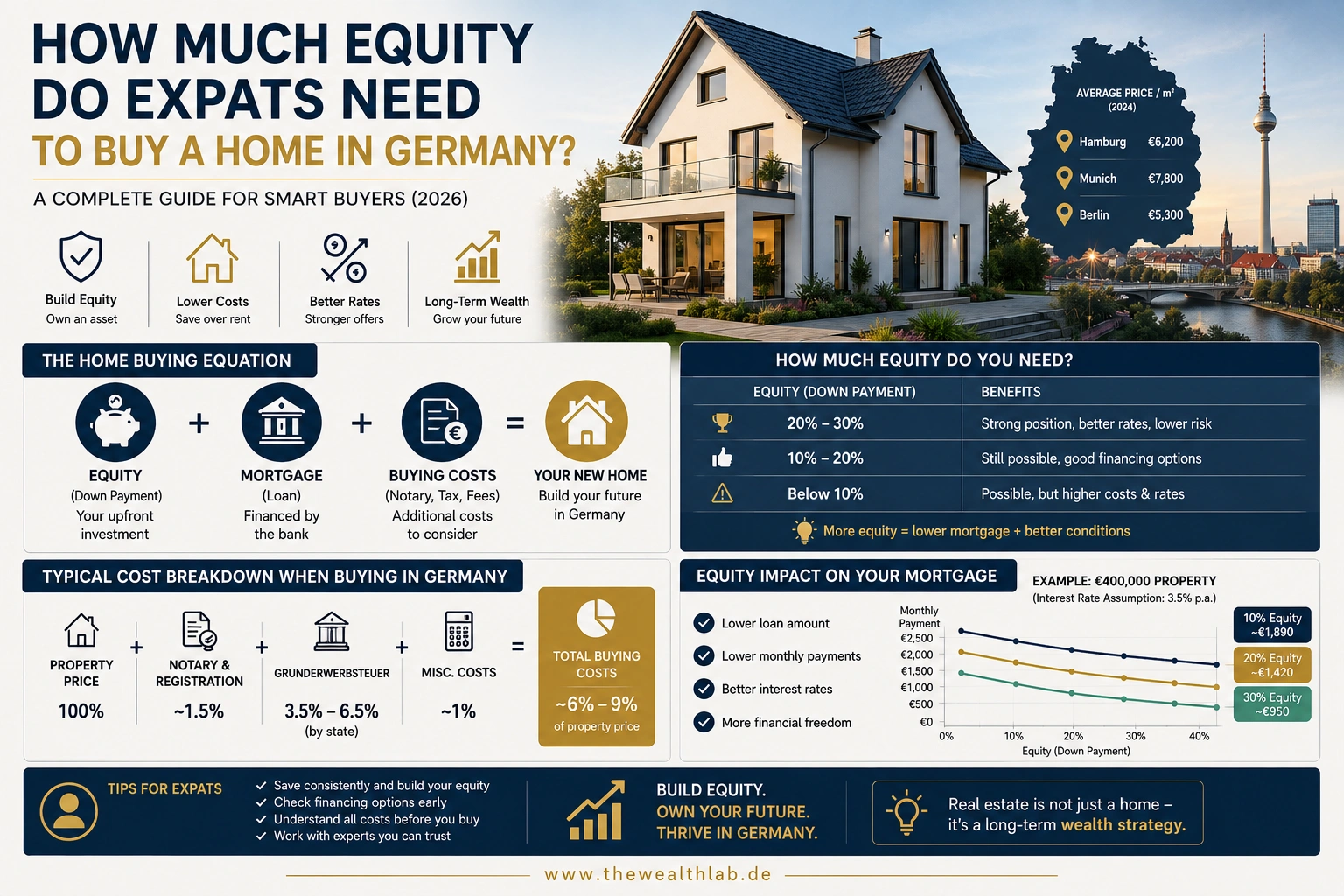
While requirements vary by lender and borrower profile, many buyers aim to cover purchase-related costs and contribute additional equity to improve financing conditions.
A stronger equity position can often lead to:
✅ Better mortgage terms
✅ Lower monthly payments
✅ Reduced financial risk
Hidden Costs Many Buyers Ignore
The purchase price is only part of the total cost.
Additional expenses may include:
• Property transfer tax
• Notary fees
• Land registry fees
• Real estate agent fees
• Renovation expenses
• Moving costs
⚠️ Many first-time buyers underestimate these costs and end up stretching their finances unnecessarily.
Buy or Rent?
Germany has one of the strongest rental markets in Europe.
For some expats, renting may actually be the more financially efficient choice.
Buying may make sense if:
✅ You plan to remain in Germany long term
✅ You value housing stability
✅ You have sufficient financial reserves
✅ The property supports your goals
Renting may make sense if:
✅ You expect career-related relocation
✅ Flexibility is important
✅ You prefer investing capital elsewhere
✅ You are still building financial reserves
💡 Home ownership should support your financial plan, not become your financial plan.
Common Property Buying Mistakes
Many buyers make avoidable mistakes such as:
• Buying too early
• Using all available savings
• Ignoring maintenance costs
• Underestimating interest-rate risk
• Buying emotionally
• Failing to maintain an emergency fund
Property can be a powerful wealth-building tool when approached strategically and within the context of a broader financial plan.
Common Financial Mistakes Expats Make in Germany
Even highly educated professionals can make costly financial mistakes when adapting to a new country.
The German financial system differs significantly from many other countries, making assumptions particularly dangerous.
Waiting Too Long to Start Investing
Many expats postpone investing because they believe they need:
• More money
• More knowledge
• Better market conditions
• More certainty
Unfortunately, waiting often means losing years of compound growth.
📈 The biggest investing mistake is often not investing at all.
Keeping Too Much Money in Cash
Emergency funds are essential.
However, keeping excessive amounts of money in low-yield accounts for many years can reduce purchasing power due to inflation.
A healthy financial plan balances security and growth.
Ignoring Retirement Planning
Retirement feels distant for many younger professionals.
Yet every year of delay reduces the amount of time available for compound growth.
The earlier retirement planning begins, the greater the flexibility later in life.
Choosing Insurance Based Only on Price
Many expats compare insurance policies solely based on monthly premiums.
However, coverage quality, exclusions, flexibility, and long-term suitability often matter far more than small differences in cost.
Making Emotional Financial Decisions
Fear and greed frequently drive poor financial decisions.
Successful investors focus on strategy rather than headlines.
⚠️ Emotional decisions often create expensive outcomes.
Trying to Do Everything Alone
The German financial system can be complex.
Taxes, pensions, insurance, and investing frequently interact in ways that are not immediately obvious.
Seeking qualified guidance when necessary can help avoid costly mistakes and improve long-term outcomes.
The Ultimate Expat Wealth Checklist
Use the following checklist to evaluate your current financial position.
Financial Foundation
✅ I maintain an emergency fund.
✅ I understand my monthly cash flow.
✅ I know my savings rate.
✅ I regularly review my financial goals.
Protection
✅ I have appropriate health insurance.
✅ I have personal liability insurance.
✅ I understand my income protection needs.
✅ My insurance strategy supports my goals.
Wealth Building
✅ I invest consistently.
✅ I understand my investment strategy.
✅ My portfolio is diversified.
✅ I avoid emotional investment decisions.
Retirement Planning
✅ I understand my pension situation.
✅ I have estimated my pension gap.
✅ I am building retirement assets outside the state pension system.
Tax Planning
✅ I understand my tax situation.
✅ I consider tax implications before major decisions.
✅ I maintain financial documentation.
Financial Clarity
✅ I know my net worth.
✅ I know my long-term financial goals.
✅ I have a written financial plan.
📌 The more boxes you can confidently check, the stronger your financial foundation is likely to be.
Financial Planning for Different Types of Expats
Not all expats face the same financial challenges.
Your financial strategy should reflect your stage of life, career, family situation, and future plans.
Students
Students benefit most from:
• Building strong financial habits
• Understanding the German financial system
• Avoiding unnecessary debt
• Learning the basics of investing
• Starting early, even with small amounts
Young Professionals
Young professionals often focus on:
• Increasing income
• Building emergency savings
• Establishing investment habits
• Protecting future earning potential
• Long-term wealth accumulation
Families
Families frequently prioritize:
• Financial protection
• Education planning
• Retirement security
• Family financial stability
• Long-term wealth building
Entrepreneurs and Self-Employed Expats
Business owners often face additional considerations including:
• Variable income
• Business-related risks
• Tax complexity
• Cash flow management
• Private retirement planning
High-Income Professionals
Higher earners often focus on:
• Tax efficiency
• Wealth preservation
• Advanced investment planning
• Retirement optimization
• Legacy planning
💡 The best financial strategy is not the most complex one. It is the one that aligns with your goals and can be followed consistently over time.
The Wealth Formula™: A Simple Framework for Building Wealth in Germany
After exploring investing, retirement planning, insurance, tax efficiency, property ownership, and wealth-building strategies, a clear pattern begins to emerge.
Financial success is rarely the result of a single investment, product, or financial decision.
Instead, long-term wealth is built through a series of interconnected financial pillars that work together over time.
At The Wealth Lab, we refer to this approach as The Wealth Formula™.
The Wealth Formula™ is designed to help expats build wealth systematically by focusing on six key stages:
- Foundation – Build a strong financial base and understand your cash flow.
- Protection – Protect your income, health, and financial future from major risks.
- Investing – Put your money to work through a disciplined long-term investment strategy.
- Property – Evaluate whether home ownership supports your financial goals.
- Retirement – Build assets that help close your future pension gap.
- Financial Freedom – Create a life where work becomes a choice rather than a necessity.
Each stage supports the next.
Without a strong foundation, investing becomes difficult.
Without protection, wealth can be vulnerable.
Without retirement planning, long-term financial security may be at risk.
And without a clear strategy, financial decisions often become reactive rather than intentional.
The goal is not perfection.
The goal is progress.
Small improvements across each pillar, repeated consistently over time, can create extraordinary financial outcomes.
Final Thoughts
Financial planning for expats in Germany is not about finding shortcuts or predicting the future.
It is about creating a structured system that helps you make better financial decisions year after year.
Successful wealth building typically follows a simple pattern:
Protect what you have.
Optimize what you earn.
Invest consistently.
Plan for retirement.
Review your strategy regularly.
📈 Small improvements repeated consistently often create extraordinary results over time.
Germany offers tremendous opportunities for individuals who take a long-term approach to financial planning.
The sooner you begin building a clear financial strategy, the more flexibility, confidence, and financial freedom you may have in the future.
Ready to Take the Next Step?
If you would like a professional review of your current financial situation, investment strategy, retirement planning, or insurance setup, consider scheduling a personalized consultation.
A structured financial plan can help you avoid costly mistakes, identify opportunities, and create a roadmap tailored to your goals as an expat living in Germany.
Book Your Free Consultation and Start Building Your Wealth Formula™ Today.
Frequently Asked Questions About Financial Planning for Expats in Germany
What is the best financial planning strategy for expats in Germany?
The best financial planning strategy for expats in Germany depends on individual circumstances, goals, income, and future plans. However, most successful financial plans include a strong emergency fund, appropriate insurance coverage, consistent investing, retirement planning, and tax optimization. Financial planning for expats in Germany should focus on both protecting current income and building long-term wealth.
Why is financial planning for expats in Germany different from financial planning in other countries?
Germany has a unique combination of taxes, social security contributions, statutory pensions, health insurance requirements, and investment regulations. Many strategies that work in other countries may not be optimal in Germany. Understanding how these systems interact is essential for effective expat financial planning Germany.
How much money should I save each month while living in Germany?
There is no universal percentage that works for everyone. However, many financial professionals suggest saving and investing between 15% and 30% of net income whenever possible. The ideal amount depends on your goals, lifestyle, income, and retirement planning objectives.
Is investing in Germany for expats a good idea?
For many expats, investing in Germany for expats can be an effective way to build long-term wealth. Germany provides access to global financial markets, regulated investment products, and strong investor protections. The most appropriate investment strategy depends on individual goals, risk tolerance, and investment horizon.
What are ETFs and why are they popular among expats?
Exchange Traded Funds (ETFs) allow investors to gain exposure to a large number of companies through a single investment. Many expats use globally diversified ETFs because they provide simplicity, diversification, and long-term growth potential while reducing dependence on individual companies.
How early should I start retirement planning in Germany?
The earlier, the better. Retirement planning Germany benefits significantly from compound growth. Starting early often allows individuals to invest smaller amounts over longer periods rather than needing much larger contributions later in life.
Will the German pension system be enough for retirement?
The German pension system provides an important foundation for retirement income. However, many individuals choose to supplement it through private investments and additional retirement planning because the state pension may not fully replace pre-retirement income.
What is the pension gap?
The pension gap refers to the difference between the income you expect to receive during retirement and the income you would like to have in order to maintain your desired lifestyle. Understanding the pension gap is one of the most important aspects of retirement planning Germany.
What insurance is most important for expats in Germany?
The most important insurance needs depend on individual circumstances. However, many financial professionals consider health insurance, personal liability insurance, and income protection among the most important forms of insurance for expats in Germany.
Should I choose public health insurance or private health insurance?
The answer depends on factors such as income, age, family situation, career plans, and long-term goals. Both systems have advantages and disadvantages, and the most suitable option varies from person to person.
Can expats buy property in Germany?
Yes. In most cases, foreign nationals can purchase residential and commercial real estate in Germany. Financing requirements, however, may vary depending on residency status, income, employment situation, and available equity.
How much equity do I need to buy a property in Germany?
The required equity depends on the lender, the property, and your personal financial situation. Many buyers aim to cover transaction costs and contribute additional equity to improve financing conditions and reduce risk.
Is renting or buying better in Germany?
Neither option is universally better. Renting offers flexibility, while buying may provide long-term stability and potential wealth-building opportunities. The right decision depends on your personal goals and expected length of stay in Germany.
How does SCHUFA affect expats in Germany?
SCHUFA is Germany’s primary credit reporting system. It may influence apartment applications, financing approvals, mobile phone contracts, and other financial arrangements. Maintaining a positive credit profile can make many aspects of life in Germany easier.
Do I need to file a tax return in Germany?
Depending on your circumstances, filing a tax return may be beneficial and sometimes required. A tax return can potentially account for deductible expenses and help optimize your overall financial situation.
How are investments taxed in Germany?
Investment taxation depends on the type of investment, applicable regulations, and individual circumstances. Taxes may apply to dividends, interest income, and capital gains. Because regulations can change, investors should always review current rules.
What happens to my German pension if I leave Germany?
The answer depends on factors such as your nationality, contribution history, destination country, and applicable international agreements. Pension rights may remain partially or fully preserved depending on the specific situation.
Can I invest while still paying off debt?
The answer depends on the type of debt and its interest rate. High-interest debt is often prioritized before aggressive investing. A balanced financial strategy should consider both debt management and long-term wealth building.
How much emergency savings should I have in Germany?
Many financial professionals recommend maintaining an emergency fund equal to three to six months of essential living expenses. The appropriate amount depends on employment stability, family responsibilities, and overall financial circumstances.
What are the biggest financial mistakes expats make in Germany?
Common mistakes include delaying investing, ignoring retirement planning, choosing insurance based only on price, keeping excessive amounts of cash, failing to understand taxes, and making emotional financial decisions.
How can expats build wealth in Germany?
Wealth building in Germany typically involves a combination of disciplined saving, tax-efficient planning, risk management, long-term investing, and retirement preparation. Consistency over time is often more important than short-term market predictions.
Do I need a financial advisor in Germany?
Not everyone requires ongoing financial advice. However, many expats find value in professional guidance when dealing with complex topics such as retirement planning, insurance decisions, investment strategy, tax planning, and cross-border financial situations.
What is the most important factor in long-term financial success?
While many factors contribute to financial success, consistency is often one of the most important. Individuals who save regularly, invest consistently, manage risk appropriately, and follow a structured financial plan are generally better positioned to build long-term wealth.
How often should I review my financial plan?
Most people benefit from reviewing their financial plan at least once per year or whenever significant life changes occur, such as marriage, relocation, career changes, property purchases, or major family events.
What is The Wealth Formula™?
The Wealth Formula™ is a structured approach to financial planning that focuses on building a strong financial foundation, protecting against major risks, growing wealth through long-term investing, optimizing financial decisions, and preparing for long-term financial independence. The goal is to help expats make confident financial decisions while living and working in Germany.
Ready to Build Your Financial Future in Germany?
Whether you’re just getting started or looking to optimize your current financial strategy, having a structured plan can help you make more confident decisions.
📍 Get a personalized review of your financial situation, investment strategy, retirement planning, and insurance setup.
Disclaimer
The information provided in this article is for educational and informational purposes only and should not be considered financial, investment, tax, legal, or insurance advice. Individual circumstances vary, and financial decisions should always be based on your personal situation and objectives. Before making any financial, tax, investment, or insurance decisions, consider consulting a qualified professional.
About the Author
Sara Rahimi is a Financial Consultant based in Germany who specializes in helping expats navigate the German financial system. Through The Wealth Lab, she provides guidance on financial planning, investing, retirement planning, insurance, and long-term wealth building for international professionals and families living in Germany.
Leave a Comment
Have a question or experience to share? Drop a comment below.
Leave a Comment