
Emergency Fund Germany:
How Much Cash Should Expats Keep Before Investing?
Table of Contents
Why Expats Need a Different Emergency Fund Strategy in Germany
An Emergency Fund Germany strategy is not the same as a general savings plan in your home country.
Germany has strong social protection systems, but expats cannot always rely on them immediately. Your access to unemployment benefits, healthcare support, and other safety nets depends on your employment history, contract type, insurance status, and residency situation.
For this reason, an Emergency Fund Germany plan should be built around your actual risk profile, not a generic rule like “save three months of expenses.”
For many expats, the real question is not only:
“How much cash should I keep?”
The better question is:
“How long could I stay financially stable in Germany if my income stopped tomorrow?”
That answer depends on several factors:
• Your monthly essential expenses
• Your employment contract
• Your eligibility for unemployment benefits
• Your health insurance system
• Your family situation
• Your residence permit status
• Whether you are employed, self-employed, or freelancing
📌 An emergency fund is not an investment. It is financial protection.
Before investing in ETFs, stocks, pension plans, or property, expats should first build a cash reserve that allows them to handle financial stress without panic-selling investments or taking on expensive debt.
This is why Emergency Fund Germany for Expats should be one of the first steps in any serious financial planning process.
What Is an Emergency Fund and Why Does It Matter?
An emergency fund is a reserve of liquid cash that you can access quickly when something unexpected happens.
It is designed to cover essential expenses if your income drops, stops, or becomes unstable.
Your emergency fund should usually cover costs such as:
• Rent
• Food
• Health insurance
• Utilities
• Transport
• Debt payments
• Essential family expenses
• Basic medical or relocation costs
The key word is essential.
Your emergency fund is not meant to finance holidays, lifestyle upgrades, shopping, or speculative investments. It exists to protect your financial stability when life becomes unpredictable.
In Germany, an emergency fund is especially important because several systems can create delays or gaps.
For example, you may not immediately qualify for unemployment benefits. You may still need to pay health insurance contributions. Your residence permit may be connected to your job. Your family may depend on your income. Or your contract may end before you have found a new position.
⚠️ For expats, an emergency is rarely only financial. It can also affect your visa, housing, insurance, and long-term plans in Germany.
This is why an Emergency Fund for Expats in Germany should be larger and more carefully planned than a standard savings buffer.
Emergency Fund Germany: How Much Cash Should Expats Keep?
There is no single correct number for every person.
A student, a permanent employee, a freelancer, and a family with children do not need the same emergency fund.
However, a practical starting point is:
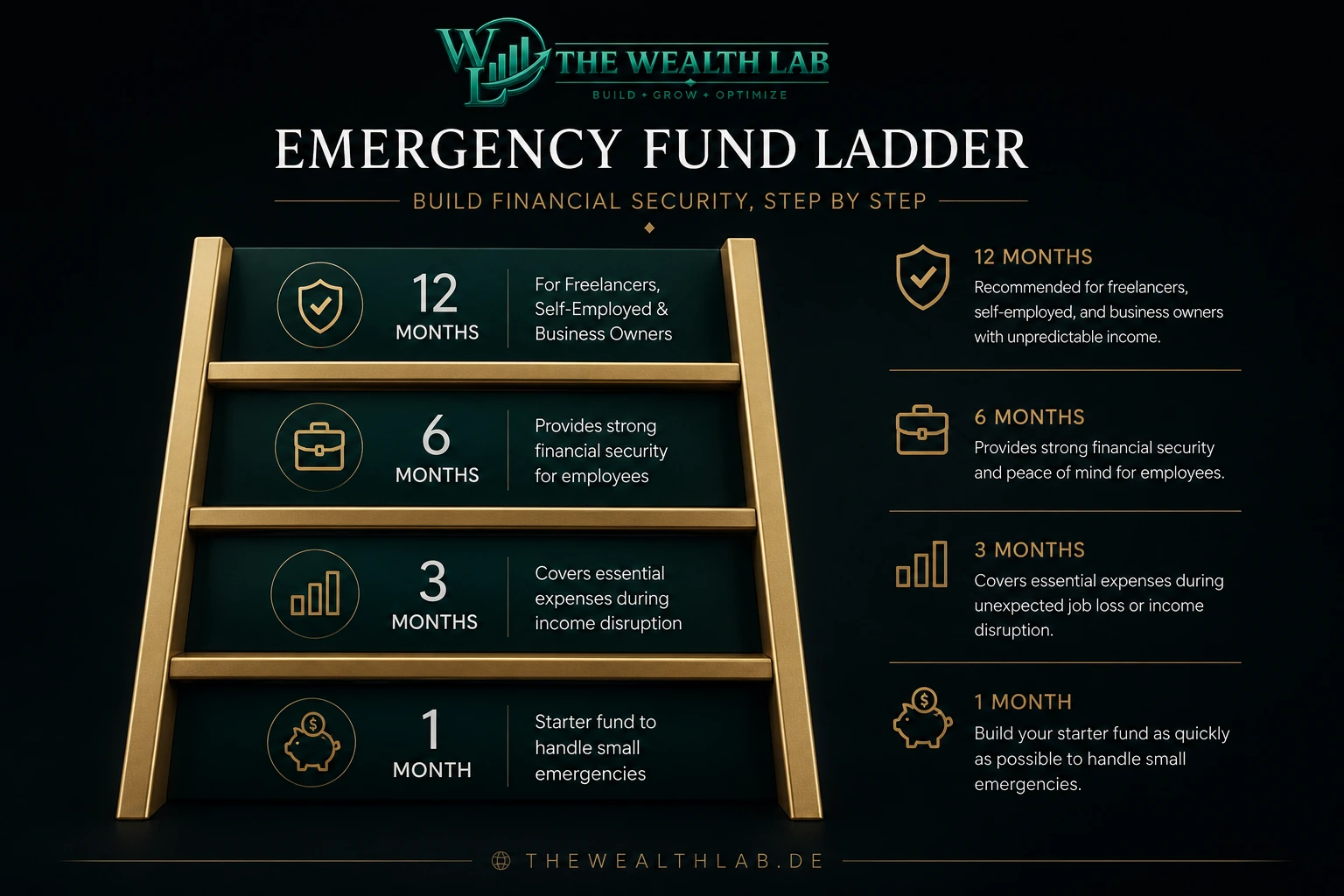
• Permanent employees: 3 to 6 months of essential expenses
• Fixed-term contract holders: around 6 months of essential expenses
• Recently arrived expats: at least 6 months of essential expenses
• Self-employed professionals and freelancers: 9 to 12 months of essential expenses
• Families with children: usually 4 to 6 months or more, depending on income stability
This is where How Much Emergency Fund Germany becomes a personal calculation rather than a fixed rule.
A single expat with a permanent job, low rent, and no dependents may need less cash than a freelancer with private health insurance and irregular income.
A family with children may need a larger buffer because expenses are higher and financial stress affects more than one person.
A recently arrived expat may need a larger emergency fund because they may not yet qualify for German unemployment benefits.
💡 The more uncertain your income, contract, visa, or insurance situation is, the larger your emergency fund should be.
As a general rule, your Emergency Savings Germany target should be based on essential monthly expenses, not your gross salary.
For example, if your essential monthly expenses are €2,500, then:
• 3 months = €7,500
• 6 months = €15,000
• 9 months = €22,500
• 12 months = €30,000
This does not mean every expat needs €30,000 in cash.
It means your emergency fund should match your risk level.
Not sure how much emergency savings you personally need in Germany? Every expat’s situation is different. A free financial review can help you calculate the right emergency fund target based on your income, visa status, family situation, and long-term goals.
Book Your Free Consultation
The Legal Reality Behind Emergency Planning in Germany
One reason an Emergency Fund Germany strategy matters is that German social protection is not automatic for everyone from day one.
Several legal rules can affect your financial safety net.
For employees, unemployment benefits are usually linked to prior contributions to the unemployment insurance system. In many cases, eligibility for Arbeitslosengeld I depends on whether you have been insured for a required period under German rules.
For employment termination, notice periods are regulated by German employment law. Under §622 BGB, statutory notice periods can vary depending on the length of employment.
For unemployment benefit amounts, §149 SGB III is relevant because Arbeitslosengeld I is generally calculated as a percentage of previous net income.
For self-employed individuals, health insurance contributions can remain a major fixed cost even when income falls. This is especially important under the general framework of §240 SGB V for voluntary statutory health insurance contributions.
📌 Official legal references used in this guide include §149 SGB III, §142 SGB III, §622 BGB, §240 SGB V, and §20 SGB II.
These references matter because emergency planning should not be based on vague advice.
It should reflect how the German system actually works.
Understanding the ALG I Income Gap
Arbeitslosengeld I, often called ALG I, is Germany’s unemployment benefit for eligible employees.
However, many expats misunderstand how much protection ALG I actually provides.
ALG I does not normally replace your full salary.
Under §149 SGB III, unemployment benefits are generally based on a percentage of previous net income:
• around 60% of previous net income for people without children
• around 67% of previous net income for people with children
This means there can be a significant gap between your usual monthly income and your unemployment benefit.
That gap must be covered somehow.
For many expats, the emergency fund is what fills this gap.
For example, if your normal net income is €3,500 per month and your unemployment benefit is significantly lower, your rent, insurance, food, and fixed costs may still remain close to the same level.
⚠️ ALG I may reduce the financial shock of unemployment, but it does not remove the need for an emergency fund.
This is especially important for higher earners, families, and people with large fixed expenses.
New Arrivals and the 12-Month Eligibility Problem
Recently arrived expats should be especially careful.
In many cases, entitlement to ALG I depends on whether you have paid into the German unemployment insurance system for a sufficient period.
Under §142 SGB III, unemployment benefit eligibility is linked to a qualifying insurance period.
This means that if you recently moved to Germany and lose your job before completing the required contribution period, you may not receive ALG I at all.
For a new arrival, this can create a serious financial risk.
You may still have:
• Rent
• Health insurance
• Transport costs
• Residence permit obligations
• Family expenses
• Moving-related costs
• Debt or financial responsibilities abroad
But you may not yet have access to the same safety net as someone who has worked in Germany for several years.
This is why a recently arrived expat should usually build a larger Emergency Fund Germany buffer before investing aggressively.
📌 If you have been in Germany for less than one year, your emergency fund is not optional. It is your first line of financial defence.
German Notice Periods and Why They Matter
Another factor expats often underestimate is the notice period.
Under §622 BGB, statutory notice periods in Germany depend on the employment relationship and length of service.
For many employees, the notice period may provide some time before income fully stops. However, newer employees may have shorter protection than they expect.
This matters because many expats assume they will have enough time to react if something goes wrong.
In reality, losing a job can create several pressures at the same time:
• You need to find a new job.
• You may need to update your residence permit situation.
• You still need to pay rent and insurance.
• You may need to support family members.
• You may need to avoid forced investment withdrawals.
A strong Emergency Fund Germany for Expats gives you time.
Time to apply for new roles.
Time to understand your rights.
Time to avoid emotional decisions.
Time to protect your long-term investment plan.
💡 The purpose of an emergency fund is not only to pay bills. It is to buy time, clarity, and options.
Emergency Funds for Freelancers and the Self-Employed
For self-employed professionals, freelancers, consultants, and business owners, an Emergency Fund Germany strategy becomes even more important.
Unlike employees, most self-employed individuals do not automatically benefit from the same unemployment protection systems. Income can fluctuate significantly from month to month, client contracts can end unexpectedly, and business expenses continue even during slow periods.
This creates a very different risk profile.
While a permanent employee may be comfortable with a 3-to-6-month emergency fund, a self-employed expat should often target 9 to 12 months of essential expenses.
Why?
Because business income can disappear much faster than employment income.
A freelancer may lose several major clients at the same time.
A consultant may experience long sales cycles before replacing lost revenue.
A business owner may face unexpected tax payments, legal expenses, or operational costs.
In addition, health insurance contributions remain a fixed obligation regardless of income levels.
Under the framework of §240 SGB V, voluntary statutory health insurance contributions can continue even during periods of low income.
For many self-employed expats, monthly obligations include:
• Rent or mortgage payments
• Health insurance contributions
• Professional insurance
• Business software and subscriptions
• Tax reserves
• Utilities and household expenses
• Family costs
• Transportation
As a result, a self-employed expat may require significantly more cash reserves than an employee.
📌 Income uncertainty should always be matched by a larger emergency fund.
The more unpredictable your earnings are, the larger your cash reserve should be before aggressively investing.
Can You Rely on Bürgergeld?
Some expats assume that Germany’s social safety net eliminates the need for emergency savings.
This is a dangerous assumption.
Bürgergeld exists to provide basic support for people who meet specific eligibility requirements, but it should never replace a personal financial safety net.
Under §20 SGB II, the standard benefit amount is intended to cover basic living needs rather than maintain your existing lifestyle.
There are several reasons why relying on Bürgergeld is risky:
• Eligibility rules apply.
• Asset tests may apply.
• Processing can take time.
• Your actual expenses may be much higher than the benefit amount.
• It may not align with your long-term financial goals.
For example, many expats living in major cities such as Munich, Frankfurt, Hamburg, or Berlin face housing costs that significantly exceed basic support levels.
A person accustomed to earning a professional salary may quickly discover that government support covers only a fraction of their previous lifestyle.
This is why an Emergency Fund Germany plan should be viewed as financial independence rather than government dependence.
💡 The goal is not to qualify for assistance. The goal is to avoid needing it.
A properly funded emergency reserve allows you to handle setbacks without disrupting your long-term wealth-building strategy.
Where Should You Keep Your Emergency Fund?
One of the most common mistakes expats make is storing their emergency fund in the wrong place.
An emergency fund should prioritize:
• Liquidity
• Stability
• Accessibility
• Capital preservation
It should not prioritize maximum return.
Your emergency fund exists to protect you during a crisis, not to generate investment performance.
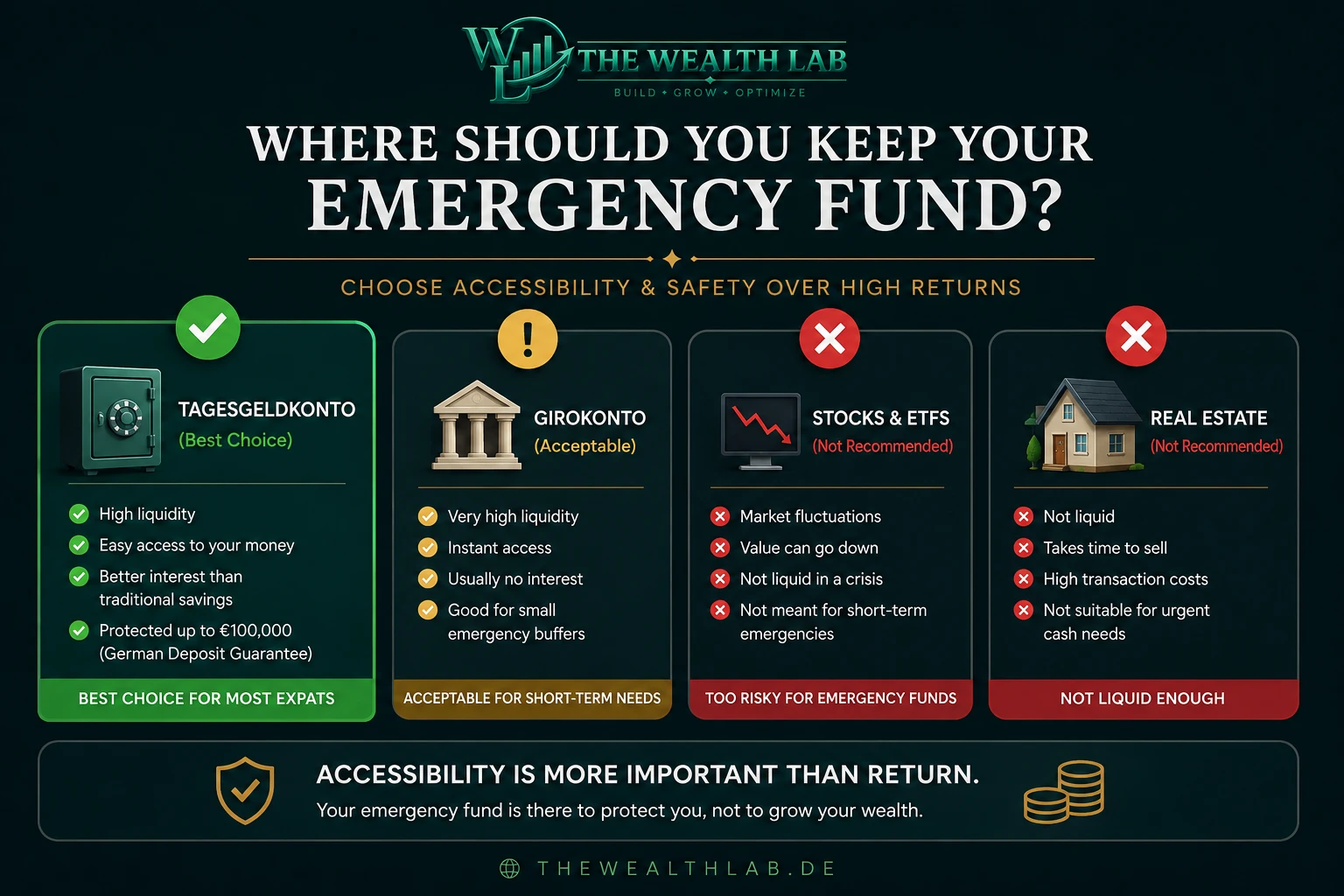
For most expats, a Tagesgeldkonto Germany solution is the most practical choice.
A Tagesgeldkonto offers:
• Fast access to cash
• Daily availability
• No lock-up period
• Interest payments
• Deposit protection within applicable regulations
By contrast, investments such as ETFs, individual stocks, cryptocurrencies, or speculative assets may experience significant volatility exactly when you need the money most.
Imagine losing your job during a market downturn.
If your emergency savings are invested, you may be forced to sell assets at a loss simply to pay rent and insurance premiums.
That is precisely what an emergency fund is designed to prevent.
📌 Emergency money should stay boring.
Investments are for growth.
Emergency funds are for protection.
The two should not be mixed.
Should You Build an Emergency Fund Before Investing?
This is one of the most common questions in Financial Planning for Expats in Germany.
Many people want to start investing immediately because they are worried about missing market growth.
While that concern is understandable, investing before building a basic financial foundation can create unnecessary risk.
A practical framework is:
Step 1: Build a Starter Emergency Fund
Aim for approximately one month of essential expenses as quickly as possible.
This creates immediate protection against unexpected costs.
Step 2: Eliminate High-Interest Consumer Debt
Credit card balances and expensive consumer loans often create a guaranteed negative return.
Reducing these obligations can significantly improve your financial position.
Step 3: Secure Essential Insurance Protection
Before focusing on wealth building, ensure your major financial risks are covered.
For many expats, this includes:
• Health insurance
• Personal liability insurance
• Disability protection where appropriate
Step 4: Build Your Full Emergency Fund
Increase your reserve until it reaches your target level based on your employment situation and risk profile.
Step 5: Begin Long-Term Investing
Once your foundation is secure, you can focus on long-term wealth creation through diversified investments.
This sequence may feel slower initially, but it often leads to better outcomes because it reduces the likelihood of emotional investment decisions during financial stress.
⚠️ Investing without adequate emergency savings can force you to sell investments during the worst possible market conditions.
A strong emergency fund allows your investments to remain invested.
That is one of the most overlooked advantages of building cash reserves first.
Special Emergency Fund Considerations for Expats
Expats face several unique challenges that do not affect most local residents.
Residence Permit Dependency
Many expats hold residence permits connected to employment.
If employment ends unexpectedly, immigration considerations may become part of the financial challenge.
A larger emergency fund provides additional time to secure new employment and evaluate available options.
Currency Risk
Some expats maintain savings in foreign currencies.
However, expenses in Germany are paid in euros.
If exchange rates move unfavourably, foreign-currency savings may lose purchasing power when converted into euros.
For this reason, emergency savings intended for use in Germany should generally be held in euros.
Family Planning
Income changes during parental leave can significantly affect household finances.
Families planning for children should review their emergency fund before any anticipated reduction in income.
International Obligations
Many expats continue supporting family members abroad or maintaining financial commitments in another country.
These obligations should be included when calculating emergency fund requirements.
📌 Your emergency fund should reflect your real life, not a generic financial rule.
The more complex your situation becomes, the more important personalized planning becomes.
Common Emergency Fund Mistakes Expats Make
Even people who understand the importance of an Emergency Fund Germany strategy often make costly mistakes.
Avoiding these errors can dramatically improve your financial resilience.
Keeping Too Little Cash
Some expats keep only a few hundred euros available and assume that is enough.
Unfortunately, unexpected expenses rarely arrive one at a time.
A job loss, relocation expense, medical issue, or family emergency can quickly create costs far beyond a small cash reserve.
Keeping Too Much Cash
The opposite mistake is also common.
Holding excessive amounts of money in a current account for many years may reduce long-term wealth-building potential.
Once your Emergency Savings Germany target has been reached, additional money can often be directed toward long-term financial goals.
Investing Emergency Savings
An emergency fund is not an investment portfolio.
Money that may be needed tomorrow should not be exposed to significant market volatility.
Stocks, ETFs, cryptocurrencies, and speculative assets can all decline precisely when access to cash is most important.
Ignoring Inflation
While safety remains the primary objective, it is still worth using a competitive Tagesgeldkonto Germany account rather than leaving large amounts of cash in a non-interest-bearing account.
Never Reviewing the Fund
An emergency fund should evolve as your life changes.
A reserve that was sufficient when you were single may no longer be adequate after marriage, parenthood, or starting a business.
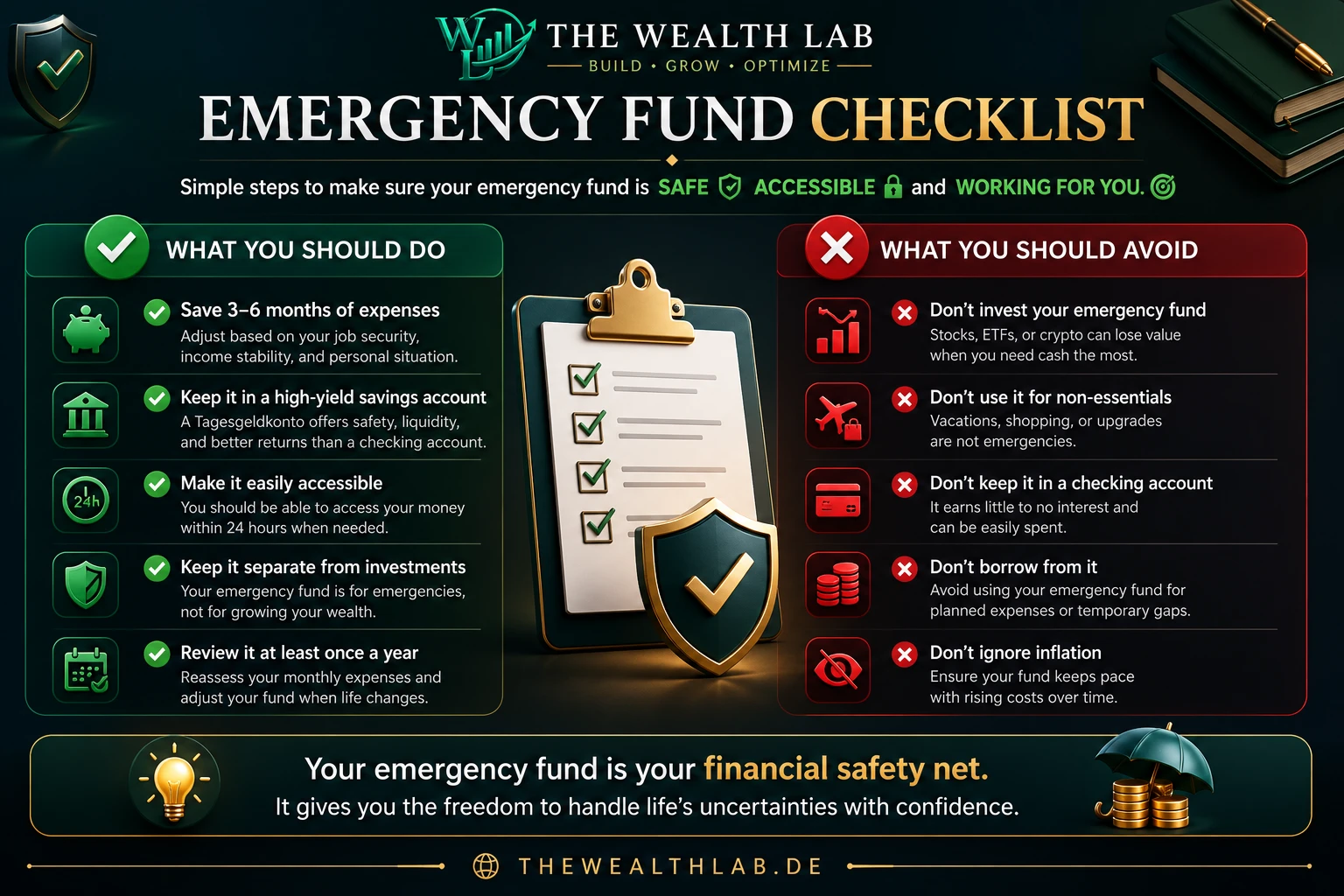
📌 Review your emergency fund at least once per year or whenever major life changes occur.
The Wealth Formula™: The Foundation Before Growth
At The Wealth Lab, we often explain financial planning using a simple framework called The Wealth Formula™.
Many people focus immediately on investing.
However, successful wealth building usually follows a specific sequence.
Financial Foundation
Before pursuing growth, you need stability.
This includes:
• A properly funded Emergency Fund Germany strategy
• Positive monthly cash flow
• Healthy savings habits
• Low consumer debt
Protection
The next step is protecting what you have built.
This typically includes:
• Health insurance
• Personal liability insurance
• Income protection strategies
• Family protection planning
Wealth Building
Only after the foundation and protection layers are established should long-term investing become the primary focus.
This may include:
• ETF investing
• Pension planning
• Property investing
• Diversified portfolio construction
Financial Freedom
The final objective is not simply accumulating assets.
The goal is creating enough financial security and flexibility to make life decisions on your own terms.
💡 An emergency fund is not separate from wealth building—it is the first step of wealth building.
Without a strong foundation, every other financial strategy becomes more vulnerable.
Ready to Build Your Financial Foundation in Germany?
Whether you’re a student, employee, freelancer, or business owner, having the right financial structure can help you avoid costly mistakes and build long-term wealth with confidence.
✔ Emergency Fund Planning
✔ Investment Strategy
✔ Retirement Planning
✔ Insurance Optimization
✔ Financial Planning for Expats
Final Thoughts
Building an Emergency Fund Germany plan may not feel exciting.
It does not generate headlines.
It does not promise quick returns.
However, it remains one of the most important decisions in Financial Planning for Expats in Germany.
A properly funded emergency reserve provides:
✔ Financial stability
✔ Reduced stress
✔ Greater flexibility
✔ Protection during unexpected events
✔ Confidence to invest for the long term
Before focusing on market returns, portfolio performance, or investment opportunities, ensure your financial foundation is secure.
Because the first step toward building wealth is making sure a temporary setback never becomes a financial disaster.
FAQ: Frequently Asked Questions About Emergency Funds in Germany
How much emergency savings should I have in Germany?
Most employees should aim for 3 to 6 months of essential expenses. Self-employed individuals and freelancers often benefit from maintaining 9 to 12 months of expenses in an emergency fund.
Where should I keep my emergency fund in Germany?
For most expats, a Tagesgeldkonto Germany account offers the best combination of accessibility, stability, and interest while keeping funds readily available.
Should I invest before building an emergency fund?
In most cases, building at least a basic Emergency Fund Germany reserve before investing helps reduce financial risk and prevents the need to sell investments during emergencies.
Is €10,000 enough for an emergency fund in Germany?
The answer depends on your monthly expenses, employment situation, and family circumstances. The correct amount should be based on your personal financial needs rather than a fixed number.
Can I use ETFs as an emergency fund?
No. ETFs are investment vehicles and may lose value during market downturns. Emergency savings should remain accessible and stable.
How often should I review my emergency fund?
At least once per year and after major life events such as marriage, relocation, having children, changing jobs, or starting a business.
Sources
- German Federal Ministry of Labour and Social Affairs (BMAS)
- German Social Code (SGB II)
- German Social Code (SGB V)
- Deutsche Bundesbank
- Federal Financial Supervisory Authority (BaFin)
Disclaimer: The information provided in this article is for educational and informational purposes only and does not constitute financial, tax, legal, or investment advice. Financial situations vary significantly between individuals, and decisions should always be based on your personal circumstances, goals, and risk tolerance. While every effort has been made to ensure accuracy, regulations, tax rules, and financial products in Germany may change over time. Before making financial decisions, consider consulting a qualified professional. Sara Rahimi is an independent financial consultant in Germany and not a tax advisor (Steuerberater) or attorney.
About the Author
Sara Rahimi is an independent financial consultant in Germany specializing in Financial Planning for Expats in Germany.
She helps international professionals, families, and entrepreneurs navigate the German financial system, including insurance, retirement planning, wealth building, and long-term financial strategies.
Through The Wealth Lab, her mission is to make complex financial topics understandable and actionable for expats building their future in Germany.
Leave a Comment
Have a question or experience to share? Drop a comment below.
Leave a Comment