
Health Insurance for Freelancers in Germany 2026:
GKV vs PKV, Costs and Common Traps
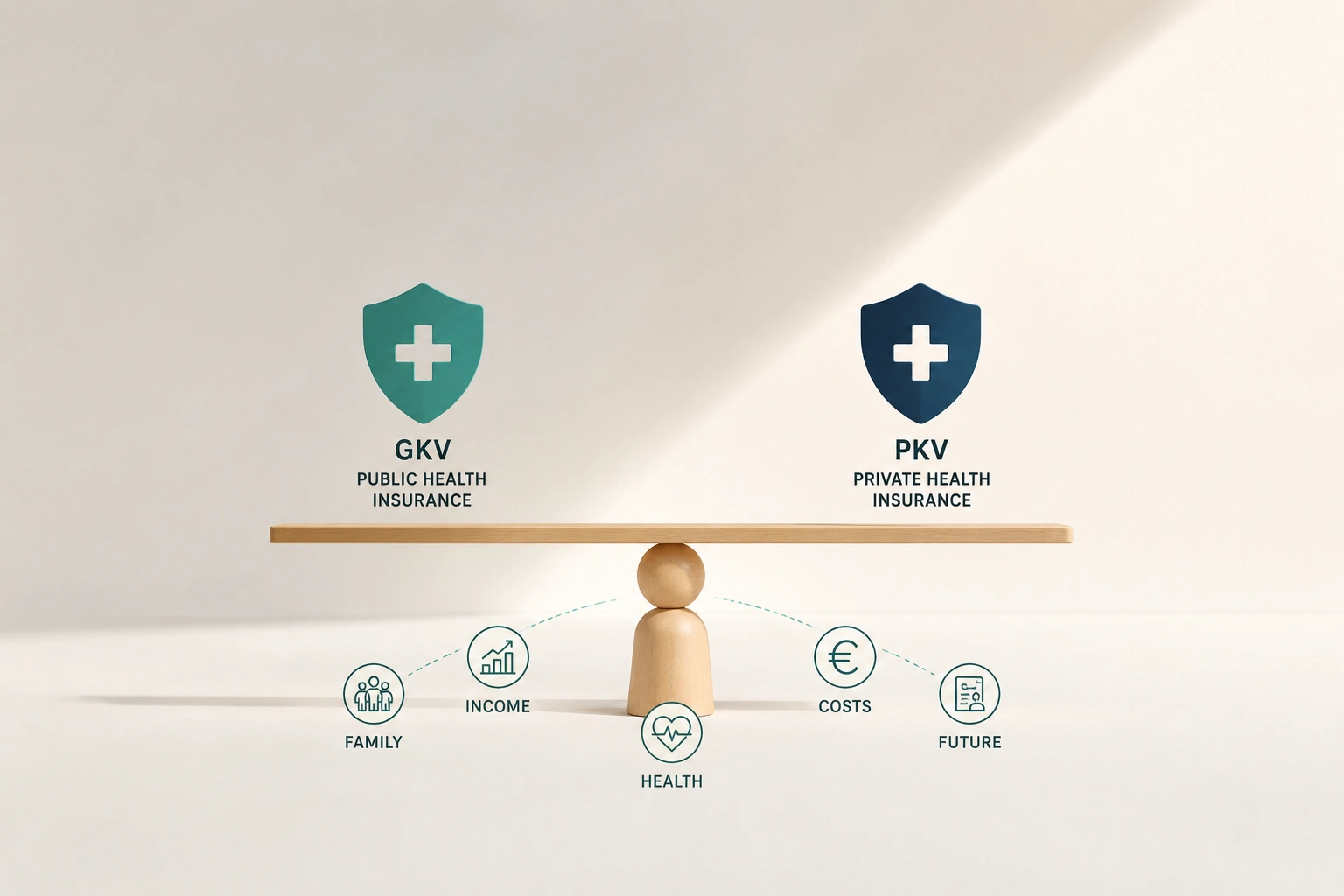
Table of Contents
Introduction: What Every Freelancer Should Know About Health Insurance in Germany
Choosing health insurance for freelancers in Germany is not simply an administrative task. It is a long-term financial decision that can affect your monthly cash flow, access to medical services, family costs, tax planning, and flexibility later in life.
Unlike employees, freelancers normally pay their health insurance contributions themselves. There is no employer automatically covering part of the premium. This means that a decision that initially appears inexpensive can become a significant financial burden if your income changes, you start a family, or you later want to move between the public and private systems.
Germany operates two main health insurance systems:
- Statutory health insurance, known as Gesetzliche Krankenversicherung or GKV
- Private health insurance, known as Private Krankenversicherung or PKV
Both systems can provide comprehensive healthcare, but they calculate contributions differently and follow different rules. In GKV, contributions are generally linked to income up to the applicable contribution ceiling. In PKV, premiums are primarily based on factors such as age at entry, health status, selected benefits, and deductible.
For this reason, the right health insurance for freelancers in Germany cannot be determined by comparing monthly premiums alone. A meaningful comparison should consider your current income, expected business development, age, medical history, family plans, desired benefits, and long-term residence plans.
This is especially important for international professionals. Many expats choose a policy quickly because they need proof of insurance for a visa, residence permit, registration, or client contract. However, short-term travel or incoming insurance may not provide the same protection as comprehensive German health insurance and may not be suitable as a permanent solution.
💡 Financial consultant’s perspective: The cheapest policy today is not automatically the most cost-effective option over the next ten or twenty years. A sustainable decision should remain affordable and appropriate when your personal and professional circumstances change.
This guide explains who needs coverage, how freelancers are classified, and which additional rules international professionals should consider before comparing GKV and PKV in detail.
Who Needs Health Insurance as a Freelancer in Germany?
Anyone who lives and works in Germany generally needs valid health insurance. This includes freelancers, sole traders, independent consultants, business owners, creative professionals, and people who combine self-employment with employment.
Therefore, health insurance for freelancers in Germany is relevant to a wide range of professionals, including:
- IT consultants, software developers, and designers
- Coaches, trainers, and business consultants
- Doctors, therapists, lawyers, architects, and engineers
- Writers, journalists, artists, and photographers
- Online entrepreneurs and content creators
- Owners of small commercial businesses
- Independent contractors working for German or international clients
Your insurance status depends not only on the title you use professionally, but also on how your activity is legally and economically structured. For example, a person may describe themselves as a freelancer in everyday English while being classified as a commercial self-employed person under German tax law.
From a health insurance perspective, both groups usually face the same central question: whether they are eligible to remain voluntarily insured in GKV or should enter PKV.
Your previous insurance history also matters. Someone who becomes self-employed after working as an employee in Germany may often continue their statutory membership voluntarily. A newcomer arriving from abroad may need a different route depending on their country of origin, prior coverage, residence status, and employment history.
Certain professional groups follow special rules. Self-employed artists and publicists may qualify for coverage through the Künstlersozialkasse under the Artists’ Social Insurance Act. If accepted, they generally receive support toward statutory health, nursing-care, and pension insurance contributions in a way that resembles the employer contribution available to employees.
Other freelancers may have both employed and self-employed income. In these situations, the health insurance provider assesses which activity is considered the main occupation. Factors can include working hours, income, business organisation, and whether employees are involved. This assessment can determine whether insurance continues through employment or whether the individual must arrange coverage primarily as a self-employed person.
Because the classification affects contributions and eligibility, it is important to provide accurate information to the insurer. Incorrectly describing a full-time business as a minor side activity can lead to retroactive contribution adjustments.
Is Health Insurance Mandatory for Freelancers?
Yes. Health insurance for freelancers in Germany is mandatory, just as it is for employees, students, pensioners, and other residents. Germany requires people with a German residence to maintain health insurance coverage. The obligation is designed to ensure access to medical care and prevent individuals from remaining uninsured until treatment becomes necessary.
However, mandatory health insurance does not always mean mandatory membership in GKV. Most full-time self-employed people are not automatically compulsory members of statutory health insurance. Depending on eligibility and previous insurance history, they may choose between:
- Voluntary membership in GKV
- Comprehensive private health insurance through PKV
This distinction is important. Freelancers are required to have valid coverage, but many are allowed to select the system that best matches their circumstances.
A common mistake is assuming that no income means no contribution. Voluntarily insured GKV members may still be assessed on a statutory minimum contribution basis, even when their actual business income is low. The rules for voluntary members require contributions to be assessed according to the framework established by the National Association of Statutory Health Insurance Funds.
Another costly mistake is simply stopping payments when a business struggles. Failure to pay does not automatically end membership. Instead, unpaid contributions can accumulate as debt. Freelancers experiencing financial difficulties should contact their insurer early, provide updated income evidence, and discuss the available adjustment or payment options.
Valid coverage should normally include both health insurance and mandatory long-term nursing-care insurance. In Germany, nursing-care insurance is connected to the health insurance system and should be included when comparing the full monthly cost.
Freelancers should also examine income protection during illness. Standard voluntary GKV membership does not necessarily provide self-employed people with the same sickness benefit arrangements as employees. Depending on the selected contribution rate or optional tariff, coverage may need to be structured specifically to include Krankengeld. German law establishes entitlement to statutory sickness benefit under defined conditions, but it also lists groups who do not automatically receive that entitlement.
PKV policyholders may need separate daily sickness allowance insurance, known as Krankentagegeld. For a freelancer, this is not a minor extra. If illness prevents you from working, medical bills may be covered while your business income falls sharply. Your health insurance decision should therefore address both treatment costs and income continuity.
✅ Before selecting a policy, confirm that it covers:
- Outpatient and hospital treatment
- Prescription medication
- Long-term nursing care
- Appropriate protection during extended illness
- Coverage that satisfies your residence status
- Any dependants who need separate insurance
Who Counts as a Freelancer or Self-Employed Person?
German law distinguishes between Freiberufler and Gewerbetreibende. Both are self-employed, but they are not identical categories.
A Freiberufler usually performs an independent professional, scientific, artistic, literary, educational, or advisory activity. Common examples include doctors, lawyers, tax advisers, engineers, architects, journalists, translators, designers, and certain consultants.
A Gewerbetreibender operates a commercial business. This can include online shops, restaurants, agencies, retail businesses, trades, and many other entrepreneurial activities. Commercial businesses normally require a trade registration, while genuine liberal professions generally do not.
The official German portal for international professionals confirms that self-employment can take two broad forms: establishing a commercial business or working in a recognised freelance profession.
For health insurance for freelancers in Germany, this tax and business distinction is not usually the only deciding factor. Insurers focus primarily on whether the activity is genuinely self-employed, whether it is your main occupation, your previous insurance status, and whether any special statutory rules apply.
The practical issue is not what appears on your website or invoice. Authorities may examine how the work is actually performed. Relevant questions may include:
- Do you decide when, where, and how you work?
- Do you bear your own business risk?
- Do you work for several clients?
- Are you integrated into one client’s organisation?
- Do you employ staff or use your own business infrastructure?
- Does one client control your schedule and working methods?
A person described as an independent contractor may, in reality, resemble an employee. This can raise concerns about Scheinselbstständigkeit, or false self-employment. Although this issue extends beyond health insurance, it can affect social-security contributions and may result in retrospective reassessment.
Another important distinction is between full-time and part-time self-employment. Someone with a regular salaried job who runs a small side business may remain insured primarily through employment. By contrast, a person whose business represents their dominant working activity may be treated as mainly self-employed.
For accurate planning, health insurance for freelancers in Germany should therefore be based on the real structure of the work—not merely the professional label chosen by the individual.
Special Rules for Expats and International Professionals
Expats must consider both German insurance law and immigration requirements. The appropriate solution depends on nationality, residence status, previous coverage, and the intended length of stay.
EU, EEA, and Swiss citizens can generally enter Germany and pursue self-employment without obtaining a German work visa. EU citizens benefit from freedom of movement and face no general restriction on access to self-employment. However, they still need suitable health insurance once they become resident and economically active in Germany.
Previous coverage in another European country may be relevant under European social-security coordination rules. This does not mean that foreign insurance will always remain sufficient after establishing permanent residence and self-employment in Germany. The responsible insurer or authority should confirm which country’s system applies.
Non-EU nationals normally need a residence permit that authorises self-employment or freelance work. Proof of health insurance is generally required during the visa or residence process, and the federal government advises applicants that valid coverage may be required from the first day of arrival.
⚠️ A visa-compliant policy is not automatically the best long-term policy.
Some incoming or travel insurance products are designed mainly for the initial visa period. They may contain benefit limits, exclusions for pre-existing conditions, restricted mental-health treatment, limited maternity benefits, or fixed expiry dates. They should not automatically be treated as equivalent to comprehensive GKV or PKV coverage.
International professionals should verify:
- Whether the policy is accepted for their specific residence permit
- Whether coverage remains valid after registering as self-employed
- Whether it provides comprehensive treatment in Germany
- Whether pre-existing conditions are covered
- Whether maternity, psychotherapy, rehabilitation, and dental care are included
- Whether family members need individual policies
- Whether the policy remains suitable if permanent residency is planned
Previous insurance history can also affect access to GKV. Voluntary statutory membership is governed by eligibility conditions, including prior periods of statutory coverage in many cases. German Social Code provides routes into voluntary GKV for people leaving compulsory insurance when the relevant qualifying periods are met.
Returning from PKV to GKV may become difficult, especially later in life. German law places significant restrictions on access to compulsory GKV for some people over age 55 who have not recently been members of the statutory system. This makes a short-term premium comparison particularly risky for expats who expect to remain in Germany long term.
Family planning is another major factor. GKV may provide non-contributory family insurance for eligible spouses and children, subject to legal conditions. A person who is mainly self-employed, however, cannot usually be insured free of charge as a dependent through a spouse’s GKV membership. In PKV, each family member generally requires an individual policy and premium.
Finally, freelancers who frequently travel or work across borders should not assume that German domestic coverage offers unlimited worldwide protection. Coverage outside Germany varies by system, destination, duration, and policy terms. Separate international travel health insurance may still be necessary.
For expats, choosing health insurance for freelancers in Germany should therefore involve more than obtaining a certificate for immigration authorities. The policy should support your residence plans, protect your income, accommodate your family situation, and remain financially manageable as your business develops.
Understanding Your Health Insurance Options
Choosing the right health insurance for freelancers in Germany is one of the most important financial decisions you will make as a self-employed professional. Unlike employees, freelancers are responsible for selecting their own insurance system and paying the full contribution themselves. The decision you make today can influence your monthly expenses, tax planning, healthcare experience, and financial flexibility for many years.
Germany’s healthcare system is widely regarded as one of the strongest in Europe, but it is also one of the most complex. Freelancers generally have two primary options:
- Public Health Insurance (Gesetzliche Krankenversicherung – GKV)
- Private Health Insurance (Private Krankenversicherung – PKV)
Both systems provide access to excellent medical care, yet they operate on fundamentally different principles. The right choice depends on your individual circumstances rather than a simple comparison of monthly premiums.
Many freelancers immediately focus on one question:
“Which option is cheaper?”
While this is understandable, it is rarely the right starting point. A better question is:
“Which system will provide the best balance of affordability, flexibility, and long-term financial security for my situation?”
For example, a 29-year-old software developer earning €95,000 per year may benefit from a completely different solution than a 42-year-old freelance graphic designer with two children or an independent consultant whose income fluctuates significantly from year to year.
There is no universal winner between GKV and PKV. Instead, there is only the option that best matches your income, age, health status, family situation, and future plans.
Before comparing costs, it is essential to understand how each system works and why they produce such different financial outcomes over time.
Public Health Insurance (GKV)
The Gesetzliche Krankenversicherung (GKV) is Germany’s statutory public health insurance system. It is built on the principle of solidarity, meaning that contributions are generally based on income rather than individual health risks.
For freelancers, GKV is usually available as voluntary insurance, provided the legal eligibility requirements are met. Unlike employees, self-employed professionals normally pay both the employer and employee share themselves, making the total monthly contribution their responsibility.
One of the biggest advantages of GKV is its predictability. Since contributions are largely linked to income, lower earnings generally result in lower contributions, while higher earnings increase contributions only up to the annual contribution assessment ceiling.
This income-based model offers an important level of financial security for freelancers whose income may fluctuate during the early stages of building a business.
What Does GKV Cover?
The statutory system provides comprehensive healthcare benefits that are defined by German law rather than individual contracts. These benefits generally include:
- ✅ Visits to general practitioners and specialists
- ✅ Hospital treatment
- ✅ Emergency medical care
- ✅ Prescription medication
- ✅ Preventive healthcare
- ✅ Pregnancy and maternity care
- ✅ Rehabilitation services
- ✅ Mental health treatment
- ✅ Long-term nursing care insurance (through a separate but linked contribution)
Although benefit details may vary slightly through optional tariffs or supplementary insurance, the core medical services are standardized across statutory health insurers.
This means that changing from one public insurer to another usually does not significantly change your medical coverage.
Advantages of GKV
For many freelancers, GKV offers several important financial advantages:
Income-based contributions
Your premium generally reflects your declared income rather than your medical history.
No medical underwriting
Applicants are not charged higher premiums because of pre-existing conditions.
Family insurance
Eligible spouses and children may be covered without paying separate health insurance premiums, provided legal requirements are fulfilled.
Guaranteed acceptance
If you are eligible for statutory insurance, insurers cannot reject your application because of your health.
Stable long-term protection
Major illnesses do not usually increase your future contributions.
These features make GKV particularly attractive for freelancers who value financial predictability over highly individualized insurance packages.
Potential Limitations
While GKV provides excellent protection, it also has certain limitations.
Medical benefits are largely determined by legislation rather than personal preference. You cannot simply pay a higher contribution to receive premium hospital accommodation or specialist treatment.
Access to some specialists may involve longer waiting times compared with private patients.
In addition, higher-income freelancers often pay significantly higher monthly contributions than younger, healthier individuals insured privately.
For this reason, GKV is not automatically the cheapest option, particularly for successful entrepreneurs with consistently high earnings.
Private Health Insurance (PKV)
The Private Krankenversicherung (PKV) follows a completely different principle.
Instead of calculating premiums mainly according to income, private insurers assess the individual risk presented by each applicant.
Your premium is primarily influenced by factors such as:
- Your age when joining
- Your current health condition
- Your medical history
- The level of benefits selected
- Your deductible (Selbstbehalt)
This approach means that two freelancers earning exactly the same annual income could pay completely different premiums.
A healthy 30-year-old consultant may pay considerably less than a 52-year-old entrepreneur with chronic medical conditions, even if both generate identical business profits.
Unlike GKV, private insurance is built around individual contracts. You decide which benefits you want to include and how comprehensive your protection should be.
What Does PKV Cover?
One of the biggest attractions of PKV is flexibility.
Depending on the tariff selected, benefits may include:
- ✅ Faster access to specialist appointments
- ✅ Treatment by senior consultants in hospital
- ✅ Private or semi-private hospital rooms
- ✅ Extensive dental treatment
- ✅ Higher reimbursement limits
- ✅ Alternative therapies
- ✅ International healthcare options
- ✅ Enhanced preventive care
- ✅ Broader access to modern treatment methods
Not every tariff includes every benefit, which is why comparing contracts carefully is essential.
The cheapest private policy is rarely the best one.
Advantages of PKV
Many freelancers choose PKV because it can offer significant advantages.
Potentially lower premiums for young healthy professionals
Since premiums are risk-based rather than income-based, successful freelancers with high incomes may initially pay considerably less than under GKV.
Individualized coverage
Instead of accepting a standardized benefit package, policyholders can tailor their protection to match personal priorities.
High-quality medical access
Private patients often experience shorter waiting times and greater flexibility when choosing specialists.
Long-term benefit guarantees
Contracted benefits cannot simply be reduced because legislation changes.
For freelancers who value premium healthcare and stable contractual benefits, PKV can be an attractive long-term solution.
Potential Limitations
Private insurance also involves important responsibilities.
Medical underwriting means that some applicants may pay higher premiums or even face exclusions depending on their health status.
Each insured family member generally requires an individual policy, which can substantially increase total household costs.
Premiums are not directly linked to income. A temporary decline in business revenue does not automatically reduce monthly insurance costs.
Although insurers build ageing reserves to help stabilize premiums over time, contribution adjustments may still occur due to rising healthcare costs and demographic developments.
For this reason, choosing PKV should always involve long-term financial planning rather than focusing solely on the initial monthly premium.
The Main Differences Between GKV and PKV
Although both systems provide access to excellent healthcare, they are based on fundamentally different financial models.
The statutory system focuses on social solidarity, where contributions generally depend on income and benefits are standardized by law. The private system focuses on individual risk and contractual freedom, allowing policyholders to customize their healthcare package according to their needs.
Perhaps the biggest misconception among freelancers is that one system is objectively “better” than the other.
In reality, each serves different financial situations.
A freelancer whose income changes significantly from year to year may appreciate the income-based contribution model offered by GKV. On the other hand, a young consultant with a consistently high income, no dependants, and a preference for premium medical services may find PKV more attractive.
Another important distinction concerns long-term planning.
When choosing health insurance for freelancers in Germany, you should not evaluate your situation only as it exists today. Consider how your circumstances may evolve over the next 10, 20, or even 30 years.
Ask yourself questions such as:
- Will your income likely increase?
- Are you planning to have children?
- Could you return to employment in the future?
- Do you intend to stay in Germany permanently?
- Would you value greater medical flexibility?
- How important is predictable long-term budgeting?
💡 Financial Consultant’s Tip: The most successful freelancers rarely choose between GKV and PKV based solely on today’s premium. Instead, they choose the system that remains financially sustainable throughout the different stages of their personal and professional life.
Understanding these fundamental differences creates the foundation for making an informed decision. In the next section, we will compare GKV vs PKV for freelancers in detail, examining monthly contributions, healthcare benefits, family insurance, waiting times, long-term costs, flexibility, and the practical implications of switching between the two systems.
GKV vs PKV for Freelancers: Which One Is Better?
After understanding how both systems work, the next question is obvious: Which option is actually better?
The answer is not as straightforward as many online comparisons suggest. There is no universal winner between GKV and PKV because the best health insurance for freelancers in Germany depends on your personal circumstances, financial goals, expected income, and long-term plans.
Many freelancers focus on one question:
“Which option is cheaper?”
However, experienced financial planners ask a different question:
“Which health insurance for freelancers in Germany will still be the right choice five, ten, or even twenty years from now?”
Choosing health insurance is a long-term financial decision rather than a short-term purchase. Your income, family situation, healthcare needs, and retirement plans are all likely to change over time. The right insurance system should continue supporting those changes instead of becoming a financial burden.
For example, a 28-year-old IT consultant earning €90,000 per year may benefit from a completely different solution than a 40-year-old freelance architect with two children or a self-employed photographer whose income varies significantly throughout the year.
Instead of looking for the “best” system, you should determine which option best fits your current lifestyle while remaining financially sustainable in the future.
Monthly Contributions
Monthly contributions are usually the first factor freelancers compare when choosing health insurance for freelancers in Germany, but they should never be the only one.
The two systems calculate contributions in completely different ways.
With GKV, contributions are primarily based on your income. As your taxable business income increases, your monthly contribution generally increases until the statutory contribution ceiling is reached. If your income decreases, contributions may also decrease after your insurer reviews updated income documentation.
This makes GKV particularly attractive for freelancers whose income fluctuates during the early years of self-employment.
With PKV, monthly premiums are generally independent of income. Instead, insurers calculate premiums based on individual factors such as:
- Age when joining
- Health status
- Medical history
- Selected tariff
- Deductible (Selbstbehalt)
- Optional benefits
This means two freelancers earning exactly the same annual income could pay completely different premiums.
For younger, healthy professionals with stable earnings, PKV may initially offer lower monthly costs than GKV. However, this should never be interpreted as automatic long-term savings.
💡 Financial Consultant’s Tip: When comparing health insurance for freelancers in Germany, always calculate the total long-term cost rather than comparing only today’s premium.
Coverage and Benefits
Germany offers excellent healthcare regardless of whether you choose public or private insurance.
The main difference lies in how those benefits are provided.
GKV offers a standardized package of healthcare benefits defined by German legislation.
These generally include:
- ✔ Visits to general practitioners
- ✔ Specialist consultations
- ✔ Hospital treatment
- ✔ Prescription medication
- ✔ Preventive healthcare
- ✔ Maternity care
- ✔ Rehabilitation
- ✔ Mental health treatment
Because benefits are largely regulated by law, changing from one statutory insurer to another usually does not significantly change the core level of medical protection.
PKV, on the other hand, is based on individual contracts.
The level of healthcare depends on the tariff you select.
Higher-quality private plans may include:
- ✔ Faster specialist appointments
- ✔ Treatment by senior consultants
- ✔ Private or semi-private hospital rooms
- ✔ Enhanced dental coverage
- ✔ Broader preventive examinations
- ✔ Alternative therapies
- ✔ International medical treatment
- ✔ Higher reimbursement limits
This flexibility allows policyholders to tailor their healthcare according to personal preferences.
However, it also means that choosing the cheapest tariff without carefully reviewing the policy conditions may result in insufficient protection later.
When evaluating health insurance for freelancers in Germany, compare benefits carefully rather than assuming all private policies provide the same level of coverage.
Family Insurance
Family planning is one of the biggest factors influencing the right choice of health insurance for freelancers in Germany.
With GKV, eligible spouses and children can often be included through family insurance without paying separate health insurance premiums, provided all legal requirements are met.
For freelancers with children, this can represent substantial long-term savings.
Private health insurance follows a different approach.
Each family member normally requires an individual insurance contract.
As a result:
- Every child has a separate premium.
- Your spouse generally needs separate coverage.
- Total household healthcare costs may increase considerably.
This does not automatically mean GKV is always better for families.
Some high-income households still benefit from PKV depending on their circumstances.
The important point is to compare total household costs rather than looking only at your own monthly premium.
For many freelancers, family planning changes the financial picture completely.
Waiting Times
One frequently discussed difference between public and private insurance concerns waiting times.
Private patients often experience:
- Faster specialist appointments
- Greater scheduling flexibility
- Wider access to private clinics
- More appointment availability
This advantage exists because many specialists allocate separate appointment capacities for privately insured patients.
However, this does not mean that GKV patients receive lower-quality healthcare.
Medical standards remain extremely high across both systems.
Emergency treatment, life-saving procedures, and essential healthcare are available regardless of whether you choose public or private insurance.
When comparing health insurance for freelancers in Germany, waiting times should therefore be considered a convenience factor rather than a measure of healthcare quality.
For some freelancers—particularly consultants, business owners, or professionals whose income depends heavily on their availability—faster access to treatment may reduce downtime and support business continuity. For others, this advantage may not justify the additional cost of private insurance.
Long-Term Costs
One of the biggest mistakes freelancers make when comparing health insurance for freelancers in Germany is focusing exclusively on the first year’s premium. While the monthly contribution is important, it represents only a small part of the overall financial picture. Health insurance is a long-term commitment, and the real value of your decision becomes apparent over many years rather than in the first few months.
The long-term cost of health insurance for freelancers in Germany depends on several factors, including your future income, healthcare needs, family situation, inflation, and retirement planning.
With GKV, contributions are generally linked to your income. As your business grows, your monthly contribution will usually increase until it reaches the statutory contribution assessment ceiling. If your income falls, your contribution may also decrease after reassessment by your health insurance provider. This makes GKV particularly attractive for freelancers who expect periods of fluctuating income or uncertain business growth.
With PKV, your monthly premium is not based on your income. Instead, it depends on your insurance contract and actuarial calculations. Although private insurers build ageing reserves (Altersrückstellungen) to help stabilize premiums later in life, contribution adjustments may still occur due to rising healthcare costs, medical inflation, and demographic developments.
Neither system guarantees permanently lower costs.
A common misconception is that PKV always becomes unaffordable with age or that GKV is always the cheaper option over a lifetime. In reality, both assumptions are oversimplified. The long-term cost of health insurance for freelancers in Germany depends on the individual’s financial situation rather than the insurance system alone.
For example, a freelancer earning a consistently high income for twenty years may pay considerably more in statutory contributions than someone insured privately. Conversely, a freelancer with an unpredictable income or growing family may find that GKV offers greater long-term financial stability.
💡 Financial Consultant’s Tip: Instead of comparing today’s premium, estimate what your healthcare costs could look like over the next 10, 20, and 30 years. Long-term planning almost always leads to better decisions than short-term savings.
Flexibility When Your Income Changes
One of the greatest challenges of self-employment is unpredictable income.
Unlike salaried employees, freelancers often experience seasonal fluctuations, changing client demand, or periods of rapid business growth followed by slower months. This makes income flexibility an important consideration when choosing health insurance for freelancers in Germany.
With GKV, contributions are generally linked to your income. If your business experiences a temporary downturn and your taxable income decreases, your monthly contribution may also decrease after your insurer reviews updated financial information.
This creates an additional layer of financial security during difficult business periods.
For freelancers who are still building their business, this flexibility can significantly reduce financial pressure.
PKV works differently.
Your premium generally remains unchanged regardless of whether your income increases or decreases.
Whether your business generates €120,000 or €40,000 in a given year, the premium is determined by your insurance contract rather than your earnings.
This predictability can be advantageous for freelancers with stable, high incomes because increasing business success does not automatically increase healthcare costs.
However, if your income drops unexpectedly, the premium usually remains the same.
For this reason, freelancers with highly variable income should carefully evaluate whether private insurance fits their financial risk profile.
When comparing health insurance for freelancers in Germany, ask yourself the following questions:
- Is my income predictable?
- Could my business experience temporary downturns?
- Do I have sufficient emergency savings?
- Can I comfortably afford the same premium even if my income decreases?
The answers often provide greater clarity than comparing premiums alone.
Switching Between GKV and PKV
Many freelancers believe they can move freely between public and private health insurance whenever their circumstances change.
In reality, switching between the two systems is governed by German legislation and can become increasingly complex over time.
Moving from GKV to PKV is often relatively straightforward for eligible self-employed professionals who meet the legal requirements.
Returning from PKV to GKV, however, may be considerably more challenging.
Eligibility depends on several factors, including:
- Your age
- Employment status
- Previous insurance history
- Whether compulsory statutory insurance becomes applicable again
- The relevant legal provisions in force at the time of the switch
For older freelancers, particularly those approaching retirement, returning to statutory insurance may become significantly more restricted.
This is one of the reasons why choosing health insurance for freelancers in Germany should never be viewed as a temporary experiment.
Instead, it should be approached as part of a long-term financial strategy.
Before changing systems, ask yourself:
- Where do I expect my business to be in ten years?
- Will I remain self-employed?
- Could I return to employment?
- Am I planning to start a family?
- Will I retire in Germany?
- How important is long-term contribution stability?
The answers to these questions are often more valuable than comparing today’s monthly premiums.
A thoughtful decision made early can prevent expensive and difficult changes later.
📊 Comparison Table: GKV vs PKV for Freelancers
| Feature | GKV (Public Health Insurance) | PKV (Private Health Insurance) |
|---|---|---|
| Contribution Calculation | Primarily based on income | Based on age, health, tariff, and deductible |
| Monthly Premium | Changes with income (up to the contribution ceiling) | Independent of income |
| Medical Underwriting | Not required | Required before acceptance |
| Acceptance | Guaranteed if legally eligible | Subject to insurer approval |
| Coverage | Standardized by law | Individually selected through the insurance contract |
| Family Insurance | Eligible dependants may be insured without separate premiums | Separate premium for each family member |
| Waiting Times | Standard appointment availability | Often shorter waiting times for specialists |
| Hospital Benefits | Standard statutory benefits | Enhanced options depending on tariff |
| Income Flexibility | Contributions may decrease when income decreases | Premium generally remains unchanged |
| Pre-existing Conditions | No health-related premium increases | Can affect premiums or acceptance |
| Tax Treatment | Contributions may be tax deductible | Basic healthcare premiums may be tax deductible |
| Best For | Freelancers with fluctuating income, families, and those seeking predictable contribution rules | Young, healthy freelancers with stable high incomes who value flexibility and enhanced benefits |
Key Takeaway
There is no universally superior system. The best health insurance for freelancers in Germany is the one that aligns with your current financial position, future income expectations, family plans, healthcare priorities, and long-term goals.
Choosing between GKV and PKV should never be based solely on today’s premium. A comprehensive comparison should consider contribution calculations, healthcare benefits, tax implications, flexibility during income changes, family costs, and the practical consequences of switching between systems later in life. By evaluating each of these factors together, freelancers can choose health insurance for freelancers in Germany with greater confidence and build a healthcare strategy that remains sustainable throughout every stage of their self-employed career.
How Much Does Health Insurance Cost for Freelancers in Germany?
One of the first questions every self-employed professional asks is:
“How much will my health insurance actually cost?”
The honest answer is that there is no fixed price. The cost of health insurance for freelancers in Germany depends on several factors, including your income, age, health status, chosen insurance system, deductible, and the level of benefits you select.
Many freelancers make the mistake of comparing only two monthly premiums without understanding how those numbers were calculated. This can lead to expensive surprises later.
For example, a freelancer paying €420 per month through private health insurance may initially believe they made the better financial decision compared to someone paying €700 in GKV. However, that comparison ignores several important factors:
- Future premium adjustments
- Family planning
- Tax deductions
- Income fluctuations
- Long-term affordability
Your monthly premium should therefore be viewed as one part of your overall financial plan—not as an isolated expense.
How GKV Contributions Are Calculated
Unlike private insurance, GKV contributions are primarily income-based.
For self-employed professionals, statutory health insurance calculates contributions based on your relevant income, subject to a statutory minimum assessment base and an annual contribution assessment ceiling (Beitragsbemessungsgrenze). Contributions generally consist of:
- General contribution rate
- Additional contribution (Zusatzbeitrag)
- Long-term care insurance contribution
Income is considered only up to the annual contribution ceiling. If your income exceeds that limit, you will not pay contributions on earnings above it. Conversely, if your income is very low, a statutory minimum assessment base still applies for voluntary members.
This means that two freelancers earning €40,000 and €90,000 annually will usually pay different GKV contributions—but only until the contribution ceiling is reached.
Another important point is that your health insurance provider may request updated income information after your tax assessment. If your actual income differs significantly from previous estimates, contributions can be adjusted accordingly.
💡 Financial Consultant’s Tip: Many freelancers underestimate how important it is to submit updated tax assessments on time. Delays may result in temporary overpayments or retroactive contribution adjustments.
How PKV Premiums Are Calculated
Private health insurance follows a completely different pricing model.
Instead of income, insurers primarily evaluate your personal risk profile.
Premiums are usually determined by factors such as:
- Age at entry
- Current health condition
- Medical history
- Selected tariff
- Deductible (Selbstbehalt)
- Optional benefits
- Occupation in certain cases
Income itself generally has no direct influence on your monthly premium.
This means that a freelancer earning €40,000 and another earning €120,000 could pay exactly the same premium if they have similar health profiles and choose the same tariff.
This is one of the reasons why younger, healthy freelancers with above-average incomes often find PKV financially attractive during the early years of self-employment.
However, lower initial premiums should never be the only decision factor.
Private insurance is designed for long-term planning, and premium adjustments can occur over time due to increasing healthcare costs, demographic developments, and actuarial calculations—not because your income increases.
Real Cost Examples
The following examples are illustrative only and are intended to demonstrate how different circumstances can affect the cost of health insurance for freelancers in Germany.
Example 1
Freelance Graphic Designer
- Age: 31
- Annual income: €38,000
- No children
Possible outcome:
- GKV contribution reflects income.
- PKV may offer a similar or slightly lower premium depending on health.
Example 2
IT Consultant
- Age: 30
- Annual income: €95,000
- Excellent health
- No dependants
Possible outcome:
- GKV contribution reaches the statutory contribution ceiling.
- PKV may initially provide significantly lower monthly premiums with broader benefits.
Example 3
Marketing Consultant
- Age: 41
- Married
- Two children
- Annual income: €78,000
Possible outcome:
- GKV family insurance may substantially reduce total household healthcare costs.
- PKV requires individual policies for each family member, increasing total monthly expenses.
📊 Example Cost Table
| Freelancer Profile | GKV | PKV |
|---|---|---|
| Young freelancer with lower income | Often cost-effective | Depends on health and tariff |
| High-income freelancer | May reach contribution ceiling | Often initially less expensive |
| Freelancer with children | Frequently advantageous due to family insurance | Separate premiums for each family member |
| Older applicant | Income-based contributions | Premiums may be considerably higher |
| Freelancer with fluctuating income | Contributions may adjust with income | Premium generally remains unchanged |
The Biggest Cost Traps Freelancers Should Avoid
Selecting health insurance for freelancers in Germany involves much more than finding the lowest monthly premium.
The following mistakes repeatedly cost freelancers thousands of euros over the course of their careers.
Choosing Based Only on Price
A low premium often attracts attention.
However, healthcare should be evaluated based on overall value, not simply the monthly payment.
A policy that excludes important benefits or becomes unsuitable after your circumstances change may ultimately cost far more than a slightly higher premium.
Underestimating Long-Term Costs
Many freelancers compare only today’s numbers.
Instead, ask yourself:
- What happens if my income doubles?
- What if my business slows down?
- What if I have children?
- What if I retire in Germany?
Health insurance should remain sustainable throughout every stage of your career.
Ignoring Tax Advantages
Health insurance premiums are not merely an expense.
Depending on your situation, substantial portions of your premiums may be deductible for tax purposes.
Failing to consider these deductions often leads freelancers to compare net costs incorrectly.
Waiting Too Long to Switch
Some freelancers postpone reviewing their insurance for years.
This may reduce available options.
For example:
- Age influences private premiums.
- Health conditions may develop over time.
- Returning from PKV to GKV later in life can become significantly more difficult under German law.
Making an informed decision earlier generally provides greater flexibility.
Choosing the Wrong Deductible
A higher deductible usually lowers the monthly premium.
However, it also increases your out-of-pocket costs.
Choosing the highest deductible simply to save money can become expensive if regular treatment is required.
The right deductible should reflect your emergency savings and expected healthcare usage.
Buying Unnecessary Add-Ons
Many private policies offer optional benefits.
While some are valuable, others provide limited practical benefit depending on your circumstances.
Before purchasing additional coverage, ask yourself:
- Will I realistically use this benefit?
- Does it solve a genuine financial risk?
- Is the additional premium justified?
More insurance does not automatically mean better financial planning.
✅ Quick Checklist: Avoid These Costly Mistakes
Before choosing health insurance for freelancers in Germany, ask yourself:
✔ Have I compared total long-term costs instead of only today’s premium?
✔ Have I considered my future family plans?
✔ Do I understand how contributions are calculated?
✔ Have I reviewed tax implications?
✔ Can I comfortably afford this policy if my income decreases?
✔ Have I compared benefits—not just prices?
✔ Have I selected an appropriate deductible?
✔ Do I actually need every optional add-on?
If you cannot confidently answer “yes” to these questions, it is worth reviewing your decision before signing a long-term contract.
Tax Benefits for Freelancers
Health insurance is not only a major business expense—it can also provide important tax advantages.
Many freelancers focus on reducing premiums while overlooking the impact that deductibility may have on their effective annual cost.
Understanding these rules can significantly improve long-term financial planning.
Can You Deduct Health Insurance Premiums?
In many cases, yes.
Health insurance premiums that provide basic healthcare protection are generally treated as deductible special expenses (Sonderausgaben) under German tax law.
This means that the effective after-tax cost of your insurance may be lower than the premium you actually pay.
The exact deductible amount depends on your individual circumstances and the composition of your insurance contract.
GKV vs PKV Tax Considerations
Both systems provide tax advantages, but they operate differently.
For GKV, statutory health insurance contributions are generally deductible as special expenses.
For PKV, the portion of the premium corresponding to basic healthcare protection is generally deductible. Premiums for optional comfort benefits—such as enhanced hospital accommodation or other supplementary services—may not qualify for the same treatment.
This distinction is important when comparing the true long-term cost of private insurance.
Which Expenses Are Tax-Deductible?
Depending on your situation, deductible healthcare-related expenses may include:
- Statutory health insurance contributions
- Basic private health insurance premiums
- Mandatory long-term care insurance contributions
- Certain additional healthcare-related expenses where permitted under tax law
Since tax planning depends on your complete financial situation, freelancers should review both insurance and taxation together rather than treating them as separate decisions.
💡 Financial Consultant’s Tip: Comparing insurance based on gross monthly premiums alone may lead to incorrect conclusions. Always evaluate the expected after-tax cost as part of your overall financial strategy.
When Does It Make Sense to Stay in GKV?
Remaining in statutory health insurance is often the better long-term decision when financial stability and family protection are priorities.
While every case should be evaluated individually, GKV is frequently appropriate for freelancers who prefer predictable contribution rules and comprehensive statutory protection.
Best Situations for Public Health Insurance
GKV often makes sense if you:
- Have children or plan to start a family.
- Expect fluctuating business income.
- Prefer contributions linked to earnings.
- Have pre-existing medical conditions.
- Value guaranteed acceptance.
- Want predictable long-term protection.
- Prefer standardized benefits over customized contracts.
- May return to salaried employment in the future.
When Does It Make Sense to Choose PKV?
Private insurance can be an excellent option for certain freelancers—but only when it aligns with their long-term financial plan.
Choosing PKV should be based on sustainability rather than short-term savings.
Who Benefits Most from Private Health Insurance?
Although every situation is unique, PKV is often attractive for freelancers who meet several of the following characteristics.
Income Level
Freelancers with consistently high incomes often find that private insurance provides better value because premiums are not directly linked to earnings.
Age
Younger applicants generally benefit from lower entry premiums because age is an important pricing factor.
Starting earlier may therefore provide greater long-term advantages than delaying the decision.
Family Situation
Single freelancers or couples without children may find private insurance financially attractive because family insurance is less relevant to their overall costs.
Health Status
Applicants in good health generally have access to a wider range of tariffs and more competitive premiums.
For this reason, reviewing your insurance options before health conditions develop may provide greater flexibility.
Ultimately, the best health insurance for freelancers in Germany is not the one with the lowest monthly premium—it is the one that supports your financial goals, protects your future, and remains appropriate as your business and personal life evolve.
Real-Life Scenarios
Understanding the rules is important, but applying them to real-life situations makes choosing health insurance for freelancers in Germany much easier. The following examples illustrate how the right decision depends on income, health, family circumstances, and long-term financial goals rather than simply choosing between GKV and PKV.
Every freelancer has different priorities. A young IT consultant with a stable six-figure income will usually evaluate health insurance for freelancers in Germany very differently from a designer building a new business or a self-employed couple raising children. Looking at realistic scenarios helps you understand which factors matter most before making a long-term commitment.
Example 1: Freelancer Earning €45,000
Profile
- Age: 32
- Freelance Graphic Designer
- Annual income: €45,000
- Single
- Good health
- Recently became self-employed
This freelancer has a moderate but still developing income. While both GKV and PKV are possible options, financial flexibility is the biggest priority.
Public health insurance offers contributions that generally reflect income. If business slows down during the first years of self-employment, monthly contributions can usually decrease accordingly after reassessment. This reduces financial pressure while the business is growing.
Private health insurance may initially offer a competitive premium because the freelancer is young and healthy. However, choosing PKV only because it appears cheaper could become problematic if income fluctuates significantly or financial priorities change.
Financial Consultant’s Recommendation
For many freelancers at this income level, health insurance for freelancers in Germany should prioritize flexibility rather than the lowest premium. If business growth is still uncertain, GKV often provides greater financial stability.
Example 2: IT Consultant Earning €90,000
Profile
- Age: 29
- Freelance Software Engineer
- Annual income: €90,000
- Excellent health
- No dependants
- Stable contracts
This freelancer has consistently high earnings and expects continued business growth.
Because GKV contributions increase with income until reaching the statutory contribution ceiling, monthly costs can become relatively high compared with private insurance.
Since PKV premiums are based primarily on health and age rather than income, this freelancer may benefit from lower monthly premiums together with broader healthcare benefits and faster specialist access.
Financial Consultant’s Recommendation
For healthy professionals with stable, above-average earnings, health insurance for freelancers in Germany often favours private health insurance. Nevertheless, retirement planning and future family plans should always be considered before making a final decision.
Example 3: Self-Employed Couple with Children
Profile
- Married
- Two children
- Family business
- Annual household income: €95,000
- Planning to remain in Germany long term
At first glance, private health insurance may appear financially attractive because both adults qualify individually.
However, the overall family picture changes considerably.
In GKV, eligible children and spouses can often benefit from family insurance without paying separate health insurance premiums.
Under PKV, every family member normally requires an individual contract, increasing total household healthcare costs.
When comparing health insurance for freelancers in Germany, many families discover that looking only at one person’s premium leads to the wrong conclusion. The correct comparison should always consider total family expenditure.
Financial Consultant’s Recommendation
For many families, statutory health insurance provides stronger long-term value despite higher individual contributions.
📊 Decision Matrix Table
| Situation | Recommended Option | Reason |
|---|---|---|
| Income below €50,000 | GKV ⭐⭐⭐⭐⭐ | Income-based contributions provide flexibility. |
| Income above €80,000 | PKV ⭐⭐⭐⭐⭐ | Income no longer determines premiums. |
| Highly variable income | GKV ⭐⭐⭐⭐⭐ | Contributions generally adjust with income. |
| Stable high income | PKV ⭐⭐⭐⭐⭐ | Often offers lower premiums and enhanced benefits. |
| Single with no children | PKV ⭐⭐⭐⭐☆ | Individual policies can provide strong value. |
| Married with children | GKV ⭐⭐⭐⭐⭐ | Family insurance may significantly reduce total costs. |
| Pre-existing medical conditions | GKV ⭐⭐⭐⭐⭐ | No health-based premium calculation. |
| Young and healthy | PKV ⭐⭐⭐⭐⭐ | Competitive entry premiums are often available. |
Remember: There is no universal answer. The best health insurance for freelancers in Germany depends on your personal and financial situation rather than your profession alone.
Step-by-Step Guide to Choosing the Right Health Insurance
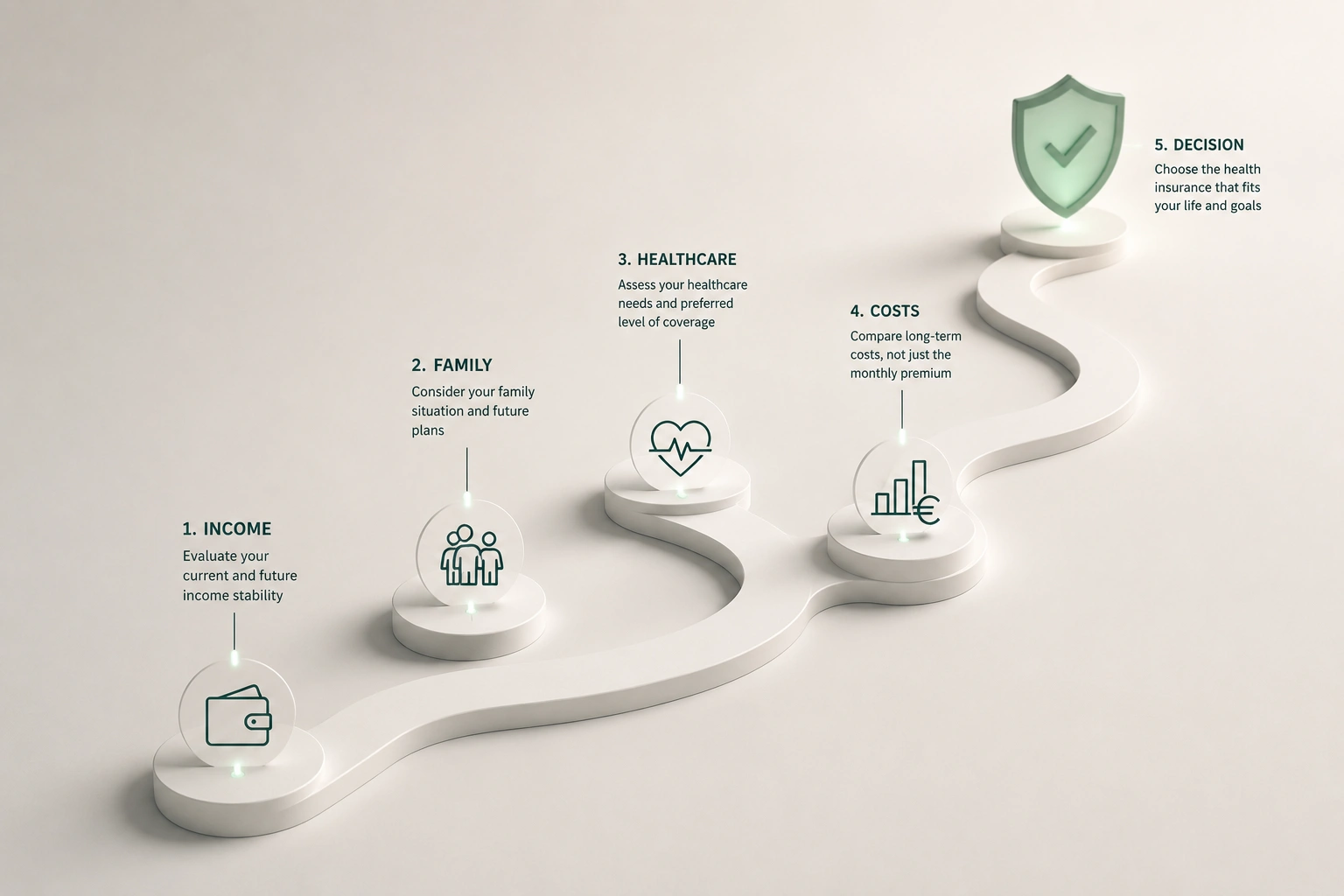
Choosing health insurance for freelancers in Germany should never be based solely on monthly premiums. A structured approach helps you compare both systems objectively and avoid costly long-term mistakes.
Step 1 — Evaluate Your Income
Start by reviewing both your current and expected business income.
Ask yourself:
- Is my income stable?
- Do I expect significant growth?
- Could my income fluctuate over the next few years?
Understanding your earning potential is the foundation for choosing the right health insurance for freelancers in Germany.
Step 2 — Consider Your Family Situation
Your insurance decision should reflect not only your current circumstances but also your future plans.
Consider:
- Marriage
- Children
- Partner’s insurance status
- Dependants
Family planning can significantly influence whether GKV or PKV offers better long-term value.
Step 3 — Estimate Long-Term Costs
Instead of comparing only today’s premiums, estimate the total cost over the next ten to twenty years.
Think about:
- Retirement
- Business growth
- Possible career changes
- Healthcare needs
- Premium adjustments
Long-term affordability is one of the most important considerations when selecting health insurance for freelancers in Germany.
Step 4 — Compare Benefits
Compare more than the monthly contribution.
Review:
- Hospital treatment
- Specialist access
- Dental benefits
- Preventive care
- Mental health support
- International coverage
- Income protection during illness
The right benefits should match your lifestyle, profession, and long-term goals.
Step 5 — Get Professional Advice
German health insurance regulations are complex, particularly for self-employed professionals and expats.
Receiving independent advice before making a decision helps ensure that your choice reflects your legal eligibility, financial objectives, family situation, and future plans.
For many people, professional guidance is the most effective way to choose the right health insurance for freelancers in Germany while avoiding expensive mistakes.
✅ Freelancer Health Insurance Checklist
Before choosing health insurance for freelancers in Germany, make sure you can confidently answer Yes to the following questions:
✔ Do I understand the differences between GKV and PKV?
✔ Have I compared long-term costs instead of only today’s premiums?
✔ Have I considered future family plans?
✔ Do I understand how my income affects my contributions?
✔ Have I reviewed the available tax advantages?
✔ Have I selected an appropriate deductible?
✔ Have I compared benefits rather than simply prices?
✔ Do I understand the rules for switching between GKV and PKV?
✔ Can I comfortably afford my premiums if my income changes?
✔ Will this health insurance for freelancers in Germany still meet my needs ten or twenty years from now?
If you answered No to any of these questions, take more time to evaluate your options before signing a long-term contract.
Final Thoughts
Choosing health insurance for freelancers in Germany is one of the most important financial decisions you will make as a self-employed professional. While both GKV and PKV provide excellent healthcare, they are designed for different financial situations, career paths, and long-term goals. Comparing health insurance for freelancers in Germany should therefore involve much more than simply finding the lowest monthly premium.
Throughout this guide, you’ve learned how health insurance for freelancers in Germany works, how GKV and PKV calculate contributions, what real healthcare costs look like, which financial mistakes to avoid, and how tax considerations can affect your overall expenses. More importantly, you’ve seen that the best solution depends on your income, health, family situation, future plans, and long-term financial strategy.
Whether you ultimately choose public or private coverage, your goal should be to select health insurance for freelancers in Germany that remains affordable, appropriate, and sustainable throughout every stage of your self-employed journey. Taking the time to make an informed decision today can help you avoid unnecessary costs, protect your financial future, and give you the confidence to focus on growing your business rather than worrying about your healthcare coverage.
FAQ: health insurance for freelancers in Germany
Is health insurance mandatory for freelancers in Germany?
Yes. Health insurance for freelancers in Germany is mandatory. Whether you choose statutory health insurance (GKV) or private health insurance (PKV), you must have valid health insurance while living and working in Germany. The right option depends on your income, eligibility, health status, and long-term financial goals.
Should freelancers choose GKV or PKV in Germany?
There is no one-size-fits-all answer. The best health insurance for freelancers in Germany depends on factors such as your annual income, age, family situation, medical history, and future plans. GKV is often suitable for freelancers with fluctuating income or families, while PKV may benefit younger, healthy professionals with stable, higher earnings.
How much does health insurance cost for freelancers in Germany?
The cost of health insurance for freelancers in Germany varies depending on the insurance system you choose. GKV contributions are generally based on your income, while PKV premiums are primarily determined by your age, health, selected tariff, and deductible. This means there is no fixed monthly price for every freelancer.
Can freelancers switch from GKV to PKV?
Yes. Eligible freelancers can usually switch from public health insurance (GKV) to private health insurance (PKV). However, the decision should be made carefully because switching back to GKV later may be subject to legal restrictions, especially for older self-employed professionals.
Is it possible to return from PKV to GKV?
In some situations, yes—but not always. Returning from private to public health insurance for freelancers in Germany depends on several legal conditions, including your age, employment status, and previous insurance history. Because returning can become difficult over time, freelancers should consider the long-term implications before choosing PKV.
Which health insurance is better for freelancers with children?
For many families, GKV can be more cost-effective because eligible spouses and children may be covered through family insurance without separate premiums. When comparing health insurance for freelancers in Germany, households should always calculate total family healthcare costs instead of comparing only one person’s monthly contribution.
Are health insurance premiums tax-deductible for freelancers?
Yes. In many cases, health insurance contributions are tax-deductible in Germany. Basic GKV contributions and the basic portion of PKV premiums can generally be claimed as special expenses (Sonderausgaben), helping reduce your taxable income. The exact tax benefit depends on your individual financial situation.
What is the difference between GKV and PKV for freelancers?
The biggest difference is how contributions are calculated. GKV is primarily income-based, while PKV is based on individual risk factors such as age, health status, and selected benefits. Choosing between GKV and PKV should involve comparing long-term costs, healthcare benefits, flexibility, and your personal financial goals rather than simply looking at today’s premium.
Is private health insurance cheaper than public health insurance?
It depends. For younger, healthy professionals with stable incomes, PKV may initially cost less than GKV. However, health insurance for freelancers in Germany should never be evaluated on monthly premiums alone. Long-term affordability, family plans, retirement, and future healthcare needs are equally important when comparing public and private health insurance.
How do I choose the right health insurance as a freelancer in Germany?
Start by evaluating your income, family situation, long-term career plans, healthcare needs, and retirement goals. Then compare GKV and PKV based on total long-term costs rather than only the monthly premium. Choosing the right health insurance for freelancers in Germany is a strategic financial decision that should support both your business and your future, not just your current budget.
Need Personal Guidance?
Choosing the right health insurance for freelancers in Germany can have a significant impact on your finances, healthcare, and long-term financial security. Every freelancer’s situation is different, and the best solution depends on factors such as your income, family circumstances, future plans, tax position, and eligibility for GKV or PKV.
If you’re unsure which option is right for you, book a personal consultation. Together, we’ll review your individual situation, compare your available options, and help you choose the most suitable health insurance for freelancers in Germany based on your long-term financial goals—not just today’s monthly premium.
About the Author
This guide was written by Sarah Rahimi, a licensed financial consultant in Germany specializing in financial planning for expats, international professionals, entrepreneurs, and self-employed individuals.
Sarah helps clients make informed decisions about health insurance for freelancers in Germany, retirement planning, investing, wealth building, financial protection, and tax-efficient financial strategies. Through The Wealth Lab, she provides practical, evidence-based guidance designed to simplify the German financial system and help professionals build long-term financial confidence.
⚠️ Disclaimer
This article is provided for educational and informational purposes only and does not constitute legal, tax, financial, or insurance advice. Although every effort has been made to ensure the accuracy of the information, German healthcare regulations, tax legislation, and insurance rules may change over time.
The information in this guide about health insurance for freelancers in Germany is intended as general guidance and may not reflect your individual circumstances. Before making decisions regarding GKV, PKV, taxation, retirement planning, or any other financial matter, you should seek professional advice tailored to your personal situation.
Leave a Comment
Have a question or experience to share? Drop a comment below.
Leave a Comment