
Church Tax in Germany:
How It Works and What Expats Should Decide

Table of Contents
Introduction
For many expats arriving in Germany, the first surprise is not the bureaucracy or the language barrier — it’s discovering that the government automatically deducts money from their salary for the church. Church tax in Germany is known as Kirchensteuer, and whether you are religious or not, it can cost you hundreds or even thousands of euros per year. This guide explains exactly how church tax in Germany works, how much it costs, and what you need to know before deciding whether to stay enrolled or formally opt out.
What Is Church Tax in Germany? Kirchensteuer Explained
Kirchensteuer — literally “church tax” — is a tax levied on members of officially recognised religious communities in Germany. These include the Roman Catholic Church, the Protestant Church (Evangelische Kirche), and in some states, Jewish communities and other denominations.
Unlike in most countries, Germany allows religious institutions to collect taxes through the state’s own tax infrastructure. When you register your residence (Anmeldung) in Germany and declare a religious affiliation, the tax authorities automatically add Kirchensteuer to your monthly payslip.
The legal basis for this arrangement is embedded in German constitutional law (Article 140 of the Grundgesetz) and goes back decades. It applies to expats just as it does to German citizens — there is no exemption for foreign nationals.
Who Actually Pays Church Tax in Germany?
Not every expat will owe Kirchensteuer. Church tax in Germany applies only to those who are registered as residents and declared a recognised religious affiliation at the time of registration. If you listed yourself as Catholic, Protestant, or Jewish, Germany’s tax system will take that seriously and begin deducting immediately.
You are liable for church tax if all of the following apply:
- You have completed your Anmeldung (residence registration)
- You declared a recognised religious denomination on the registration form
- Your declared religion is one of the state-recognised denominations in your Bundesland
This catches many expats off guard. Someone from Ireland who ticked “Catholic” without thinking twice on the Anmeldung form suddenly finds their take-home pay slightly lower each month — with no automatic refund and no reminder from the authorities.
If you registered and left the religion field blank, or declared keine (none), you will not be charged Kirchensteuer.
How Much Does Church Tax Actually Cost?
The rate is 8% of your income tax in Bavaria (Bayern) and Baden-Württemberg, and 9% of your income tax in all other German states. Critically, Kirchensteuer is calculated on your income tax (Lohnsteuer/Einkommensteuer), not your gross salary. This means the cost scales with your tax bracket.
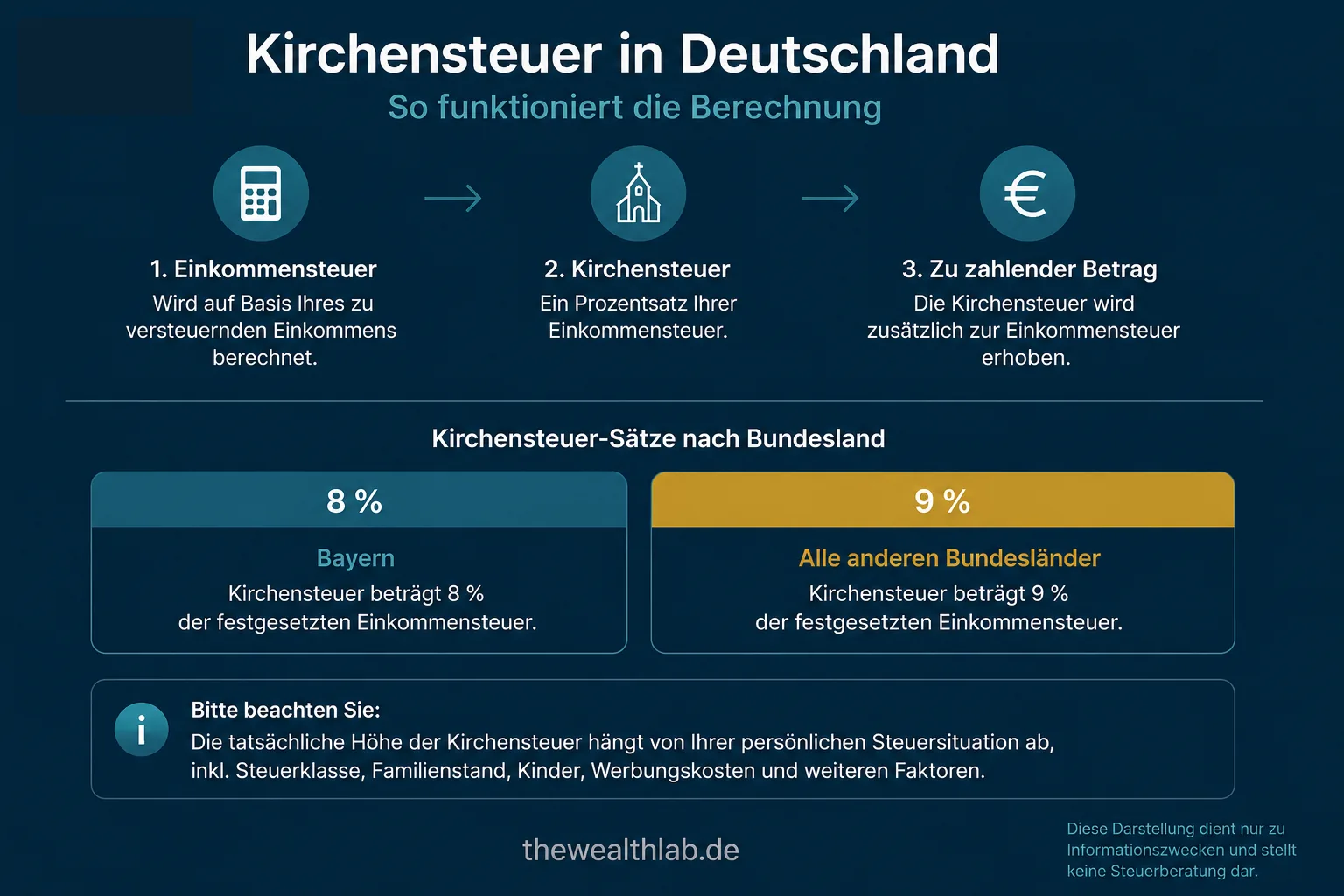
Annual Kirchensteuer by Salary Level
| Annual Gross Salary | Est. Income Tax | Church Tax (9% of Income Tax-Most States) | Church Tax (8% of Income Tax-Bavaria / BW) |
| €30,000 | ~€4,200 | ~€378/year | ~€336/year |
| €50,000 | ~€11,500 | ~€1,035/year | ~€920/year |
| €70,000 | ~€19,500 | ~€1,755/year | ~€1,560/year |
| €100,000 | ~€32,000 | ~€2,880/year | ~€2,560/year |
Estimates for Tax Class I (single, no children). Actual amounts depend on deductions and individual circumstances.
Church tax also applies to capital gains (Abgeltungsteuer). If you earn dividends or sell shares from a German brokerage account, the standard 25% flat rate attracts a further 9% church tax layer. For an expat earning €4,000 in annual dividends, that adds approximately €90 in additional Kirchensteuer — on top of €1,000 in Abgeltungsteuer and €55 in Solidaritätszuschlag.
Kirchensteuer Rate by German State
The rate varies by federal state. Bavaria and Baden-Württemberg apply a reduced rate of 8%; everywhere else it is 9%. Here is a full breakdown:
| Federal State (Bundesland) | Kirchensteuer Rate |
| Bayern (Bavaria) | 8% |
| Baden-Württemberg | 8% |
| Berlin | 9% |
| Brandenburg | 9% |
| Bremen | 9% |
| Hamburg | 9% |
| Hessen | 9% |
| Mecklenburg-Vorpommern | 9% |
| Niedersachsen | 9% |
| Nordrhein-Westfalen | 9% |
| Rheinland-Pfalz | 9% |
| Saarland | 9% |
| Sachsen | 9% |
| Sachsen-Anhalt | 9% |
| Schleswig-Holstein | 9% |
| Thüringen | 9% |
Source: Bundeszentralamt für Steuern / state tax authorities. Rates as of January 2025.
Note that your state of residence determines which rate applies — not the state where your employer is based.
How Church Tax Affects Your Investments as an Expat
Expats building long-term wealth in Germany should be aware that Kirchensteuer extends beyond salary income. If you hold a German brokerage account and are registered as a church member, your broker is legally required to withhold church tax on your capital gains and dividends automatically, via the ELSTAM system.
Here is how the deductions stack on a €4,000 dividend payment:
- Abgeltungsteuer (25%): €1,000
- Kirchensteuer (9% of €1,000): €90
- Solidaritätszuschlag (5.5% of €1,000): €55
- Total deducted: €1,145 instead of €1,000 without church membership
Over years of ETF investing or dividend reinvestment, church tax on capital gains can add up significantly. This is one reason many expats with active investment portfolios choose to initiate Kirchenaustritt shortly after arriving in Germany.
Not sure how German tax rules affect your financial plan?
We help expats in Germany understand how taxes, registration, and financial decisions work together — so nothing catches you off guard.
How to Opt Out: The Kirchenaustritt Process Step by Step
Leaving the church for tax purposes in Germany is a formal legal act called Kirchenaustritt (church exit declaration). It is not enough to simply stop attending services or inform your employer — you must file an official declaration with the relevant authority in your state.
Step-by-Step: How to Formally Leave
- Step 1 — Find your local authority: Depending on your state, this is the Standesamt (Berlin, Bavaria), Amtsgericht (district court), or Bürgeramt. Check your city’s official website to confirm.
- Step 2 — Bring valid ID: Your passport or German residence permit (Aufenthaltstitel) is required.
- Step 3 — Sign the Kirchenaustritt declaration: You complete and sign a formal withdrawal form. No reason needs to be given.
- Step 4 — Pay the fee: Usually €25–€35 depending on the state. This is a one-time administrative fee.
- Step 5 — Receive your Austrittsbescheinigung: Keep this certificate confirming your withdrawal. Your employer will be updated via the ELSTAM system and Kirchensteuer will stop at the end of the current calendar month.
When Does the Kirchenaustritt Take Effect?
Kirchenaustritt takes legal effect at the end of the calendar month in which you filed. If you file on 12 June, church tax stops being deducted from July. There is no retroactive refund for months already paid prior to filing.
Can You Do It Online?
Some German states as of 2025 offer online Kirchenaustritt via the church’s own platform. However, for full legal and tax effect — particularly the update to the ELSTAM payroll system — visiting the Standesamt or Amtsgericht in person remains the most reliable route.
What Happens If You Don’t Opt Out?
If you declared a religious affiliation during Anmeldung and do nothing, church tax will be deducted automatically for as long as you are employed and registered in Germany. There is no cap, no annual review, and no automatic notification to remind you how much you have paid.
If you leave Germany and later return, re-registering without explicitly declaring no religious affiliation may cause deductions to resume. There are also no retroactive refunds for past payments — the only way to stop future deductions is through a formal Kirchenaustritt.
One partial relief: Kirchensteuer paid is deductible as a Sonderausgabe (special expense) in your annual German tax return (Einkommensteuerklärung). This partially reduces the real cost, but does not eliminate it.
Should You Keep Paying Church Tax in Germany — or Formally Opt Out?
This is ultimately a personal decision, but it should be a deliberate one — not a default. Many expats only discover they have been paying church tax in Germany for years when preparing their first German tax return. Here are the key considerations on both sides:
Reasons to opt out:
- You are not religiously active and the payments carry no personal meaning
- The annual cost is significant relative to your income or savings objectives
- You are planning to stay in Germany long-term and the cumulative cost matters
- You hold investments and want to reduce deductions on capital gains
Reasons to remain enrolled:
- The church provides social services, counselling, or community support you genuinely value
- Your children attend a church-affiliated school (Konfessionsschule) and membership is relevant
- The spiritual or community dimension is important to you
There is no right or wrong answer. What matters is that you make an informed, conscious choice — not one you discover years later by accident on a payslip.
Frequently Asked Questions about Church Tax in Germany
Can non-Christians be charged church tax in Germany?
Only if they declared affiliation with a recognised denomination during Anmeldung. If you declared keine Religion (no religion) or left the field blank, no church tax applies. Jewish communities (Jüdische Gemeinden) in some states are also state-recognised and levy Kirchensteuer on members.
Does Kirchenaustritt affect my relationship with the church?
Yes — formally leaving for tax purposes constitutes full withdrawal from church membership. Some denominations may restrict access to sacraments (e.g., a church wedding in the Catholic Church, or a church funeral). This is a personal and spiritual consideration, not just a financial one.
I’ve been paying church tax for years. Can I get a refund?
No. Kirchensteuer paid in prior years is not refundable. However, all church tax paid is deductible as a Sonderausgabe in your annual tax return, which reduces your tax liability and partially offsets the cost.
I didn’t know I was enrolled. What should I do now?
Check your payslip (Gehaltsabrechnung) for a line labelled KiSt or Kirchensteuer. If you find it and did not intend to pay it, visit your local Standesamt or Amtsgericht and initiate Kirchenaustritt as soon as possible. Future deductions will stop at the end of that calendar month.
Does church tax apply to freelancers and self-employed expats?
Yes. Self-employed individuals and Freiberufler pay Kirchensteuer as part of their annual income tax assessment (Einkommensteuerklärung). There is no exemption for freelancers. The amount is calculated on your total income tax liability for the year.
Ready to take control of your finances in Germany?
Whether you’re deciding on Kirchenaustritt, planning your tax return, or building a long-term financial strategy as an expat — The Wealth Lab is here to help.
DISCLAIMER
The information provided in this article is intended for general educational purposes only and does not constitute financial, legal, tax, or religious advice. Tax regulations in Germany, including Kirchensteuer rates and Kirchenaustritt procedures, are subject to change and may vary by state. The figures and examples presented are illustrative only and may not reflect your individual circumstances. The Wealth Lab is not a licensed tax adviser or legal professional. Before making any decisions regarding church tax registration, withdrawal, or related financial matters in Germany, you are strongly encouraged to consult a qualified, regulated tax adviser or legal professional who can provide personalised guidance based on your specific situation.
Leave a Comment
Have a question or experience to share? Drop a comment below.
Leave a Comment