
Foreign Investment Tax in Germany:
How Shares, ETFs, Dividends, Interest, and Foreign Brokers Are Taxed
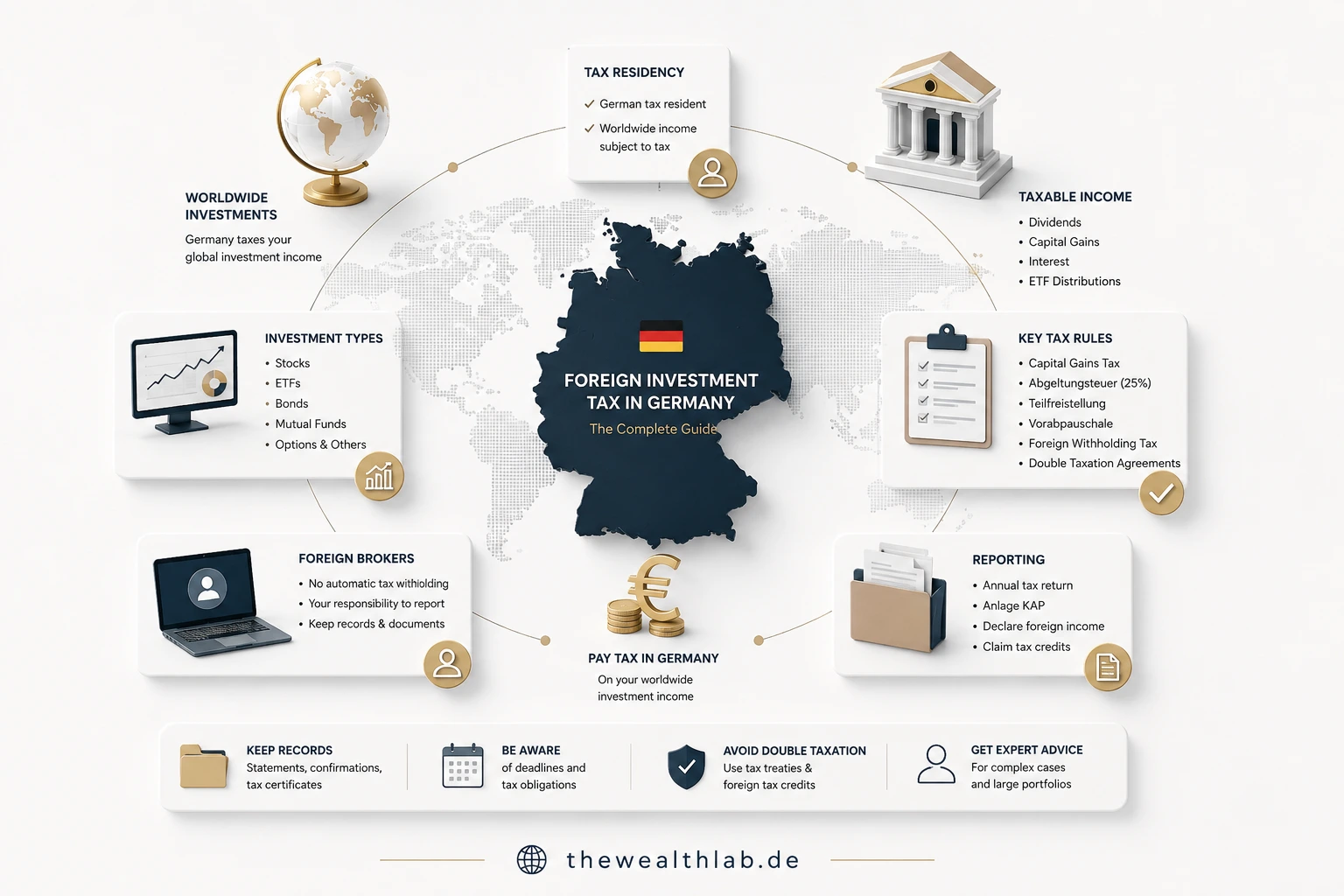
Table of Contents
Imagine arriving in Germany to start a new chapter of your life. You’ve completed your Anmeldung, opened a German bank account, and sorted out your health insurance. Then a question suddenly comes to mind:
What happens to the investments I already own outside Germany?
Perhaps you have shares with Interactive Brokers, ETFs in your home country, dividend-paying US stocks, or a savings account that continues to earn interest abroad. Many expats assume these investments remain outside the reach of the German tax authorities simply because they are held overseas.
In reality, becoming a German tax resident can significantly change how your global investments are taxed.
Understanding foreign investment tax in Germany is essential for anyone who moves to Germany while continuing to invest internationally. Whether you own foreign shares, ETFs, bonds, mutual funds, or overseas savings accounts, knowing how the German tax system works can help you stay compliant, avoid unexpected tax bills, and make informed financial decisions.
The good news is that the rules are often more straightforward than they first appear. Once you understand the key principles—such as tax residency, worldwide taxation, foreign brokers, ETF taxation, and double taxation agreements—the overall system becomes much easier to navigate.
This guide explains how foreign investment tax in Germany works for expats in clear, practical language, without assuming any previous knowledge of German tax law.
Quick Answer
If you’re looking for the short version, here are the most important things to know about foreign investment tax in Germany:
- Germany taxes tax residents on their worldwide investment income, regardless of where their investments or brokerage accounts are located.
- Foreign brokers generally do not withhold German taxes, meaning you are usually responsible for reporting foreign investment income yourself.
- Investment income is generally subject to Germany’s flat-rate capital gains tax (Abgeltungsteuer), together with the solidarity surcharge and, where applicable, church tax.
- Every taxpayer benefits from an annual tax-free allowance (Sparer-Pauschbetrag) for investment income, provided the applicable conditions are met.
- Foreign ETFs are generally taxed under the same German rules as domestic ETFs, including the Vorabpauschale for many accumulating funds.
- Foreign withholding taxes can often be credited against your German tax liability, depending on the relevant double taxation agreement.
- Keeping accurate records of purchase prices, dividends, exchange rates, and transaction dates is essential when reporting investments held outside Germany.
If you are an expat with investments abroad, these are the core principles you should understand before filing your German tax return.
Understanding German Tax Residency and Worldwide Income
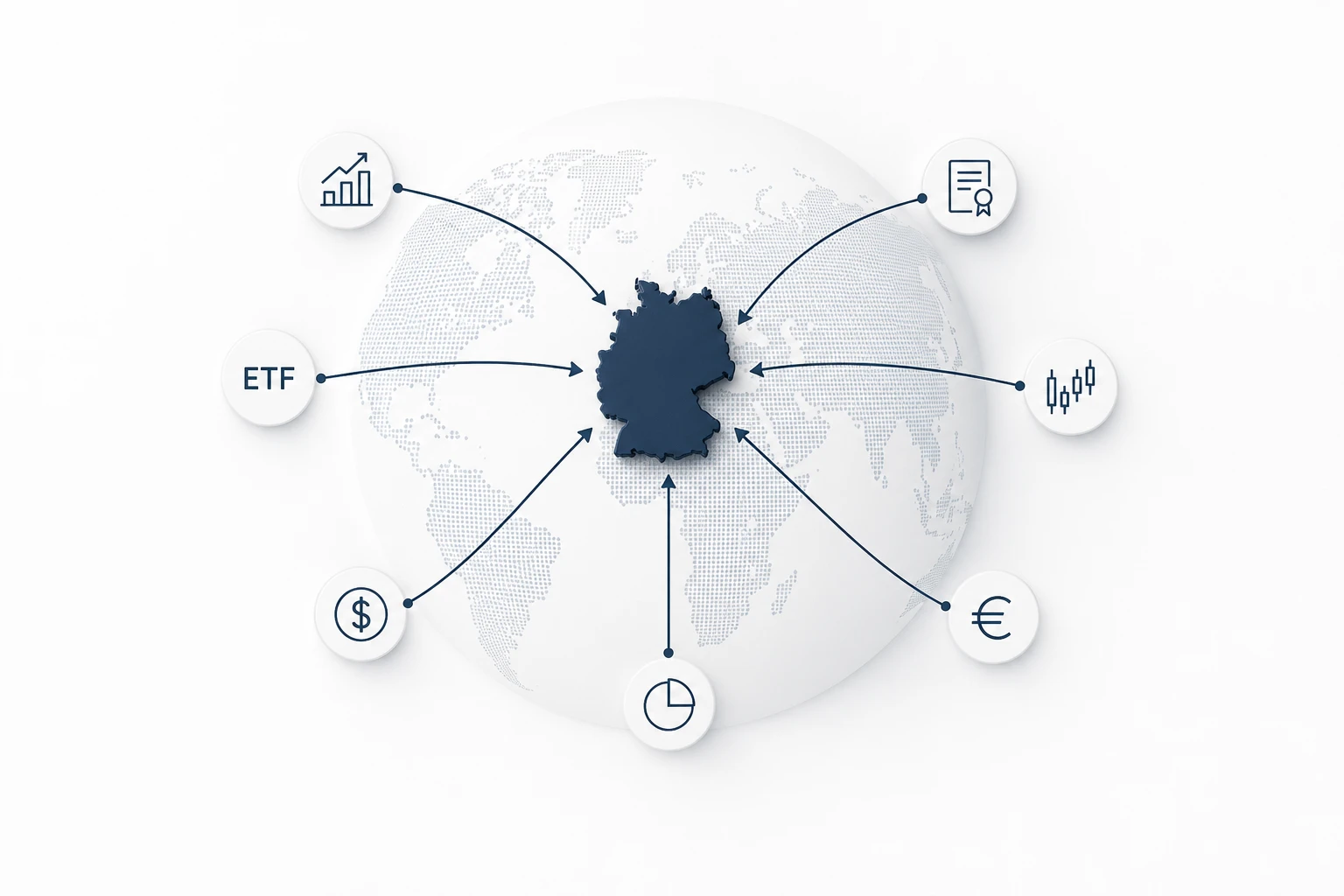
Foreign investment tax in Germany is primarily determined by your tax residency—not by where your investments are held. Once you become a German tax resident, much of your worldwide investment income may fall within the German tax system, even if your assets remain in another country.
This is one of the biggest surprises for many international professionals moving to Germany.
A common misconception is that investments remain taxable only in the country where the brokerage account is located. In practice, Germany generally looks first at where you are tax resident, not where your broker, bank, or investment platform is based.
Whether you are considered a German tax resident depends on your individual circumstances. Factors such as maintaining a residence (Wohnsitz) or having a habitual abode (gewöhnlicher Aufenthalt) in Germany are particularly important. Spending more than 183 days in Germany may also be relevant in many situations, but it is not the only factor used to determine tax residency.
Once you become subject to unlimited tax liability (unbeschränkte Steuerpflicht), Germany generally taxes your worldwide income under the worldwide income principle (Welteinkommensprinzip).
In simple terms, this means that Germany is interested not only in income earned within Germany but also in many types of investment income generated abroad.
This may include:
- Capital gains from foreign shares
- Dividends paid by overseas companies
- Interest earned on foreign bank accounts
- Income from foreign ETFs and investment funds
- Returns generated through international brokerage accounts
So what does this mean in practice?
Imagine you moved from Canada, India, the United States, or another country and decided to keep your existing investment portfolio with your original broker. Even if you never transfer those investments to Germany, they do not automatically fall outside the German tax system simply because they remain abroad.
Similarly, leaving profits inside a foreign brokerage account instead of transferring them to a German bank account does not usually prevent German taxation. In many situations, what matters is when the taxable event occurs, such as receiving a dividend, earning interest, or realising a capital gain—not where the cash is physically held.
Understanding this principle is the foundation of foreign investment tax in Germany, because nearly every other rule discussed in this guide builds upon it.
The Mechanics of Foreign Investment Tax in Germany
Foreign investment tax in Germany is generally based on Germany’s flat-rate capital gains tax system, known as the Abgeltungsteuer. For most private investors, investment income is taxed separately from employment income, making the rules more predictable than Germany’s progressive income tax system.
Now that you understand when Germany can tax your worldwide investments, the next question is straightforward:
How much tax could you actually pay?
For most types of investment income—including capital gains from shares, dividends, interest, and many ETF distributions—Germany applies a flat-rate capital gains tax of 25%.
On top of this, a 5.5% solidarity surcharge (Solidaritätszuschlag) is calculated on the tax itself, resulting in an effective rate of approximately 26.375%. If you are a registered member of a recognised church in Germany, church tax may also apply, increasing the overall tax burden slightly.
One reason the foreign investment tax in Germany system can initially seem confusing is that employment income and investment income are usually taxed under different rules. While salary is generally subject to Germany’s progressive income tax rates, most private investment income falls under the flat-rate capital gains tax regime.
As a result, understanding which rules apply to your investments can be just as important as understanding how your salary is taxed.
The standard structure of the German capital gains tax is shown below:
| Tax Component | Standard Rate |
|---|---|
| Capital Gains Tax (Abgeltungsteuer) | 25.00% |
| Solidarity Surcharge | 1.375% |
| Church Tax (if applicable) | Varies by federal state |
| Typical Effective Rate | Approximately 26.375% (without church tax) |
Although these rates apply in many situations, individual circumstances may differ depending on the type of investment, your tax residency, available exemptions, and any applicable international tax treaties.
The Saver’s Tax-Free Allowance (Sparer-Pauschbetrag)
One of the most valuable features of foreign investment tax in Germany is the annual tax-free allowance available for investment income. Before paying tax on dividends, interest, or capital gains, many investors can benefit from the Sparer-Pauschbetrag.
For many expats, this is one of the most misunderstood parts of the German tax system.
Germany allows each taxpayer to earn a certain amount of investment income every year before capital gains tax becomes payable. This allowance is called the Sparer-Pauschbetrag, and it applies to qualifying investment income regardless of whether the investments are held in Germany or abroad.
At the time of writing, the allowance is:
- €1,000 per year for individuals.
- €2,000 per year for married couples filing jointly.
If your total qualifying investment income remains below your available allowance, you may not owe German capital gains tax on that portion of your investment returns.
However, there is an important difference between German and foreign brokers.
A German broker can usually apply your allowance automatically through a Freistellungsauftrag (exemption order). Foreign brokers generally cannot do this because they are not connected to the German tax system.
This means that if your investments are held outside Germany, you will normally claim the allowance yourself when filing your German tax return.
Understanding how this allowance works can significantly simplify your approach to foreign investment tax in Germany, especially if you receive investment income from several different countries.
How Foreign Brokers Are Taxed in Germany
Using an overseas broker does not exempt you from foreign investment tax in Germany. In most cases, foreign brokers simply do not collect German taxes on your behalf, meaning the responsibility for accurate reporting usually rests with you.
This is one of the most common areas of confusion for expats.
Many investors assume that because their broker is based outside Germany, German tax rules do not apply. In reality, German tax obligations are generally linked to your tax residency, not the location of your brokerage platform.
If you invest through a German bank or broker, the process is usually straightforward.
The institution automatically:
- calculates your taxable investment income,
- applies your available Sparer-Pauschbetrag (where instructed),
- withholds the appropriate capital gains tax,
- and transfers the tax directly to the German tax authorities.
As a result, many investors using only German brokers have relatively little administrative work to do.
Foreign brokers operate differently.
International platforms typically credit your dividends, interest, and capital gains to your account without withholding German tax. This does not mean the income is tax-free. Instead, it generally means you must report the income yourself when completing your German tax return.
Examples of international brokerage platforms include:
- Interactive Brokers
- Charles Schwab
- DEGIRO
- Trading 212
- eToro
- other overseas investment platforms
Because reporting obligations remain with the investor, keeping accurate records becomes extremely important.
You should retain documents such as:
- annual account statements,
- dividend reports,
- trade confirmations,
- purchase prices,
- sale prices,
- and currency conversion records where applicable.
Critical Compliance Note
Receiving investment income without automatic tax withholding is not a tax advantage or a legal loophole.
If you are a German tax resident, foreign investment income generally still needs to be reported correctly. Failure to declare taxable investment income may lead to additional tax, interest, penalties, or further enquiries from the Finanzamt.
German Broker vs Foreign Broker
| Feature | German Broker | Foreign Broker |
|---|---|---|
| German tax withheld automatically | ✅ Usually | ❌ Usually not |
| Applies Sparer-Pauschbetrag automatically | ✅ Yes (with Freistellungsauftrag) | ❌ No |
| German tax certificate provided | ✅ Usually | ❌ Usually not |
| Manual reporting required | Often minimal | Usually required |
| Currency conversion often needed | Rarely | Frequently |
What This Means for Expats
For many international professionals, the biggest challenge is not paying foreign investment tax in Germany—it is understanding their reporting responsibilities.
Using an overseas investment platform is perfectly possible while living in Germany. However, it usually comes with additional administrative responsibilities, including keeping complete records and ensuring that foreign investment income is accurately reported on your annual German tax return.
Currency Conversion and Foreign Investment Tax in Germany
Currency conversion is an often-overlooked part of foreign investment tax in Germany. Even if your investments are denominated in US dollars, British pounds, or another foreign currency, your tax calculations generally need to be reported in euros.
Many expats naturally focus on the performance of their investments. However, from a German tax perspective, another factor also matters: the exchange rate on the date each taxable transaction takes place.
This means that every dividend payment, interest payment, purchase, and sale may need to be converted into euros before your German tax liability can be determined.
For investors using foreign brokers, this can create additional administrative work, especially when dozens or even hundreds of transactions occur during the year.
Why Exchange Rates Matter
Imagine you bought shares for $10,000 and later sold them for exactly the same amount.
From your perspective, you made no profit.
However, if the euro weakened against the US dollar during that period, the value of your investment expressed in euros may have increased.
As a result, your taxable capital gain in Germany could differ from the gain you see in your brokerage account.
Likewise, if exchange rates move in the opposite direction, your taxable gain may be lower than expected.
For this reason, maintaining complete transaction records is an important part of managing foreign investment tax in Germany, particularly when investing through international platforms.
Foreign ETFs and Foreign Investment Tax in Germany
Foreign investment tax in Germany applies to ETFs regardless of whether they are held with a German or foreign broker. The tax treatment is generally based on German investment tax rules rather than the country where the ETF is purchased.
Many expats assume that buying an ETF outside Germany automatically changes how it is taxed after moving to Germany.
In reality, this is usually not the case.
Once you become a German tax resident, German investment tax rules generally apply to both domestic and foreign ETFs.
The most important distinction is not where the ETF is located, but how the ETF distributes its income.
Broadly speaking, ETFs fall into two categories:
- Distributing ETFs, which regularly pay dividends or other income directly to investors.
- Accumulating ETFs, which automatically reinvest that income instead of distributing cash.
Although these two types of funds operate differently, both are covered by the foreign investment tax in Germany rules.
Distributing ETFs
Distributing ETFs transfer dividends or other investment income directly into your brokerage account.
These payments generally represent taxable investment income and may need to be reported if German tax has not already been withheld.
If foreign withholding tax has already been deducted, Germany may allow a credit under the applicable double taxation agreement, depending on your individual circumstances.
Accumulating ETFs
Accumulating ETFs do not pay dividends directly to investors.
Instead, the income remains inside the fund and is automatically reinvested, allowing the investment to grow over time.
Without special rules, this structure could allow investors to postpone taxation for many years simply by avoiding cash distributions.
To prevent this, Germany introduced the Vorabpauschale, a mechanism that ensures certain accumulating funds may generate taxable income even if no cash is actually paid to the investor.
Understanding this rule is one of the most important aspects of foreign investment tax in Germany for long-term ETF investors.
Understanding the Vorabpauschale
The Vorabpauschale is one of the most distinctive features of foreign investment tax in Germany. Rather than taxing only actual cash distributions, German tax law may require investors in accumulating ETFs to recognise a calculated minimum amount of taxable income each year.
For many newcomers, this concept initially sounds confusing.
The important point is that the Vorabpauschale is not an additional tax.
Instead, it is a method of collecting tax earlier on investment growth that has been retained within the fund instead of being distributed to investors.
The calculation is based on rules defined in the German Investment Tax Act (Investmentsteuergesetz), using an annually published base interest rate (Basiszins).
Because the Basiszins changes over time, the exact amount of the Vorabpauschale can vary from one year to the next.
If an ETF performs poorly or loses value during the year, the Vorabpauschale may be significantly reduced or may not apply at all.
Partial Tax Exemption (Teilfreistellung)
Another important feature of foreign investment tax in Germany is the Teilfreistellung, or partial tax exemption.
Germany recognises that many investment funds already hold shares in companies that have paid corporate taxes before profits reach investors.
To reduce this economic double taxation, part of an ETF’s income may be exempt from German tax.
The percentage depends on the type of fund.
Typical examples include:
| ETF Type | Typical Partial Tax Exemption |
|---|---|
| Equity ETFs | 30% |
| Mixed Funds | 15% |
| Certain Real Estate Funds | Up to 60% or 80%, depending on the underlying assets |
As a result, investors are generally taxed only on the remaining taxable portion of qualifying investment income.
A Practical Example
Suppose you own an accumulating global equity ETF through an international broker.
At the beginning of the year, your investment is worth €100,000.
By the end of the year, the fund has increased in value, but no dividends have been paid into your account because the ETF automatically reinvests its income.
Even though you have not received any cash, German investment tax rules may still require part of that investment growth to be recognised through the Vorabpauschale calculation.
After applying the relevant partial tax exemption for equity ETFs, only the taxable portion is used when determining your German capital gains tax.
When you eventually sell the ETF, previous amounts already taxed through the Vorabpauschale are generally taken into account so that the same investment growth is not taxed twice.
Key Takeaway
For many international investors, ETFs represent a significant part of their portfolio. Understanding how foreign investment tax in Germany applies to accumulating funds, distributing funds, partial tax exemptions, and the Vorabpauschale can help avoid confusion and make annual tax reporting considerably easier.
Foreign Dividends Tax in Germany and Double Taxation
Foreign dividends are one of the most common sources of foreign investment tax in Germany for expats who continue investing internationally. If you receive dividend payments from companies outside Germany, those payments may be taxable in Germany even if tax has already been deducted in the country where the dividend originated.
This is one of the areas where many investors worry about being taxed twice.
Fortunately, Germany has signed Double Taxation Agreements (DTAs) with many countries to help prevent the same income from being taxed twice.
How Foreign Dividends Are Usually Taxed
When a foreign company distributes a dividend, taxation often happens in two stages.
First, the country where the company is based may deduct foreign withholding tax before the money reaches your brokerage account.
Second, if you are a German tax resident, Germany may also tax that dividend as part of your worldwide investment income.
At first glance, this appears to be double taxation.
However, in many cases, the tax already paid abroad can be credited against your German tax liability under the applicable tax treaty.
Understanding these treaty rules is an important part of managing Foreign Dividends Tax Germany and reducing unnecessary tax costs.
Example
Imagine you own shares in a US company that pays a dividend.
Before the dividend reaches your brokerage account, US withholding tax is deducted.
Because you are now a German tax resident, Germany may also assess tax on that dividend.
Rather than paying the full amount twice, the German tax authorities generally allow part of the foreign withholding tax to be credited against your German tax bill where the relevant double taxation agreement permits it.
Exactly how much can be credited depends on the treaty between Germany and the country where the dividend originated.
What Happens If Too Much Foreign Tax Is Withheld?
Some countries deduct withholding tax at rates that are higher than the amount recognised under Germany’s tax treaties.
When this happens, Germany generally cannot credit the excess amount against your German tax liability.
Instead, investors may need to submit a refund claim directly to the foreign tax authority if they wish to recover the additional withholding tax.
Because the procedures vary significantly between countries, investors with substantial overseas portfolios may benefit from discussing these situations with a qualified tax adviser.
Key Takeaway
For most investors, Foreign Dividends Tax Germany is less about paying tax twice and more about understanding how foreign withholding tax and double taxation agreements interact.
Keeping dividend statements and withholding tax certificates can make claiming available tax credits significantly easier when preparing your German tax return.
Existing Investments When Moving to Germany
One of the biggest surprises for new expats is that foreign investment tax in Germany does not automatically restart from the day they move to Germany.
Many people assume that when they become German tax residents, Germany simply begins taxing any future investment growth.
Unfortunately, the rules are not usually that simple.
For many privately held investments, Germany generally continues using your original acquisition cost when calculating future capital gains.
This means that appreciation that occurred before your relocation may still be relevant when determining your taxable gain after becoming a German tax resident.
For anyone with significant German tax resident foreign investments, understanding this rule before selling long-held assets can be extremely important.
Cost Basis Matters
Suppose you purchased shares several years before moving to Germany.
By the time you relocate, those shares have already increased substantially in value.
If you later sell those investments while living in Germany, your taxable gain will generally be calculated using the original purchase price rather than the market value on the day you moved.
Because every investor’s circumstances differ, particularly where multiple countries are involved, individuals with substantial unrealised gains may wish to discuss the timing of significant transactions with a qualified German tax adviser before making major investment decisions.
The FIFO Rule
Another important concept within foreign investment tax in Germany is the First-In, First-Out (FIFO) principle.
Many investors gradually purchase additional shares or ETF units over several years.
For example, you may buy:
- 100 shares in 2018
- another 100 shares in 2021
- another 100 shares in 2025
If you later sell only part of your investment, Germany generally assumes that the oldest shares are sold first.
This can have a significant impact on the taxable capital gain because your earliest purchases often have the lowest acquisition cost.
Understanding the FIFO rule is especially important for investors holding long-term portfolios through a foreign broker, where transaction histories may span many years.
Accurate purchase records therefore become essential for anyone managing Foreign Broker Tax Germany responsibilities.
Why Record Keeping Is So Important
Whether you invest through a German broker or an international platform, maintaining complete records can save considerable time during tax season.
Important documents include:
- Original purchase confirmations
- Sale confirmations
- Dividend statements
- Foreign withholding tax certificates
- Annual brokerage statements
- Currency conversion records where applicable
Good documentation makes it much easier to calculate foreign capital gains, support your tax return, and respond to any questions from the German tax authorities.
Key Takeaway
If you moved to Germany with an existing investment portfolio, understanding cost basis rules, FIFO accounting, and the taxation of German tax resident foreign investments can help you avoid unexpected tax outcomes when selling assets in the future.
Reporting Foreign Investment Income in Germany
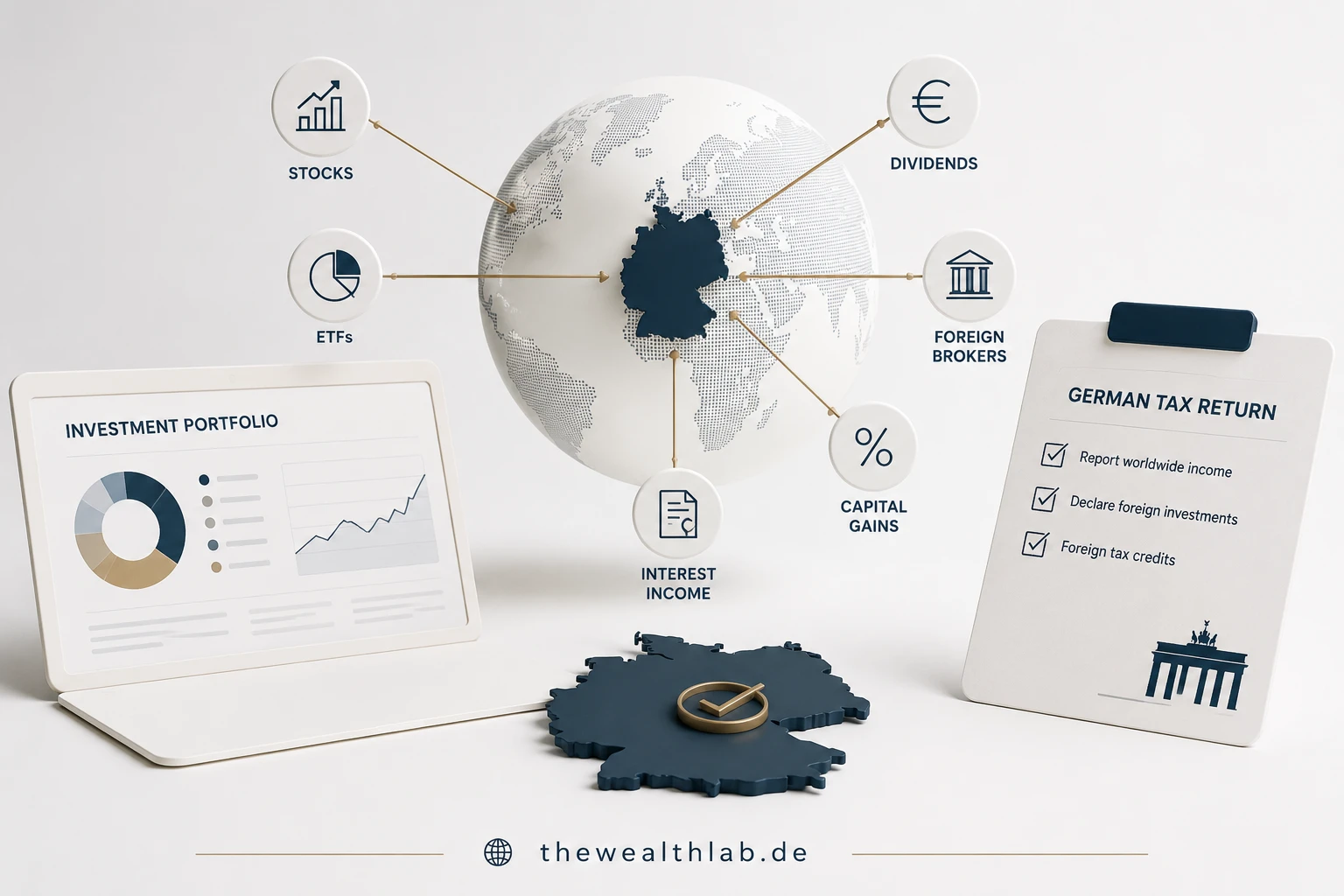
Correct reporting is one of the most important parts of foreign investment tax in Germany. Even if your investments are held with an overseas broker, you are generally responsible for declaring taxable foreign investment income on your German tax return if no German tax has already been withheld.
For many expats, filing the tax return is the most intimidating part of the process.
The good news is that once your records are organised, reporting German tax resident foreign investments becomes much more manageable.
Unlike many German banks, international brokers usually do not issue tax certificates that are specifically designed for the German tax system. Instead, they provide transaction reports that often need to be reviewed and, where necessary, converted into euros before being used for German tax purposes.
Because of this, investors using international platforms should keep complete records throughout the year rather than trying to reconstruct transactions shortly before filing their tax return.
Which Forms Are Typically Used?
Depending on your individual circumstances, foreign investment income may need to be declared using supplementary forms that accompany your annual German income tax return.
Commonly used forms include:
- Anlage KAP, which is generally used for reporting investment income that has not already been taxed in Germany.
- Anlage AUS, which may be relevant when claiming relief for eligible foreign withholding tax under a double taxation agreement.
The exact reporting requirements depend on your personal circumstances, the type of investments you hold, and how your investment income has already been taxed abroad.
Documents You Should Keep
Good documentation makes foreign investment tax in Germany significantly easier to manage.
Whether you invest through a domestic or foreign broker, consider keeping records such as:
- Annual brokerage statements
- Dividend statements
- Interest statements
- Purchase confirmations
- Sale confirmations
- Foreign withholding tax certificates
- ETF distribution reports
- Currency conversion records where applicable
Maintaining these records not only simplifies your annual tax return but also makes it easier to respond if the German tax authorities request additional information.
This is particularly important for investors using Foreign Broker Tax Germany rules, where tax reporting is generally handled by the investor rather than the brokerage platform.
Practical Tips for Expats
Managing foreign investment tax in Germany does not have to be overwhelming.
Many experienced investors follow a few simple habits throughout the year that make tax season considerably easier.
Some practical recommendations include:
- Download your brokerage statements regularly instead of waiting until year-end.
- Keep records of every purchase and sale.
- Save dividend and withholding tax statements.
- Track investments held through multiple foreign brokers in one spreadsheet.
- Store documents securely for future reference.
- Seek professional advice if your portfolio includes multiple countries, trusts, employee share plans, or complex investment structures.
Small organisational habits today can save many hours when preparing your German tax return.
Common Mistakes to Avoid
Many of the issues associated with foreign investment tax in Germany arise from misunderstandings rather than intentional mistakes.
Some of the most common include:
- Assuming investments held abroad do not need to be reported.
- Believing foreign brokers automatically calculate German taxes.
- Forgetting to report foreign dividends or interest.
- Ignoring exchange rate calculations.
- Losing historical purchase records.
- Assuming foreign withholding tax completely eliminates German tax.
- Waiting until tax season to organise several years of brokerage statements.
Avoiding these common mistakes can make managing German tax resident foreign investments much simpler over the long term.
Conclusion
Moving to Germany does not necessarily mean changing your investment strategy—but it does mean understanding how your investments fit into the German tax system.
As a German tax resident, your worldwide investment income may become relevant for German tax purposes, regardless of whether your assets are held in Germany or through an overseas investment platform.
Understanding foreign investment tax in Germany allows you to make informed decisions, keep accurate records, and approach your annual tax return with greater confidence.
Whether you invest in international shares, global ETFs, overseas savings accounts, or use a foreign broker, becoming familiar with the basic principles of Foreign Investment Tax in Germany, Foreign Broker Tax Germany, Foreign ETF Tax Germany, and Foreign Dividends Tax Germany can help you avoid unnecessary surprises and remain compliant with German tax rules.
While many investors can successfully manage straightforward situations themselves, more complex international portfolios may require individual professional advice, particularly where multiple countries or tax treaties are involved.
At The Wealth Lab, we help expats understand how investing, taxation, and long-term financial planning fit together after moving to Germany. Explore our educational resources to continue building your financial knowledge, or book an introductory consultation if you would like to discuss your broader financial goals.
FAQ: Frequently Asked Questions About Foreign Investment Tax in Germany
Do I have to pay German tax on investments held outside Germany?
In many cases, yes. If you are a German tax resident, Germany generally taxes your worldwide investment income, regardless of whether your investments are held with a German or foreign broker. This means Foreign Investment Tax in Germany may apply to overseas shares, ETFs, dividends, interest, and capital gains.
How does Foreign Broker Tax Germany work?
Most foreign brokerage platforms do not automatically withhold German capital gains tax. Instead, investors are generally responsible for reporting taxable investment income when filing their German tax return. Understanding Foreign Broker Tax Germany is essential if you use platforms such as Interactive Brokers, DEGIRO, Charles Schwab, Trading 212, or eToro while living in Germany.
How is Foreign ETF Tax Germany calculated?
Foreign ETF Tax Germany generally follows the same German investment tax rules that apply to domestic ETFs. Depending on whether the ETF is distributing or accumulating, investors may need to consider dividend taxation, the Vorabpauschale, and the Teilfreistellung (partial tax exemption). Understanding these rules can help investors avoid unexpected tax liabilities.
How does Foreign Dividends Tax Germany work?
Foreign Dividends Tax Germany can initially seem complicated because dividends may be taxed both in the country where they originate and in Germany. However, Germany has signed double taxation agreements with many countries, allowing eligible foreign withholding tax to be credited against your German tax liability in many situations.
Do I have to declare dividends if they remain in my foreign brokerage account?
Usually, yes. Your reporting obligation generally depends on when the dividend is received rather than whether you transfer the money to a German bank account. Leaving dividends in a foreign brokerage account does not automatically exempt them from Foreign Investment Tax in Germany.
What happens to investments I purchased before moving to Germany?
Existing investments do not automatically receive a new purchase value when you relocate. Depending on your individual circumstances, Germany may continue using the original acquisition cost when calculating future capital gains. Investors with significant German Tax Resident Foreign Investments should consider obtaining professional advice before selling long-held assets.
What is the Vorabpauschale, and why does it apply to foreign ETFs?
The Vorabpauschale is a German tax mechanism that may apply to accumulating ETFs. Instead of waiting until an investment is sold, Germany may tax a calculated minimum amount of investment income each year, even if no cash distribution has been received. This rule applies to many domestic and foreign ETFs.
Can foreign withholding tax reduce my German tax bill?
Often, yes. Under many double taxation agreements, eligible foreign withholding tax can be credited against your German tax liability. The amount that can be credited depends on the relevant treaty and your personal tax situation.
What records should I keep for foreign investments in Germany?
You should retain purchase confirmations, sale confirmations, annual brokerage statements, dividend statements, foreign withholding tax certificates, and currency conversion records where applicable. Good record keeping makes reporting Foreign Investment Tax in Germany much easier and helps support your German tax return if additional information is requested.
Should I speak to a tax adviser if I have foreign investments?
If your portfolio includes investments in multiple countries, employee share plans, trusts, significant unrealised gains, or other complex assets, professional advice may help ensure compliance with Foreign Investment Tax in Germany. Investors with German Tax Resident Foreign Investments may also benefit from expert guidance when claiming foreign tax credits or planning future investment sales.
Build Your Wealth with Confidence
Moving to Germany brings new financial opportunities—but also new rules.
At The Wealth Lab, we help English-speaking expats understand investing, retirement planning, insurance, and the German financial system with clarity and confidence.
If you’re ready to take the next step, book a free introductory consultation and let’s discuss your financial goals together.
What you can expect:
- A personalised discussion about your financial situation
- Answers to your questions about investing and financial planning in Germany
- Guidance tailored to your long-term goals
- No obligation and no pressure
👉 Schedule your free consultation today and start building your financial future with confidence.
Disclaimer
This article is provided for educational and informational purposes only and should not be interpreted as personalised tax, legal, or investment advice.
German tax legislation, international tax treaties, and administrative guidance may change over time, and individual circumstances can differ significantly. The information presented here is intended to provide a general overview of foreign investment tax in Germany rather than advice for any specific individual or investment portfolio.
If you have a complex international investment portfolio or are unsure how German tax rules apply to your situation, consider seeking advice from a qualified German tax professional (Steuerberater) before making financial or tax-related decisions.
About the Author
Sara Rahimi is an IHK-certified financial consultant in Germany and the founder of The Wealth Lab, an educational platform dedicated to helping English-speaking expats navigate the German financial system.
She writes extensively about topics such as investing in Germany, retirement planning, financial literacy, health insurance, and personal finance for expats. Her content combines practical experience with reliable sources to simplify complex financial concepts and help readers make informed financial decisions.
Through The Wealth Lab, Sara’s goal is to make financial education more accessible for international professionals building their lives in Germany.
Leave a Comment
Have a question or experience to share? Drop a comment below.
Leave a Comment