
Moving to Germany Financial Checklist:
What to Set Up in Your First 90 Days
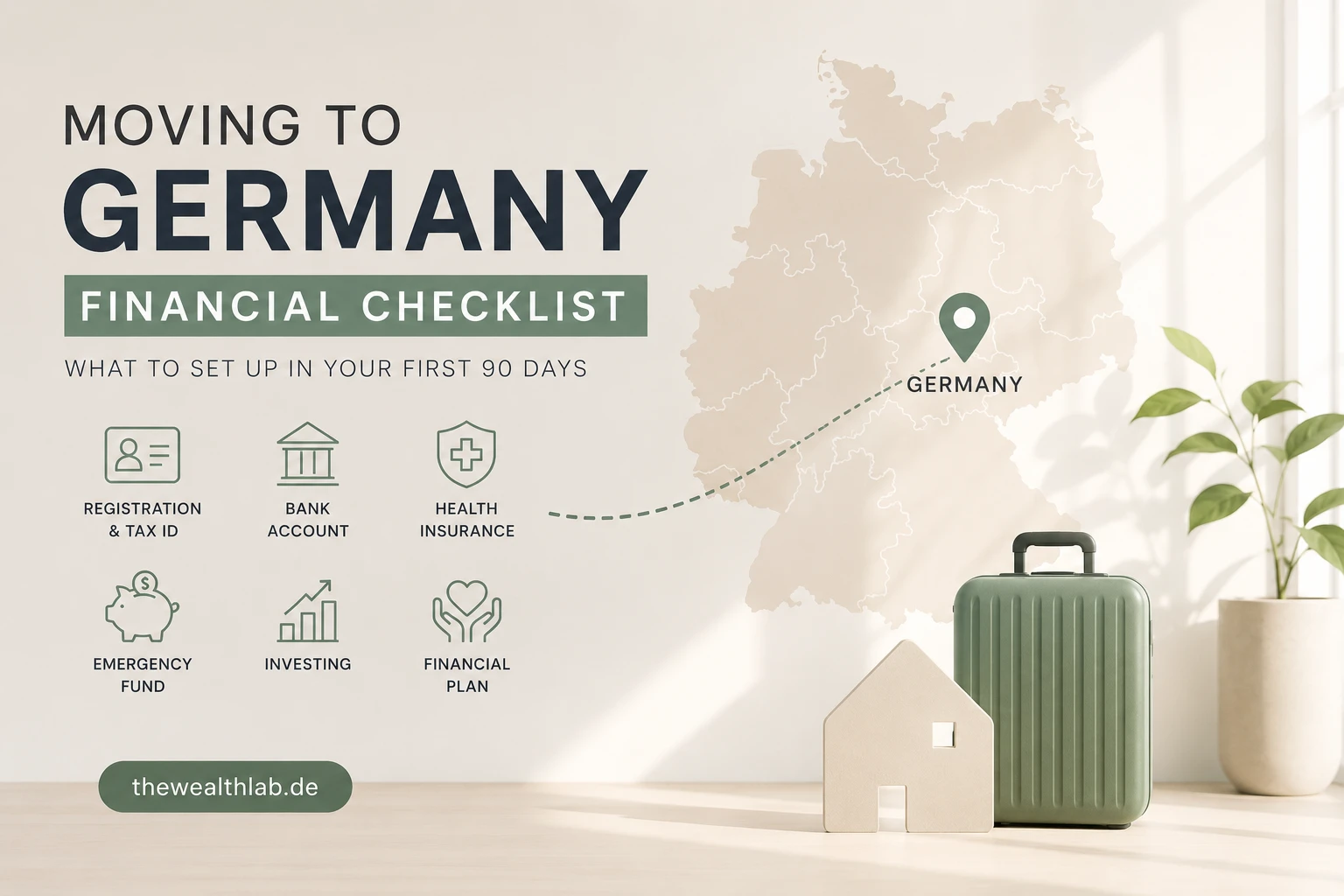
Table of Contents
Moving to Germany is an exciting opportunity, but it also comes with important financial responsibilities. During your first few months, the decisions you make can have a lasting impact on your financial stability, access to services, and long-term wealth-building opportunities.
As a financial consultant working with expats across Germany, I regularly meet newcomers who focus on finding accommodation, starting a new job, or settling into a new city while overlooking critical financial tasks. Many only discover later that a delayed registration, an unsuitable insurance choice, or a lack of financial planning has cost them time, money, and unnecessary stress.
This moving to Germany financial checklist is designed to help you avoid those mistakes.
In this guide, you will learn exactly what to prioritize during your first 90 days, why each step matters, and how to build a strong financial foundation from the very beginning.
Whether you are moving as a professional, entrepreneur, researcher, student, or accompanying family member, this guide will help you navigate Germany’s financial system with confidence.
Your Germany Financial Checklist at a Glance
The first 90 days are all about building the right foundation. The table below gives you a high-level overview of the most important financial priorities.
| Task | Recommended Timeline | Priority |
|---|---|---|
| Complete Anmeldung | Week 1 | 🔴 Critical |
| Receive Tax ID | Week 1–2 | 🔴 Critical |
| Open a German Bank Account | Week 1 | 🔴 Critical |
| Arrange Health Insurance | Week 1 | 🔴 Critical |
| Create a Budget | Days 15–30 | 🟠 High |
| Build an Emergency Fund | Days 15–30 | 🟠 High |
| Check SCHUFA Status | Days 15–30 | 🟠 High |
| Get Liability Insurance | Days 30–60 | 🟠 High |
| Review Income Protection | Days 30–60 | 🟡 Medium |
| Start Long-Term Financial Planning | Days 60–90 | 🟢 Important |
Free Resource for Expats
Download Your 90-Day Financial Checklist
Get a premium PDF roadmap designed to help you set up your financial life in Germany with clarity — including first-week priorities, emergency fund planning, common mistakes, and a personal wealth-building worksheet.
Download Free PDF100% free • Created by The Wealth Lab • For expats building their financial life in Germany
Why Every Expat Needs a Moving to Germany Financial Checklist
Germany offers a high quality of life, strong consumer protections, and one of the most stable economies in Europe. However, the financial system can feel overwhelming when you first arrive.
Many important processes are connected.
For example:
✅ You need an Anmeldung before many official processes can move forward.
✅ Your Tax Identification Number is linked to your employment and tax status.
✅ Health insurance is mandatory for residents.
✅ Your banking setup affects salary payments, rent payments, and everyday financial management.
✅ Financial planning decisions made during your first year can significantly impact your long-term financial future.
Without a structured approach, it is easy to miss important deadlines or make decisions that are difficult and costly to reverse later.
That is exactly why following a moving to Germany financial checklist is so valuable.
The Financial Challenges of Starting Life in Germany
Most expats arrive with little understanding of how the German financial system works.
Some of the most common challenges include:
💶 Understanding taxes and payroll deductions
🏥 Choosing the right health insurance
🏠 Managing high housing costs and deposits
📈 Understanding investment opportunities
🛡️ Protecting income and assets
👴 Planning for retirement in Germany
While information is available online, it is often scattered across government websites, insurance providers, banks, and financial institutions.
A clear roadmap helps you focus on what matters most first.
What Happens If You Delay Important Financial Tasks?
Many newcomers assume they can postpone financial planning until they feel more settled.
Unfortunately, this often creates unnecessary complications.
For example:
❌ Delaying health insurance can create administrative problems and limit your options.
❌ Delaying financial planning may result in missed opportunities to build wealth early.
❌ Failing to establish emergency savings can make unexpected expenses much harder to manage.
❌ Choosing financial products without understanding the long-term implications can become expensive later.
The goal is not to complete everything immediately.
The goal is to complete the right tasks at the right time.
Week 1: Essential Financial Tasks to Complete Immediately
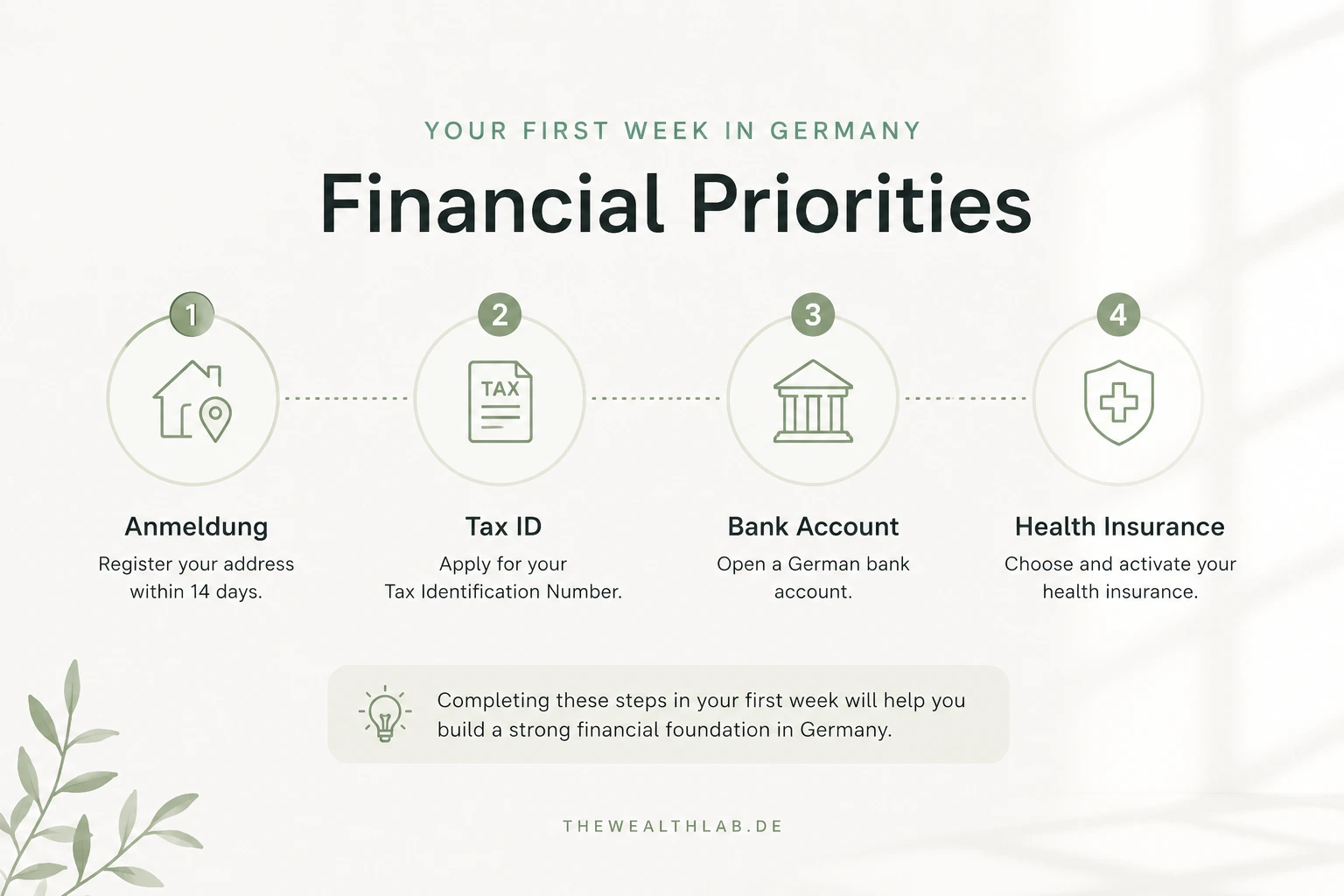
The first week is the most important phase of your moving to Germany financial checklist.
Focus on completing the foundational tasks that unlock everything else.
Complete Your Anmeldung (Address Registration)
The Anmeldung is your official address registration in Germany.
Once you move into accommodation, you typically need to register your address with the local registration office (Bürgeramt).
This process is extremely important because many other administrative and financial processes depend on it.
Why Anmeldung Matters
✅ Required for obtaining your Tax Identification Number
✅ Often needed when opening a bank account
✅ Frequently requested by employers
✅ Important for official correspondence
✅ Required for many future applications
Common Mistake
Many newcomers delay booking their appointment because they underestimate its importance.
In some cities, appointment availability can be limited, so scheduling it early is highly recommended.
Receive Your Tax Identification Number
After your Anmeldung has been processed, you will typically receive your Tax Identification Number (Steueridentifikationsnummer).
This number remains with you permanently and plays an important role in your financial life in Germany.
Why Your Tax ID Matters
📌 Employers use it to calculate taxes correctly.
📌 Financial institutions may request it.
📌 Tax authorities use it to identify you throughout your time in Germany.
Store this number safely because you will use it repeatedly in the future.
Open a German Bank Account
A German bank account should be one of your highest priorities.
Although some employers accept certain European accounts, having a local account often simplifies daily financial life.
Why a German Bank Account Is Important
💳 Salary payments
💳 Rent payments
💳 Insurance contributions
💳 Utility bills
💳 Everyday spending
A reliable banking setup is one of the most important elements of any successful Germany setup checklist.
What to Compare Before Choosing a Bank
- Monthly account fees
- Online banking features
- English-language support
- ATM availability
- International transfer options
- Mobile app quality
Choosing the cheapest option is not always the best decision. Convenience and service quality matter as well.
Arrange Health Insurance Coverage
Health insurance is mandatory in Germany.
Every resident generally needs health insurance coverage.
Depending on your circumstances, you may qualify for:
- Public Health Insurance (GKV)
- Private Health Insurance (PKV)
The right choice depends on several factors, including:
- Employment status
- Income level
- Family situation
- Future plans
- Length of stay in Germany
Why This Decision Is Important
Health insurance is often one of the largest recurring financial expenses for residents in Germany.
Choosing the right solution can affect:
🏥 Access to healthcare
👨👩👧 Family coverage options
💶 Monthly costs
📈 Long-term financial flexibility
This is why health insurance should never be selected based solely on price.
Need Professional Guidance?
📅 If you would like personalized support with health insurance, pension planning, investments, wealth building, or financial protection strategies, explore our services or book a consultation with The Wealth Lab.
Professional guidance can help you avoid costly mistakes and create a financial strategy tailored to your goals in Germany.
Days 15–30: Build Your Financial Foundation
Once the urgent administrative tasks are complete, it is time to focus on financial stability.
This phase is where your financial planning for expats in Germany begins to take shape.
Instead of reacting to financial challenges, you start building a structured plan for your future.
Understand Your German Payslip
One of the first surprises for many newcomers is the difference between gross salary and net salary.
German payslips contain several mandatory deductions.
Common deductions include:
- Income Tax
- Pension Insurance
- Health Insurance
- Long-Term Care Insurance
- Unemployment Insurance
Understanding these deductions helps you make informed financial decisions and avoid unrealistic budgeting expectations.
Why This Matters
A strong understanding of your payslip is one of the foundations of effective money management in Germany.
When you know where your money goes, you can make better decisions about saving, investing, and spending.
Create Your First German Budget
Building a realistic budget should be one of your first financial priorities.
Germany can be expensive, especially during the initial months when you may face:
🏠 Security deposits
🛋️ Furniture purchases
🚆 Transportation costs
📱 Mobile contracts
⚡ Utility setup costs
A simple budget helps you maintain control over your finances while reducing stress.
Include These Categories
- Housing
- Utilities
- Transportation
- Food
- Insurance
- Savings
- Lifestyle spending
The most successful expats do not simply earn more money.
They manage their money intentionally.
That is the foundation of long-term financial success in Germany.
Start Building an Emergency Fund
Once you have created your budget, your next priority should be building an emergency fund.
Many expats focus on investing too early and underestimate the importance of having cash reserves. While investing is important, financial stability always comes first.
An emergency fund is money set aside specifically for unexpected expenses.
Examples include:
🚑 Medical expenses not covered by insurance
🏠 Emergency housing costs
🔧 Car or household repairs
💼 Job loss or periods of unemployment
✈️ Unexpected travel expenses
📦 Relocation costs
Without emergency savings, even a small financial setback can force you to rely on credit, loans, or expensive financing options.
How Much Emergency Fund Do You Need in Germany?
There is no universal number that works for everyone.
However, many financial professionals recommend keeping between three and six months of essential living expenses available in cash or highly accessible savings.
For example:
| Monthly Essential Expenses | Suggested Emergency Fund |
|---|---|
| €1,500 | €4,500 – €9,000 |
| €2,000 | €6,000 – €12,000 |
| €2,500 | €7,500 – €15,000 |
| €3,000 | €9,000 – €18,000 |
If you are self-employed, a freelancer, or working in a highly competitive industry, maintaining a larger emergency fund may be appropriate.
Where Should You Keep Your Emergency Savings?
Your emergency fund should be:
✅ Safe
✅ Easily accessible
✅ Separate from your everyday spending account
It should not be invested in volatile assets such as stocks or cryptocurrencies.
The primary purpose of an emergency fund is protection, not growth.
This step is one of the most important elements of successful financial planning for expats in Germany.
Common Emergency Fund Mistakes
❌ Investing emergency savings in high-risk assets
❌ Keeping emergency funds in a spending account
❌ Waiting until “later” to start saving
❌ Building investments before establishing financial security
The goal is progress, not perfection. Even small monthly contributions can build meaningful protection over time.
Check Your SCHUFA Credit Profile
One of the most misunderstood parts of German finance is SCHUFA.
SCHUFA is Germany’s largest private credit reporting agency.
Many newcomers only learn about SCHUFA when applying for:
🏠 Apartments
📱 Mobile phone contracts
💳 Credit cards
🚗 Financing agreements
🏦 Loans
A strong SCHUFA profile can make many aspects of life easier.
Why SCHUFA Matters
German lenders and service providers often use SCHUFA information to evaluate financial reliability.
A positive credit history may improve access to:
✅ Better financing conditions
✅ Faster apartment approvals
✅ Certain contracts and services
Building a positive credit profile starts with responsible financial behavior from day one.
How to Build a Healthy SCHUFA Profile
You do not need complicated strategies.
In most cases, the following habits are enough:
✔️ Pay bills on time
✔️ Maintain stable banking relationships
✔️ Avoid missed payments
✔️ Use financial products responsibly
✔️ Keep personal information up to date
For most newcomers, consistency matters far more than complexity.
Days 30–60: Protect Yourself Financially
Once your financial foundation is in place, the next step is protecting yourself against risks that could threaten your income, assets, and future plans.
Many expats spend months researching investments while completely ignoring risk management.
In reality, protecting what you have is often just as important as growing it.
Get Personal Liability Insurance (Haftpflichtversicherung)
If there is one insurance policy that many financial professionals consider essential in Germany, it is personal liability insurance.
Personal liability insurance protects you if you accidentally cause damage to another person or their property.
Depending on the situation, claims can become extremely expensive.
Why Liability Insurance Is So Important
Examples may include:
🚲 Causing an accident while cycling
💻 Accidentally damaging someone else’s property
🏠 Causing damage in a rented apartment
👤 Accidentally injuring another person
Without insurance, you may be personally responsible for covering the costs.
This is why liability insurance is often considered one of the most important forms of financial protection in Germany.
What Makes Liability Insurance Valuable?
Compared with many other insurance products, liability insurance often provides:
✅ Broad protection
✅ High coverage limits
✅ Affordable premiums
✅ Significant financial security
For many residents, it is one of the best value-for-money financial products available.
Common Mistakes When Choosing Liability Insurance
❌ Choosing based solely on price
❌ Ignoring coverage exclusions
❌ Failing to review contract details
❌ Assuming protection from another country automatically applies in Germany
Always review policy terms carefully before making a decision.
Review Your Income Protection Strategy
Your ability to earn an income is often your most valuable financial asset.
Most people spend years building their careers, yet very few consider what would happen if they became unable to work.
This is where income protection becomes important.
Why Income Protection Matters
Imagine losing your ability to work for an extended period because of illness or injury.
Questions worth considering include:
🤔 How would you pay your rent?
🤔 How would you cover daily expenses?
🤔 Could you maintain your current lifestyle?
🤔 Would your financial goals remain achievable?
These are uncomfortable questions, but they are essential parts of responsible financial planning.
Who Should Review Income Protection?
Income protection is particularly relevant for:
- Young professionals
- High-income earners
- Self-employed individuals
- Families with financial dependents
- Expats building a long-term future in Germany
The earlier you evaluate your options, the greater your flexibility is likely to be.
Estimated Monthly Costs for New Expats in Germany
Although expenses vary significantly depending on location and lifestyle, the table below provides a rough illustration of common monthly costs.
| Expense Category | Typical Monthly Range |
|---|---|
| Rent | €700 – €1,800+ |
| Utilities | €100 – €300 |
| Health Insurance | Varies by status and income |
| Transportation | €49 – €150 |
| Food | €250 – €600 |
| Mobile & Internet | €20 – €80 |
| Savings & Investments | Individual |
These figures should only be used as general reference points.
Your personal situation may differ significantly depending on your city, family size, housing situation, and career stage.
Ready to Take Control of Your Finances in Germany?
📅 Whether you need support with health insurance, pension planning, investment strategies, financial protection, or long-term wealth building, professional guidance can help you make informed decisions with confidence.
Explore our services or schedule a personalized consultation to build a financial plan tailored to your goals in Germany.
Why Financial Protection Comes Before Investing
One of the biggest mistakes I see among newcomers is rushing into investments before building a solid foundation.
Successful wealth building usually follows this sequence:
1️⃣ Stable income
2️⃣ Budget and cash flow management
3️⃣ Emergency fund
4️⃣ Financial protection
5️⃣ Long-term investing
6️⃣ Wealth accumulation
Following this order helps reduce financial stress and creates a stronger platform for future growth.
Before focusing on investment returns, make sure your foundation is secure.
That foundation will support every financial goal you pursue in Germany moving forward.
Days 60–90: Start Building Long-Term Wealth
By the time you reach days 60 to 90, your financial foundation should be more stable.
You may already have:
✅ Registered your address
✅ Received your Tax ID
✅ Opened a bank account
✅ Set up health insurance
✅ Created a budget
✅ Started building an emergency fund
✅ Reviewed basic financial protection
Now it is time to think beyond survival and start building long-term financial security.
This part of your moving to Germany financial checklist is not about rushing into random investments. It is about creating a strategy that fits your life in Germany, your career plans, your family situation, and your future goals.
For many expats, this is where real financial planning begins.

Learn the Basics of Investing in Germany
Investing can be one of the most powerful tools for long-term wealth building, but it should come after your basic financial foundation is in place.
Before investing, ask yourself:
💰 Do I have a stable income?
💰 Do I understand my monthly cash flow?
💰 Do I have an emergency fund?
💰 Do I have basic financial protection?
💰 Do I understand the risks of the investment?
If the answer is yes, you can start learning how investing works in Germany.
Why Investing Matters for Expats
Keeping all your money in a normal bank account may feel safe, but over time, inflation can reduce your purchasing power.
Investing gives your money the potential to grow over the long term.
For expats in Germany, investing may support goals such as:
📈 Building wealth
🏠 Buying property
👶 Planning for children
🌍 Preparing for future relocation
👴 Creating additional retirement income
💼 Becoming financially independent
However, investing should always match your personal risk tolerance, time horizon, tax situation, and long-term plans.
What New Expats Should Understand Before Investing
Before choosing any investment product, you should understand the basics:
- What you are investing in
- How much risk you are taking
- How long you plan to invest
- What fees apply
- How taxes may affect returns
- Whether the investment fits your goals
A good investment strategy should be clear, diversified, and aligned with your personal situation.
For most people, investing is not about finding the “perfect product.”
It is about building a sustainable system and staying consistent over time.
Common Investing Mistakes New Expats Make
Many newcomers make similar mistakes when they start investing in Germany.
These include:
❌ Investing without an emergency fund
❌ Taking advice from social media without understanding the risks
❌ Choosing products based only on past performance
❌ Ignoring fees
❌ Investing money they may need soon
❌ Not considering their future plans outside Germany
The best investment strategy is not the one that looks exciting today.
It is the one you can realistically maintain for years.
Understand Germany’s Pension System
Retirement planning is one of the most important parts of financial planning for expats in Germany.
Germany has a statutory pension system, but many people misunderstand what it can and cannot provide.
If you are employed in Germany, you usually contribute to the statutory pension insurance system through your salary. Your employer also contributes. The exact contribution rate can change over time and is set by law.
This system creates an important foundation, but for many people, the statutory pension alone may not be enough to maintain their desired lifestyle in retirement.
That is why private pension planning and long-term investing become important topics for many expats.
Why Expats Often Start Pension Planning Too Late
As a financial consultant, one of the most common patterns I see is that expats postpone pension planning because retirement feels far away.
This is understandable.
When you are new in Germany, you may be more focused on:
🏠 Finding an apartment
💼 Starting a job
📄 Handling paperwork
💸 Managing relocation costs
🌍 Building a new life
But waiting too long can reduce your flexibility.
The earlier you start planning, the more time you usually have to build capital, adjust your strategy, and benefit from long-term growth.
What Expats Should Ask About Retirement Planning
Before choosing any pension or investment solution, ask yourself:
- How long do I plan to stay in Germany?
- Do I want to retire in Germany or somewhere else?
- What retirement lifestyle do I want?
- How much income will I need later?
- What pension rights am I already building?
- Do I need private pension planning?
- How flexible does my plan need to be?
These questions are important because expats often have more complex lives than local residents.
You may move countries again.
You may have pension rights in more than one country.
You may have family responsibilities abroad.
You may earn in Germany but plan to retire elsewhere.
A future-proof financial plan should take these possibilities into account.
The Three Layers of Retirement Planning
A strong retirement strategy usually includes more than one source of income.
For many people, retirement planning can include:
| Layer | Purpose |
|---|---|
| Statutory Pension | Basic retirement foundation |
| Private Pension Planning | Additional long-term retirement income |
| Investments | Flexible wealth building and future options |
This structure gives you more flexibility than relying on only one source.
The goal is not just to retire.
The goal is to retire with choices.
Set Your First Long-Term Financial Goals
Once you understand the basics of investing and pension planning, the next step is setting clear financial goals.
Without goals, financial decisions become random.
With goals, every decision has a purpose.
Your goals may include:
🏠 Buying a home in Germany
💼 Becoming self-employed
👶 Building wealth for your children
📈 Investing monthly
👴 Creating retirement income
🌍 Moving to another country later
💰 Reaching financial independence
Each goal requires a different strategy, timeline, and risk level.
Short-Term, Mid-Term, and Long-Term Goals
A strong financial plan separates goals by timeline.
| Goal Type | Time Horizon | Example |
|---|---|---|
| Short-Term | 0–2 years | Emergency fund, relocation costs |
| Mid-Term | 3–7 years | Property deposit, career change |
| Long-Term | 8+ years | Retirement, wealth building |
This matters because money needed in the short term should usually be managed more conservatively.
Money intended for long-term goals may have more room for investment risk, depending on your personal situation.
Why Goal-Based Planning Works Better
Goal-based planning helps you answer important questions:
✅ How much should I save monthly?
✅ How much risk can I take?
✅ Which financial products fit my situation?
✅ What should I prioritize first?
✅ How can I balance today’s lifestyle with tomorrow’s security?
This is where money management in Germany becomes more strategic.
You are no longer just tracking expenses.
You are building a financial system around your life goals.
Create Your Personal Financial Roadmap
The final step in this phase is creating a personal roadmap.
A roadmap connects all parts of your financial life into one clear strategy.
It should include:
- Income
- Expenses
- Emergency fund
- Insurance protection
- Investments
- Pension planning
- Tax considerations
- Property goals
- Family goals
- Future relocation plans
This is especially important for expats because your financial life may involve more than one country.
What a Strong Financial Roadmap Should Include
A good financial roadmap should answer these questions:
📌 Where am I financially today?
📌 What risks do I need to protect against?
📌 What are my short-term goals?
📌 What are my long-term goals?
📌 How much should I save and invest monthly?
📌 Which financial decisions should I prioritize first?
📌 How flexible does my plan need to be?
The best financial plans are not rigid.
They are structured, flexible, and designed to adapt as your life changes.
Why This Matters for Your Future in Germany
Your first 90 days in Germany are not only about paperwork.
They are about setting the direction for your financial future.
A clear plan can help you:
✅ Avoid costly mistakes
✅ Build confidence
✅ Protect your income
✅ Start investing with purpose
✅ Prepare for retirement
✅ Make better long-term decisions
This is why the final phase of your moving to Germany financial checklist should focus on strategy, not just administration.
At this stage, you move from “getting settled” to “building wealth.”
That mindset shift can make a major difference in your financial future.
7 Financial Mistakes New Expats Make in Germany
Moving to a new country comes with a steep learning curve.
While every expat’s journey is different, I have noticed the same financial mistakes appearing again and again among newcomers in Germany.
The good news is that most of these mistakes are completely avoidable.
Understanding them early can save you significant time, money, and stress.
1. Delaying Health Insurance Decisions
One of the most common mistakes new expats make is postponing their health insurance decision.
Many assume they can simply deal with it later once they feel more settled.
Unfortunately, health insurance is one of the most important financial decisions you make in Germany.
The choice you make can affect:
🏥 Healthcare access
💶 Monthly costs
👨👩👧 Family coverage options
📈 Long-term financial flexibility
🔄 Future insurance options
Because of its long-term impact, health insurance should never be selected purely based on monthly cost.
A decision that seems cheaper today may not necessarily be the best option for your future plans.
What Successful Expats Do Instead
✅ Understand both public and private options
✅ Consider long-term goals
✅ Review family circumstances
✅ Seek professional guidance when necessary
2. Living Without an Emergency Fund
Many newcomers spend their first months focusing entirely on relocation expenses, furniture, deposits, and daily costs.
While these expenses are understandable, failing to build emergency savings can create unnecessary financial vulnerability.
Life rarely goes exactly according to plan.
Unexpected events happen.
Examples include:
🚑 Medical expenses
🔧 Emergency repairs
💼 Employment interruptions
🏠 Housing-related costs
✈️ Urgent travel expenses
Without emergency savings, even minor setbacks can become major financial challenges.
What Successful Expats Do Instead
✅ Build emergency savings early
✅ Save consistently every month
✅ Keep emergency funds accessible
✅ Separate emergency savings from spending money
This is one of the most important principles of money management in Germany.
3. Focusing on Investing Before Building a Financial Foundation
Investing has become increasingly popular, especially through social media.
Unfortunately, many newcomers believe investing should be their first financial priority.
In reality, investing should come after:
1️⃣ Stable income
2️⃣ Budgeting
3️⃣ Emergency savings
4️⃣ Financial protection
5️⃣ Clear financial goals
Skipping these steps often leads to poor financial decisions.
Investing is important.
Investing before building a foundation is risky.
What Successful Expats Do Instead
✅ Build a financial foundation first
✅ Understand investment risks
✅ Invest for long-term goals
✅ Follow a structured strategy
The goal is not to invest as quickly as possible.
The goal is to invest intelligently.
4. Ignoring Pension Planning
Many expats postpone retirement planning because it feels too far away.
This is completely understandable.
When you are adapting to a new country, retirement is rarely your first concern.
However, pension planning becomes more powerful when started early.
Time is one of the most valuable resources in long-term financial planning.
Every year of delay reduces flexibility.
This is one reason why financial planning for expats in Germany should begin much earlier than most people expect.
What Successful Expats Do Instead
✅ Understand their pension situation
✅ Review long-term retirement goals
✅ Consider multiple retirement income sources
✅ Build a strategy that supports future mobility
Remember that many expats may retire in a different country than the one where they currently live.
Future flexibility matters.
5. Choosing Financial Products Based Only on Price
Price matters.
But choosing purely based on price often creates problems later.
This applies to:
- Insurance
- Banking
- Investments
- Pension solutions
- Financial protection products
The cheapest solution is not always the most suitable solution.
Many people focus on what something costs while ignoring what it actually provides.
What Successful Expats Do Instead
They ask better questions:
✔️ What protection does this provide?
✔️ What are the limitations?
✔️ How flexible is it?
✔️ Does it support my long-term goals?
✔️ What happens if my circumstances change?
These questions often matter more than a small difference in monthly cost.
6. Not Understanding Their Payslip
Many professionals moving to Germany focus only on their gross salary.
What truly matters, however, is understanding your net income and how deductions affect your financial life.
German payroll deductions can initially feel complex.
Without understanding them, budgeting becomes much harder.
Many people overestimate how much disposable income they will actually have.
What Successful Expats Do Instead
✅ Review their payslip carefully
✅ Understand major deductions
✅ Build budgets using net income
✅ Adjust financial goals accordingly
This simple habit creates better financial decisions across every area of life.
7. Trying to Manage Everything Alone
The final mistake is one I see surprisingly often.
Many expats try to figure everything out themselves.
While independent research is valuable, Germany’s financial system can be complex.
Health insurance, taxes, pension planning, investments, and financial protection often interact with one another.
A decision in one area may affect another area.
Trying to optimize everything without guidance can become overwhelming.
What Successful Expats Do Instead
Successful expats understand that professional advice can help them:
📌 Avoid costly mistakes
📌 Save time
📌 Build confidence
📌 Create a clear financial strategy
📌 Align financial decisions with personal goals
The objective is not simply to buy financial products.
The objective is to make informed decisions that support your life in Germany.
The Biggest Lesson for New Expats
If there is one lesson that stands out after working with expats from many different backgrounds, it is this:
Financial success in Germany rarely comes from making one perfect decision.
It usually comes from consistently making good decisions over time.
The people who build strong financial foundations are not necessarily the highest earners.
They are the people who:
✅ Plan ahead
✅ Understand risks
✅ Protect themselves financially
✅ Save consistently
✅ Invest with purpose
✅ Review their goals regularly
Following a structured moving to Germany financial checklist can help you avoid these common mistakes and create a much smoother financial journey during your first years in Germany.
FAQ: Frequently Asked Questions About Moving to Germany Finances
What is the first financial thing I should do after moving to Germany?
The first financial priority after moving to Germany is completing your Anmeldung (address registration). Many other important processes, including receiving your Tax Identification Number and setting up certain financial services, depend on it. Once your registration is complete, you should focus on opening a bank account and arranging health insurance coverage.
Is health insurance mandatory in Germany?
Yes. Health insurance is generally mandatory for people living in Germany. Depending on your circumstances, you may qualify for either public health insurance (GKV) or private health insurance (PKV). The most suitable option depends on factors such as income, employment status, family situation, and long-term plans.
How much emergency fund should I have in Germany?
Many financial professionals recommend keeping between three and six months of essential living expenses in an emergency fund. The exact amount depends on your lifestyle, income stability, and personal circumstances. Self-employed individuals and freelancers often benefit from larger emergency reserves.
Do I need a German bank account?
While some employers may accept certain European bank accounts, having a German bank account often makes daily financial management easier. It simplifies salary payments, rent payments, insurance contributions, and other recurring expenses.
When should I start investing after moving to Germany?
Investing should generally come after establishing a financial foundation. Before investing, focus on building an emergency fund, understanding your cash flow, and securing appropriate financial protection. Once these elements are in place, you can begin developing a long-term investment strategy.
How does the German pension system work for expats?
Many employees in Germany contribute to the statutory pension system through payroll deductions. These contributions may help build future pension entitlements. Depending on your goals and expected retirement lifestyle, additional private pension planning or investing may also be worth considering.
What are the biggest financial mistakes expats make in Germany?
Common mistakes include delaying health insurance decisions, neglecting emergency savings, postponing pension planning, investing too early without a financial foundation, and choosing financial products based only on price rather than suitability.
Should I get professional financial advice after moving to Germany?
Professional financial advice can help you understand complex topics such as health insurance, pension planning, investing, financial protection, and long-term wealth building. For many expats, personalized guidance helps avoid costly mistakes and creates a clearer path toward achieving financial goals in Germany.
Ready to Build Your Financial Future in Germany?
Moving to Germany is more than an administrative transition—it’s a financial journey.
The decisions you make during your first 90 days can influence your financial security, investment opportunities, retirement planning, and overall quality of life for years to come.
Whether you need guidance on health insurance, pension planning, investing, financial protection, or building a long-term wealth strategy, having a clear roadmap can help you make more confident decisions.
At The Wealth Lab, we help expats across Germany navigate complex financial topics and create personalized strategies aligned with their goals, lifestyle, and future plans.
Next Step
Ready to Build Your Financial Life in Germany?
Download the complete checklist and book a free consultation to create a personalized financial roadmap based on your situation, goals, and long-term plans in Germany.
Free PDF • Free consultation • Designed for expats in Germany
About the Author
Sarah Rahimi is a Financial Consultant specializing in financial planning for expats living in Germany.
She works with international professionals, entrepreneurs, students, and families to help them understand the German financial system and make informed decisions about health insurance, pension planning, wealth building, investments, and financial protection.
Having experienced the challenges of building a life in Germany herself, Sarah combines professional expertise with practical insights to help expats create financial strategies that support both their current needs and long-term goals.
Through The Wealth Lab, she shares educational content designed to make financial planning more accessible, transparent, and actionable for people navigating life in Germany.
Disclaimer
The information provided in this article is intended for general educational purposes only and does not constitute financial, tax, legal, or investment advice. While every effort has been made to ensure the accuracy of the information at the time of publication, regulations, financial products, and personal circumstances may change over time.
Financial decisions should always be based on your individual situation, objectives, risk tolerance, and needs. Before making financial, tax, insurance, pension, or investment decisions, consider seeking personalized professional advice.
The Wealth Lab and the author assume no liability for actions taken based on the information contained in this article.
Leave a Comment
Have a question or experience to share? Drop a comment below.
Leave a Comment