
Financial Advisor for Expats in Germany: Should You Invest on Your Own?

Table of Contents
Moving to Germany changes more than your address. It also changes the way you should think about money, taxes, insurance, retirement, investing, and long-term financial security.
Many expats arrive in Germany with one big question:
Do I really need a financial advisor for expats in Germany, or can I simply invest on my own?
The honest answer is: it depends on your situation.
If your financial life is simple, you understand investing, and you are comfortable making long-term decisions alone, DIY investing in Germany may be enough. But if you are dealing with pension planning, private retirement products, German tax rules, insurance decisions, cross-border assets, family planning, or uncertainty about how long you will stay in Germany, professional advice can be valuable.
As a financial advisor, I often see that the problem is not that expats do not care about money. The problem is that the German financial system can feel fragmented. You may hear about ETFs from one source, private pension from another, health insurance from another, and tax optimization from someone else. But without a clear strategy, these pieces do not automatically create a strong financial plan.
That is where the difference between investing and financial planning becomes important.
Investing is only one part of your financial life. Financial planning for expats in Germany looks at the bigger picture: your income, tax situation, pension gap, insurance protection, investment strategy, family plans, career goals, and retirement timeline.
This article will help you understand when working with a financial advisor makes sense, when DIY investing can work well, and how to decide which path is better for your situation in Germany.
What Does a Financial Advisor for Expats in Germany Actually Do?
A financial advisor for expats in Germany helps you connect different parts of your financial life into one clear strategy.
This is important because most financial decisions in Germany are connected. Your health insurance can affect your monthly budget. Your pension strategy can affect your tax planning. Your investment choices can affect your long-term retirement income. Your career status, family situation, and residence plans can all change what makes sense for you.
A good advisor should not simply sell you a product. The role should be to help you understand your options, compare risks and benefits, and make decisions that fit your personal situation.
In Germany, financial advice can involve different areas, including:
- Investment planning
- Retirement planning
- Private pension options
- Insurance planning
- Tax-efficient financial decisions
- Pension gap analysis
- Long-term wealth building
- Financial planning for families
- Planning for expats who may leave Germany later
For expats, this advice becomes even more specific because your situation is often different from someone who was born and raised in Germany.
You may have questions like:
- Should I invest in Germany if I may move to another country later?
- What happens to my pension if I leave Germany?
- Is ETF investing enough for retirement?
- Do I need private pension planning in addition to public pension?
- Which insurance is really necessary in Germany?
- How do taxes affect my investment strategy?
- Should I prioritize flexibility or tax benefits?
- How do I avoid signing contracts I do not fully understand?
These are exactly the kinds of questions that make financial planning for expats in Germany more complex than simply opening a brokerage account.
BaFin, Germany’s financial supervisory authority, also emphasizes that consumers should understand financial products, risks, and the nature of investment advice before making decisions. :contentReference[oaicite:0]{index=0}
A Financial Advisor Should Look at the Full Picture
One of the biggest mistakes expats make is looking at financial products separately.
For example, you may think:
“I just need an ETF savings plan.”
That may be true. But before deciding that, you should also ask:
- Do I already have an emergency fund?
- Do I understand my German tax situation?
- Am I protected if I cannot work?
- Am I building enough for retirement?
- Do I know my pension gap?
- Do I need flexibility because I may leave Germany?
- Am I investing in a way that matches my risk tolerance?
A financial advisor for expats in Germany should help you answer these questions before recommending any solution.
This is also where professional advice can be different from general financial content online. A YouTube video, blog article, or social media post can explain general concepts. But it cannot fully understand your income, family situation, visa status, tax position, retirement goals, or personal risk level.
Financial Advisor vs Financial Influencer
This difference matters.
A financial influencer may give general information. A financial advisor should help you make decisions based on your personal situation.
General information can be helpful, but it is not the same as individual financial advice. This is especially important in Germany because financial products, insurance contracts, pension solutions, and investment structures can have long-term consequences.
For example, a general post may say:
“Invest in ETFs and you are fine.”
But for an expat in Germany, the real answer may depend on:
- Your time horizon
- Your tax residency
- Your retirement country
- Your income level
- Your family situation
- Your need for flexibility
- Your existing pension rights
- Your insurance protection
- Your ability to handle market volatility
That is why the question is not only whether DIY investing in Germany is possible. Of course it is possible. The better question is:
Can you build and maintain a complete financial strategy on your own?
For some expats, yes. For others, professional help can prevent expensive mistakes.
What a Good Financial Advisor Should Help You Clarify
A good financial advisor should help you get clarity in at least five areas:
| Area | Why It Matters for Expats in Germany |
|---|---|
| Retirement planning | You need to understand how much income you may need later and whether your current savings are enough. |
| Investment strategy | Your portfolio should match your goals, time horizon, risk tolerance, and flexibility needs. |
| Insurance protection | Germany has important insurance options, but not every product is necessary for every person. |
| Tax awareness | Some financial decisions can have tax implications, especially for higher-income expats. |
| Exit flexibility | If you may leave Germany, your plan should not trap you in unsuitable long-term structures. |
The best financial plan is not always the most complicated one. In many cases, the right plan is the one you understand, can maintain, and can adapt as your life changes.
For expats in Germany, this is especially important because your financial life may change quickly. You may change jobs, move cities, get married, have children, buy property, become self-employed, or decide to stay in Germany permanently.
A strong financial plan should be flexible enough to grow with you.
DIY Investing in Germany: When It Can Work Well
The rise of low-cost brokers, ETF investing, and financial education has made DIY investing more accessible than ever before. Today, opening an investment account in Germany takes only a few minutes, and thousands of articles, videos, and online communities explain how to build a portfolio.
Because of this, many expats wonder whether they really need professional advice at all.
The truth is that DIY investing is not inherently good or bad—it depends on whether it matches your financial situation.
For some people, managing investments independently is a sensible decision. For others, it can create unnecessary risks that only become visible years later.
When DIY Investing May Be the Right Choice
Managing your own investments can be a reasonable approach if most of the following statements describe your situation:
- You already understand the basics of investing.
- You know how different asset classes behave during market volatility.
- You have a long-term investment mindset.
- You are comfortable making financial decisions without emotional reactions.
- Your financial life is relatively straightforward.
- You regularly review your portfolio instead of reacting to daily market news.
- You understand that investing is only one part of financial planning.
Many successful investors follow a simple long-term strategy using globally diversified ETFs. In these situations, keeping costs low and staying disciplined can often be more important than constantly changing investments.
However, investing independently requires much more than choosing a fund.
It also means understanding why you are investing, how much you should invest, and whether your investment strategy supports your long-term financial goals.
DIY Investing Is About Behaviour, Not Just Knowledge
One misconception is that successful investing depends only on choosing the “best” ETF.
In reality, investor behaviour has a much greater impact on long-term results.
For example, imagine two investors with identical portfolios.
The first investor continues investing during market downturns, rebalances periodically, and follows a long-term plan.
The second investor panics after a market correction, sells investments, waits for the “right moment” to return, and repeatedly changes strategy.
Although both started with the same portfolio, their long-term outcomes can be dramatically different.
Discipline usually matters more than finding the perfect investment product.
Investing Alone Does Not Mean Planning Alone
One of the biggest misunderstandings is believing that investing automatically equals financial planning.
It does not.
Consider the following comparison:
| DIY Investing | Comprehensive Financial Planning |
|---|---|
| Focuses on selecting investments | Focuses on your entire financial life |
| Answers: “Where should I invest?” | Answers: “What financial strategy fits my goals?” |
| Mainly concerned with portfolio performance | Includes retirement, taxes, insurance, risk management and wealth planning |
| Often investment-focused | Goal-focused |
This distinction becomes particularly important for expats in Germany.
Many financial decisions are interconnected. Improving one area while ignoring another may reduce the overall effectiveness of your financial strategy.
For example, increasing monthly investments while having insufficient emergency savings may expose you to unnecessary financial stress if your circumstances suddenly change.
Likewise, building a strong investment portfolio while ignoring retirement planning or essential insurance protection may leave important gaps in your financial security.
Common Challenges Expats Face When Investing Independently
Even experienced investors can face additional complexity after moving to Germany.
Some of the most common challenges include:
- Understanding how long they expect to stay in Germany.
- Coordinating investments with future relocation plans.
- Deciding whether flexibility or tax efficiency should be the higher priority.
- Estimating future retirement income from different sources.
- Understanding which financial decisions have long-term contractual consequences.
- Separating useful financial information from online marketing.
These challenges are rarely solved simply by choosing a different ETF.
Instead, they require a broader understanding of personal financial planning.
The Hidden Cost of DIY Investing
Most people assume the biggest risk of investing alone is choosing poor investments.
In reality, that is often not the most expensive mistake.
The hidden cost usually comes from making important financial decisions without considering how they affect other areas of your financial life.
For example, an investor may spend weeks comparing ETFs while never calculating how much retirement income they actually need.
Another person may focus entirely on investment returns while overlooking the financial impact of inadequate protection against unexpected life events.
Sometimes, the most expensive financial mistakes are not caused by poor investments—they are caused by missing the bigger picture.
This does not mean everyone needs a financial advisor.
It simply means that successful investing should always be part of a broader financial strategy rather than an isolated decision.
The key question is therefore not:
“Can I invest on my own?”
The better question is:
“Can I confidently manage every financial decision that supports my long-term goals?”
For some expats, the answer will be yes.
For many others, especially as their financial lives become more complex, having professional guidance can provide greater clarity, reduce costly mistakes, and help ensure that every financial decision works together rather than independently.

Financial Advisor vs DIY Investing: Which Option Is Better for Expats?
There is no universal answer to this question.
The better option depends on your financial knowledge, the complexity of your situation, your long-term goals, and how confident you feel making important financial decisions without professional guidance.
Many people assume they must choose one approach or the other.
In reality, that is rarely the case.
Some expats manage their own investment portfolio while occasionally working with a financial advisor to review their overall financial strategy. Others prefer professional support from the beginning because they value having a structured financial plan and avoiding costly mistakes.
Instead of asking which option is “better,” it is more useful to ask:
Which option is more suitable for my current situation?
A Side-by-Side Comparison
| Financial Advisor | DIY Investing |
|---|---|
| Receives personalised financial guidance | Makes independent financial decisions |
| Helps coordinate retirement, investments, insurance and long-term planning | Primarily focuses on investment decisions |
| Can identify financial blind spots | Requires the investor to identify risks independently |
| Saves time by providing structured recommendations | Requires ongoing personal research and education |
| Useful for complex financial situations | Works well for straightforward financial situations |
| May help improve overall financial organisation | Requires strong discipline and consistency |
Neither column is automatically better.
The right choice depends entirely on the person sitting behind the portfolio.
Ask Yourself These Questions
Before deciding whether you need a financial advisor for expats in Germany, answer the following questions honestly.
- Do I understand how the German financial system works?
- Can I calculate my own retirement needs?
- Do I know whether my current investment strategy matches my financial goals?
- Am I confident making financial decisions during market downturns?
- Do I understand how different financial decisions affect one another?
- If I make a mistake today, will I recognise it before it becomes expensive?
If several of these questions make you hesitate, that does not necessarily mean you need ongoing financial advice.
It simply suggests that obtaining professional guidance before making major financial decisions may be worthwhile.
Complexity Often Matters More Than Income
Many people believe financial advice is only useful for high-income earners.
In practice, complexity is usually a more important factor than income.
For example, a young professional earning a moderate salary but planning to stay in Germany permanently may need advice on retirement planning, long-term investing, insurance protection and future family planning.
On the other hand, someone with a higher income but a very simple financial situation may feel comfortable managing their investments independently.
Income alone does not determine whether professional advice is valuable.
Financial complexity does.
When DIY Investing Is Usually Enough
DIY investing may be a suitable choice if:
- You already have a clear long-term financial plan.
- Your financial goals are straightforward.
- You understand investment risk.
- You regularly review your financial situation.
- You enjoy researching financial topics.
- You are disciplined enough to follow your investment strategy without emotional decisions.
Many experienced investors successfully manage their own portfolios for decades.
However, they typically spend years developing the knowledge and discipline required to do so.
When Professional Advice May Add More Value
Working with a financial advisor may become increasingly valuable if you experience major life changes, including:
- Moving to Germany for the first time.
- Starting a family.
- Buying property.
- Becoming self-employed.
- Receiving a significant salary increase.
- Building long-term retirement wealth.
- Planning to retire in another country.
- Managing assets across multiple countries.
These situations often involve decisions that go far beyond selecting investments.
They require understanding how multiple financial areas interact over many years.
The Real Value of Professional Advice
Many people assume that financial advisors are hired to outperform the market.
That expectation is often unrealistic.
Markets cannot be predicted consistently.
The greater value of professional advice usually comes from helping clients make better financial decisions over time.
This may include:
- Building a realistic financial plan.
- Identifying risks before they become problems.
- Keeping investments aligned with changing life goals.
- Avoiding emotional investment decisions.
- Reviewing financial progress regularly.
- Adjusting strategies when circumstances change.
Good financial advice is rarely about finding the “perfect” investment.
Instead, it is about creating a financial strategy that remains appropriate throughout different stages of your life.
For expats in Germany, that strategy should also remain flexible enough to adapt if your career, family situation or country of residence changes in the future.
Ultimately, whether you choose DIY investing or work with a financial advisor, the goal should be the same:
Building a financial plan that supports your life—not one that becomes another source of uncertainty.
How to Choose the Right Financial Advisor for Expats in Germany
Choosing a financial advisor is an important decision, especially if you are building your life in a new country.
The right financial advisor for expats in Germany should do much more than recommend investment products. They should help you understand your options, explain complex financial topics clearly, and develop a financial strategy that supports your long-term goals.
Not every advisor specialises in working with expats, and not every expat needs the same type of financial advice. Before making a decision, take the time to evaluate whether an advisor is the right fit for your personal situation.
Look for Experience Working with Expats
Expats often face financial questions that differ from those of German nationals.
For example:
- You may not know how long you will stay in Germany.
- You may have assets or investments in another country.
- You may plan to retire outside Germany.
- Your tax residency could change in the future.
- Your financial priorities may be different from someone who plans to live in Germany permanently.
A financial advisor for expats in Germany should understand these challenges and consider them when discussing long-term financial planning.
Ask How the Financial Strategy Is Built
A good financial advisor should begin by understanding your situation before discussing possible solutions.
The first conversation should focus on questions such as:
- What are your financial goals?
- How long do you expect to stay in Germany?
- What does your current financial situation look like?
- What level of investment risk are you comfortable taking?
- What are your retirement objectives?
- Do you have family responsibilities or future plans that should be considered?
Financial planning should always start with understanding the client—not with recommending products.
Understand How the Advisor Is Compensated
It is perfectly reasonable to ask how a financial advisor is paid.
Different advisors work under different compensation models, and understanding this helps you make an informed decision.
Do not hesitate to ask questions such as:
- How are your services compensated?
- Which areas of financial planning do you specialise in?
- What qualifications or licences do you hold?
- How often will my financial plan be reviewed?
A professional advisor should answer these questions openly and transparently.
A Good Financial Advisor Educates, Not Just Recommends
One of the most valuable qualities of a financial advisor is the ability to explain financial decisions in a way you understand.
You should leave every meeting with greater clarity than before.
If an advisor recommends a financial strategy, you should understand:
- why it is being recommended,
- what benefits it offers,
- what risks it involves,
- and how it supports your long-term financial goals.
Good financial planning is based on informed decisions—not confusion.
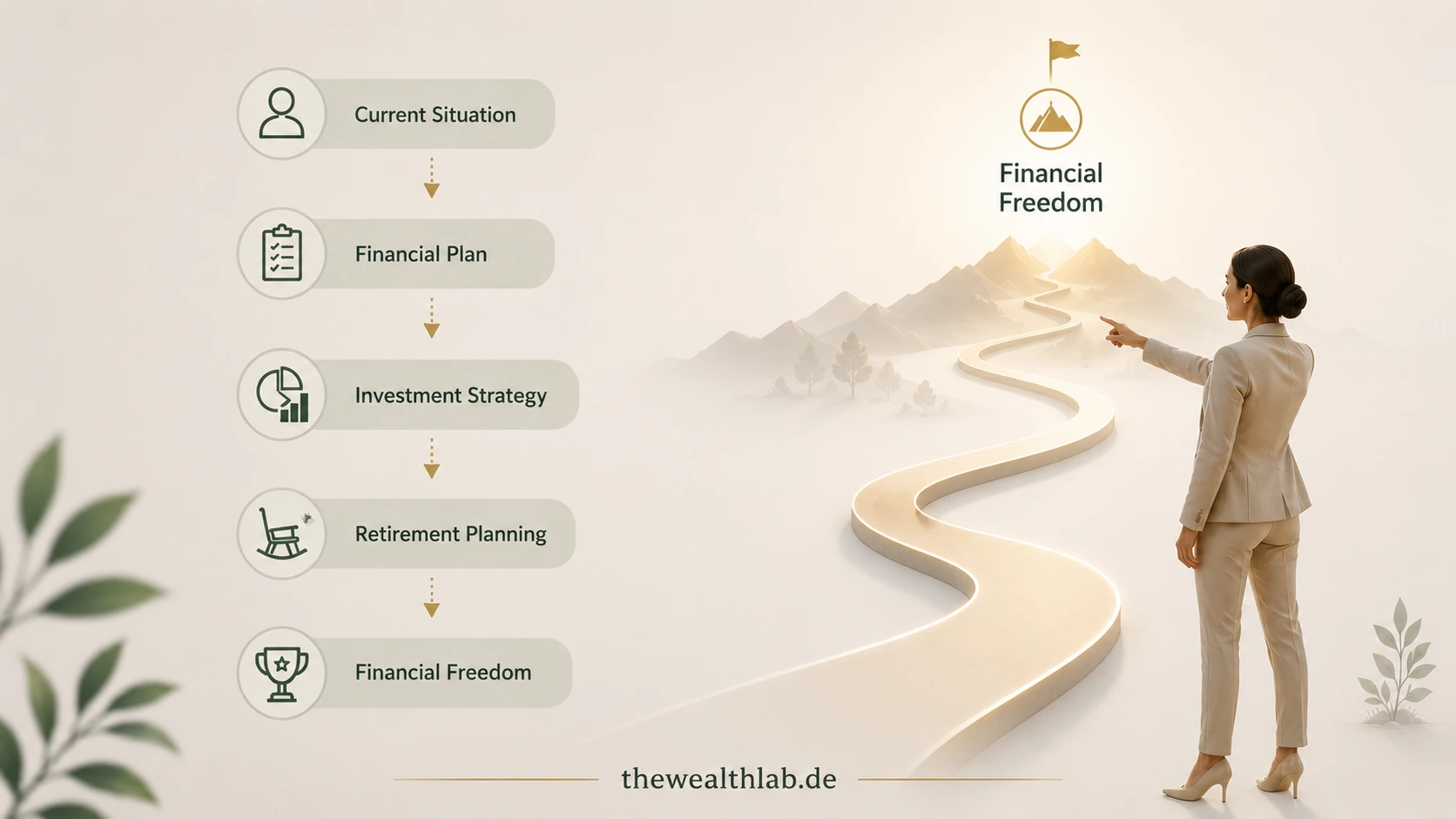
Is a Financial Advisor for Expats in Germany Worth It?
For some people, the answer is yes.
For others, managing their own finances may be the better option.
The value of a financial advisor for expats in Germany is not determined by how much money you earn. It depends on how complex your financial situation has become and how confident you feel making important financial decisions on your own.
If your finances are relatively simple, you enjoy learning about investing, and you already have a structured long-term plan, DIY investing in Germany may be sufficient.
However, if your financial life includes multiple goals, changing circumstances, retirement planning, insurance decisions, tax considerations, or cross-border financial questions, professional guidance may help you build a more coordinated strategy.
The goal is not to convince every expat to work with a financial advisor.
The goal is to make sure your financial decisions are based on knowledge, careful planning, and a clear understanding of your personal situation.
Final Thoughts
There is no single financial strategy that works for every expat living in Germany.
Some people are comfortable managing their own investments and regularly reviewing their financial plan. Others prefer the confidence of working with a financial advisor for expats in Germany to ensure that every financial decision supports their long-term objectives.
Neither approach is inherently better.
The best approach is the one that matches your knowledge, your goals, your level of financial complexity, and the amount of time you are willing to dedicate to managing your finances.
Whether you choose DIY investing in Germany or professional financial advice, remember that successful financial planning is not about chasing the highest returns.
It is about making informed decisions, staying consistent, adapting your strategy as your life changes, and building long-term financial security.
A well-designed financial plan should give you more than the potential to grow your wealth.
It should give you confidence in the financial decisions you make—today and for many years to come.
Financial Advisor for Expats in Germany: A Simple Decision Checklist
After reading this guide, you may still be asking yourself one question:
Should I work with a financial advisor for expats in Germany, or is DIY investing the right choice for me?
The answer depends on your personal circumstances rather than a single rule.
Use the checklist below to evaluate which approach is likely to fit your current financial situation.
| Your Situation | DIY Investing May Be Enough | Working with a Financial Advisor for Expats in Germany May Be More Suitable |
|---|---|---|
| You have recently moved to Germany | ✅ | |
| You have a simple financial situation and understand investing | ✅ | |
| You regularly review your own financial plan | ✅ | |
| You are building long-term retirement wealth | ⚠️ | ✅ |
| You have children or family financial responsibilities | ✅ | |
| You own or plan to buy property | ✅ | |
| You expect your income to increase significantly | ⚠️ | ✅ |
| You have investments or assets in multiple countries | ✅ | |
| You are confident making investment decisions during market volatility | ✅ | |
| You are unsure whether your current strategy will achieve your retirement goals | ✅ |
There is nothing wrong with choosing either column.
Some expats successfully manage their own portfolios for decades, while others prefer professional guidance because they value having an experienced person review their financial strategy.
The important question is not whether you can invest independently.
The better question is whether you are confident making every major financial decision that affects your future.
Remember that DIY investing in Germany focuses primarily on managing investments.
A financial advisor for expats in Germany should help you look beyond investments by considering retirement planning, financial protection, long-term wealth building, changing life circumstances, and how different financial decisions work together.
In many cases, the greatest value of professional financial planning is not selecting better investments.
It is helping you avoid expensive mistakes, identify financial blind spots, and create a strategy that remains suitable as your life changes.
Ultimately, whether you choose DIY investing or professional advice, your financial decisions should always be based on a structured plan—not on assumptions, emotions, or short-term market trends.
FAQ: GKV vs PKV 2026
Do I need a financial advisor for expats in Germany?
Not necessarily. If your financial situation is straightforward and you understand long-term investing, DIY investing may be enough. However, if you need help with retirement planning, insurance, taxes, or building a complete financial strategy, working with a financial advisor for expats in Germany can help you make more informed decisions.
Is DIY investing in Germany a good option for expats?
Yes. DIY investing in Germany can be a good choice if you understand investing, stay disciplined during market fluctuations, and regularly review your financial plan. However, investing is only one part of financial planning, so make sure your investment strategy also supports your retirement and long-term goals.
What does a financial advisor for expats in Germany do?
A financial advisor for expats in Germany helps you build a complete financial strategy. This may include investment planning, retirement planning, insurance, long-term wealth building, and reviewing how different financial decisions work together based on your personal circumstances.
How do I know if I need a financial advisor in Germany?
You may benefit from working with a financial advisor for expats in Germany if you recently moved to Germany, have multiple financial goals, are planning for retirement, have investments in more than one country, or want professional guidance before making important long-term financial decisions.
Is a financial advisor better than DIY investing?
Neither option is automatically better. DIY investing works well for many experienced investors, while others benefit from working with a financial advisor for expats in Germany because of their financial complexity, long-term goals, or changing life circumstances.
Can I invest in Germany without a financial advisor?
Yes. Anyone can invest independently using regulated investment platforms available in Germany. However, investing on your own means taking responsibility for research, portfolio management, risk assessment, and long-term financial planning.
How do I choose the right financial advisor for expats in Germany?
Look for a financial advisor for expats in Germany who understands the financial challenges expats face, explains financial concepts clearly, develops personalised financial strategies, and is transparent about their services and compensation.
Is financial planning different from investing?
Yes. Investing focuses on growing your money, while financial planning for expats in Germany includes retirement planning, insurance, emergency savings, tax awareness, and long-term financial goals. Investing is only one part of a comprehensive financial plan.
When should expats start financial planning in Germany?
The earlier, the better. Starting financial planning for expats in Germany early gives you more time to build wealth, prepare for retirement, and adjust your strategy as your career, family, and financial goals evolve.
Is ETF investing enough for retirement?
For some people, ETFs may play an important role in retirement planning. However, before relying only on ETFs, you should evaluate your retirement income needs, investment timeline, risk tolerance, and overall financial strategy.
Can a financial advisor help with more than investing?
Absolutely. A financial advisor for expats in Germany can also help with retirement planning, insurance, financial protection, long-term wealth building, and reviewing how different financial decisions support your overall financial goals.
What is the biggest financial mistake expats make in Germany?
One of the most common mistakes is focusing only on investments while ignoring the bigger picture. Successful financial planning for expats in Germany combines investing, retirement planning, financial protection, emergency savings, and long-term goal setting into one coordinated strategy.
About the Author
This article was written by a financial advisor who works with expats in Germany, helping individuals and families make informed financial decisions with confidence.
The goal is to provide practical, easy-to-understand financial education tailored to the unique challenges of living in Germany. Every article published on The Wealth Lab is designed to simplify complex financial topics and support expats in building long-term financial security through informed decision-making.
Disclaimer
The information provided in this article is for educational and informational purposes only and should not be considered individual financial, legal, or tax advice.
Every person’s financial situation is different. Financial decisions should always be based on your personal circumstances, objectives, and risk tolerance. If you are considering making significant financial decisions, you should seek personalised advice from a qualified professional before taking action.
Ready to Build Your Financial Strategy?
Whether you decide to manage your own investments or work with a financial advisor for expats in Germany, the most important step is having a clear financial plan.
If you’re unsure whether your current strategy supports your long-term goals, retirement planning, or overall financial future in Germany, professional guidance can help you evaluate your options and make informed decisions with confidence.
Book your free initial consultation today and start building a financial strategy designed around your goals, not someone else’s.
Leave a Comment
Have a question or experience to share? Drop a comment below.
Leave a Comment